Abstract
Coal particles with a high water content tend to coalesce and grow into quasi-particles. As a result, the strength of the coke produced by carbonizing the coal is weak, which causes a problem in the operation of the blast furnace as the following process. It has been reported that mixing of blended coal is effective to disintegrate quasi-particles and produce high strength coke. In this paper, the suitable operating conditions of an actual-scale mixer are investigated by applying the discrete element method (DEM).
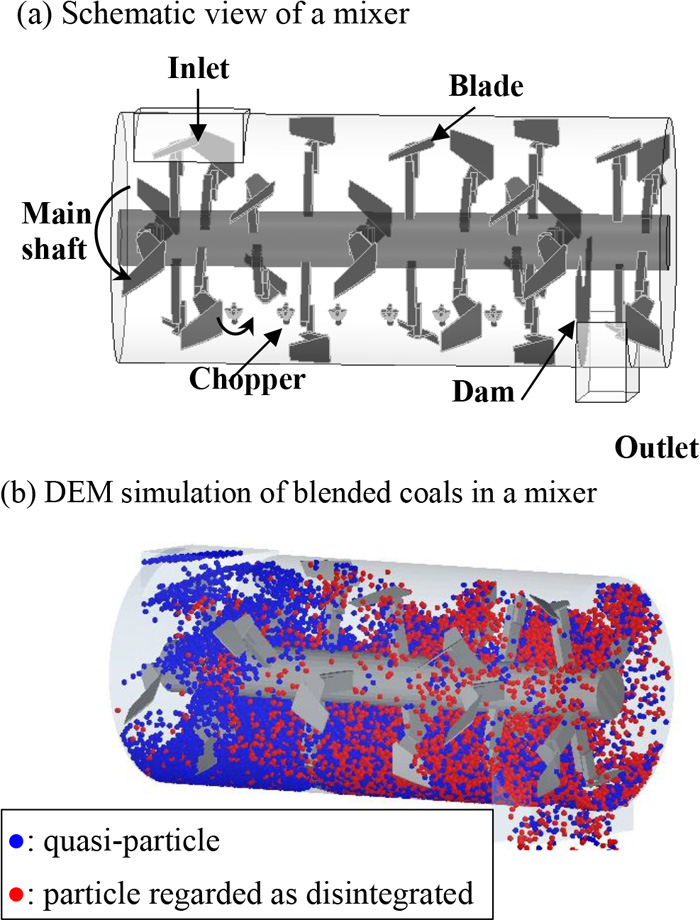
First, mixing tests with a laboratory-scale mixer and corresponding DEM simulations are performed. The mixer is a horizontal vessel having a rotating main shaft with blades. In the middle of the mixer, there are choppers rotating at high speed, which contribute to disintegration of quasi-particles. In the experiments, test coal which includes tracer coal painted with fluorescent paint is mixed, and images of the mixed coal sample are taken under ultraviolet light. From the images, the area ratio of particles over 1 mm is evaluated as the non-mixing degree. In the DEM simulation, coal particles which receive a prescribed high collision stress are considered as disintegrated during mixing. The ratio of non-disintegrated particles to the total is evaluated as the non-mixing degree. Validation of the DEM evaluation is performed by comparing the results of the experiment and simulation.
Then, actual-scale DEM simulations are performed by varying the operating conditions. Based on the results, feasible and suitable operating conditions are suggested.