All issues
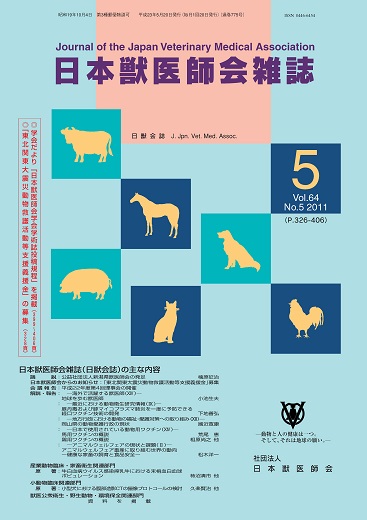
Volume 64, Issue 5
Displaying 1-5 of 5 articles from this issue
- |<
- <
- 1
- >
- >|
Farm Animal Medicine and Animal Health
-
Seiichi KAKINUMA, Hiromichi OHTSUKA, Kaori OHMAE, Kyouko AYABE, Motoha ...Article type: Original Article
2011Volume 64Issue 5 Pages 375-380
Published: May 20, 2011
Released on J-STAGE: May 26, 2017
JOURNAL FREE ACCESSThe aim of this study was to investigate the immune status of dairy cows infected with bovine leukemia virus (BLV). BLV infection was diagnosed by Nested-PCR assay to detect BLV proviral DNA. A farm with high incidence of BLV-positive cows (more than 80% of cows tested positive for BLV) required more frequent treatment of gastrointestinal and metabolic diseases compared to a farm with no BLV-positive cows. Blood samples were obtained from BLV-positive cows on a farm with high BLV incidence (Group A : n =18) and BLV negative cows in a BLV negative farm (Group B : n =23) within 240 days of calving. The number of MHC class Ⅱ+CD14 -B cells, CD14 +monocytes and WC1-N1 +γδT cells in Group A were significantly higher than those in Group B. The number of CD335 +NK cells in Group A was lower than that in Group B but the difference was not statistically significant. These results suggested that cows infected with BLV have abnormal immune status and are at higher risk of gastrointestinal and metabolic diseases.View full abstractDownload PDF (265K) -
Yosuke SASAKI, Emmanuel KABALI, Tomoyuki SHIBAHARA, Hideki KOBAYASHI, ...Article type: Short Communication
2011Volume 64Issue 5 Pages 381-384
Published: May 20, 2011
Released on J-STAGE: May 26, 2017
JOURNAL FREE ACCESSA 30-day-old piglet showed severe emaciation. Macroscopically, fibrinous pleuropneumonia was detected. Histopathologically, necrotic lesions were found in the pleura, epicardium, and renal medulla, and were surrounded by numerous necrotic neutrophils. Gram-negative bacterial colonies were seen in the lesions. Similar lesions were also observed in the liver, spleen, mesenterium, and brain. Immunohistochemically, the bacteria were positively reacted with rabbit anti Actinobacillus suis serum. 16S rRNA gene segment from genomic DNA isolated from formalin-fixed paraffin-embedded tissue sections was amplified, and the base sequence analysis results indicated high homology with A. suis (100% similarity, based on a comparison of 650 bp). The present results indicated that A. suis caused necrotic pleuropneumonia, epicarditis and nephritis in the piglet.View full abstractDownload PDF (477K)
Small Animal Medicine
-
Kenji KUTARA, Kazushi ASANO, Masato KITAGAWA, Daisuke ITO, Kenji TESHI ...Article type: Original Article
2011Volume 64Issue 5 Pages 385-389
Published: May 20, 2011
Released on J-STAGE: May 26, 2017
JOURNAL FREE ACCESSThe purpose of this study was to investigate the abdominal perfusion dynamics of contrast agent for computed tomography (CT) in small-breed dogs. In this study, 49 dogs were used and categorized in 5 groups with different injection doses and duration and different of over-the-needle catheter sizes. Each hounsfield unit (HU) in the aorta (AO), caudal vena cava (CVC), and portal vein (PV) was recorded for 60 sec. A time- intensity curve was created for each group. In AO, the mean time of appearance of the contrast medium (Tup) was approximately 12 sec in all groups. However, the mean HU and time (Tpeak) of the maximum contrast enhancement were different in each group. In CVC, Tup was approximately 20 sec, and Tpeak was 33-39 sec in all groups. In PV, Tup was approximately 22 sec, and Tpeak was 40-45 sec in all groups. In CVC and PV, the mean HU of maximum contrast enhancement was influenced by the injection dose. None of the data were correlated with body weight or heart rate. In conclusion, it is suggested that the contrast effects of abdominal CT in small-breed dogs could be evaluated objectively with the contrast protocol used in this study.View full abstractDownload PDF (246K) -
Satoshi TAKASHIMA, Yasunori OHBA, Kazuhiro WATANABE, Atsushi KODAMA, H ...Article type: Short Communication
2011Volume 64Issue 5 Pages 390-393
Published: May 20, 2011
Released on J-STAGE: May 26, 2017
JOURNAL FREE ACCESSAn abdominal mass was detected by ultrasonography in a 10-month-old French bulldog with a complaint of vomiting. Exploratory surgery revealed an enlargement of the lymph node between the border of the stomach and the pancreas as well as disseminated multiple white nodules in the liver. Both lesions were biopsied for histological evaluation and diagnosed as T-cell lymphoma. There are few reports of T-cell lymphoma in juvenile dogs. The present report suggests that clinicians should not exclude lymphoma from the diagnoses even if the patients are juveniles.View full abstractDownload PDF (326K)
Veterinary Public Health, Wildlife and Environmental Conservation
-
Hisamitu OSADA, Takao IGARASHI, [in Japanese], [in Japanese], [in Japa ...Article type: Data and Information
2011Volume 64Issue 5 Pages 395-398
Published: May 20, 2011
Released on J-STAGE: May 26, 2017
JOURNAL FREE ACCESSDownload PDF (390K)
- |<
- <
- 1
- >
- >|