Warranting Translation Judgements under Manga Translational Configurations

2026 Volume 16 Pages 21-41
Details
2026 Volume 16 Pages 21-41
| 研究論文 |
MEDIA, ENGLISH AND COMMUNICATION, No. 16 2026 The Japan Association for Media English Studies |
|---|
Warranting Translation Judgements under Manga Translational Configurations
Yoshihiro Minamitsu (Osaka Electro-Communication University), Junichi Haruguchi (Osaka Sangyo University), Shigehiro Haruki (Kindai University)
Abstract: This study examines how manga translation judgements are made defensible through warranting discourse and operationalises translational configuration by distinguishing documented cue availability from coded cue uptake. Eighteen Japanese undergraduates (mock TOEIC 281–580; approximately CEFR A2–B1) completed the same Japanese–English panel tasks using My Next Life as a Villainess: All Routes Lead to Doom! at the first and final sessions (R1 and R2, respectively) of a 13-week sequence; Q1 and Q2 were administered at both endpoints and Q3 at R2 only. Eleven intervening sessions used three manga for panel-supported L2→L1 (English-to-Japanese) retranslation, individual feedback, and anonymised whole-class editing. Q1, Q2, and Q3 were analysed using qualitative content analysis, reflexive thematic analysis, and directed qualitative content analysis, respectively. The R2 Q1 corpus contained more reformulation-, stance-, and interpersonal-effect-oriented codes; Q2 alternatives drew on four warrant types; and 18 of 100 Q3 responses formed warranting chains. The findings support a descriptive, task-ecological account without causally attributing any warrant to a single cue.
Keywords: manga translation, warranting discourse, translational configuration
1. Introduction
1.1 Background
Research on manga and comics translation has shown that translated dialogue is shaped not only by lexical transfer but also by verbal-visual orchestration, character voice, role language (yakuwarigo; Kinsui, 2003), and medium-specific conventions (Kaindl, 1999; Zanettin, 2008). Much of this work, however, has focused on translated products, translational strategies, and medium-specific constraints, leaving less room for the study of how translation judgements themselves are verbalised and defended.
The present study addresses this gap by analysing retrospective written accounts produced during staged manga translation tasks. The study draws analogically on Slobin’s (1996) thinking-for-speaking perspective, according to which linguistic reformulation can reorganise attention to meaning and stance. Because the participants are novice, non-specialist undergraduates, the study does not generalise to translator cognition; instead, it examines the discourse through which translation-relevant judgements are articulated, organised, and made accountable. Novice accounts are analytically useful here because less-routinised participants may need to verbalise criteria that more routinised practice can leave tacit; this is a methodological possibility, not a comparison with experts.
This orientation connects with work on metalinguistic awareness and languaging, which shows that learner reflection can make evaluative criteria and semiotic attention visible (Bialystok, 2001; Roehr-Brackin, 2018; Swain, 2006, 2010). Such reflections are treated here as discourse practices, not transparent windows onto cognition.
In this paper, justificatory reasoning is used in the broad sense of warranting or legitimating discourse: the explicit reasons participants use to make a translation choice defensible, appropriate, or accountable. This usage is compatible with descriptive work on translational norms (Toury, 1995) while also resonating with discourse-analytic approaches to legitimation, where reasons are understood as socially organised rather than merely private mental contents (e.g., van Leeuwen, 2008). The aim is not to impose a full typology of legitimation strategies on the data, but to foreground justification itself as an analytically meaningful object in translation research.
1.2 Translational Configuration as a Task-Ecological Heuristic
Translational configuration refers to the bundle of edition-level cues (e.g., publication format, labelling, crediting) and task-level cues (e.g., panel selection, parallel display, prompt wording, retranslation, and feedback) through which a target text is encountered. It is related to but distinct from Genette’s (1997) paratext, Nord’s (2005) translation brief, Goffman’s (1974) framing, and Toury’s (1995) norms: it includes task-embedded cues (unlike Genette’s edition-level paratext), concerns participant-facing presentation rather than production instructions (Nord) or interactional framing (Goffman), and is not itself a norm (Toury). It instead names the situated environment in which licences and expectations may become grounds for judgement.
Only cues and procedures directly encountered in worksheets, digital displays, or feedback/editing are treated as participant-visible; edition metadata remain contextual unless shown. The analysis distinguishes documented cue availability from cue uptake. Cue uptake was recorded only when a response explicitly referred to, or unambiguously relied on, a documented cue. This heuristic links task ecology and norm invocation, including expectancy and professional norms (Chesterman, 1993), but it is not treated as an isolated causal factor.
1.3 Focus of the Study
This study adopts a descriptive, task-sequential perspective on translation judgement. It examines three complementary but non-equivalent forms of written data: aggregate redistribution between the initial (R1) and final (R2) elicitations in verbalised noticing (Q1), the warrants participants stated when proposing alternative renderings at the two endpoints (Q2), and the ordering of warrants in R2 evaluations of published renderings judged especially skilful (Q3). These analyses are not treated as stages in a single within-participant developmental sequence.
The contribution is therefore not a report of classroom effectiveness but an account of how warranting discourse and translational configuration can be used to analyse the grounds on which manga translation judgements are made accountable.
1.4 Research Questions
In line with this descriptive and task-sequential focus, the study addresses the following research questions:
RQ1: How do participants verbalise source–target differences in manga translation tasks?
RQ2: What warrants do participants invoke when proposing and justifying alternative renderings?
RQ3: How do participants order warrants when justifying published renderings they regard as especially skilful?
2. Methodology
2.1 Research Context and Participants
Data were collected from 18 novice, non-specialist, second-year undergraduate participants at a private university in the Kansai region of Japan. All participants were non-English majors. The coursework setting is treated here as a staged elicitation site for participant-generated warranting discourse rather than as the object of pedagogical evaluation. The sample permits a bounded description of the noticing and justificatory resources that emerged under shared task conditions.
An institutional mock TOEIC administered before data collection yielded scores of 281–580, broadly corresponding to CEFR A2–B1 under ETS Global’s (2025) thresholds. This mapping is a broad profile rather than a precise individual classification. Proficiency is reported only to delimit the sample and was not used as an explanatory variable.
Data were collected over 13 weekly class sessions between April and July 2025. All procedures were reviewed and approved through the authors’ institutional ethics review process. Participation was voluntary and informed consent was obtained. Because the tasks were embedded in regular coursework, written responses were anonymised and analysed only after course grading had been completed, reducing evaluative pressure and treating the data as reflective writing rather than assessed performance. Instead of reproducing copyrighted dialogue, we report worksheet line identifiers and paraphrased cues to orient readers (Appendix B).
2.2 Materials and Rationale for Text Selection
Three manga works were used as source–target materials: My Next Life as a Villainess: All Routes Lead to Doom! (hereafter My Next Life as a Villainess) (Yamaguchi, 2018, 2019), Sazae-san (Hasegawa, 2015), and Dragon Ball (Toriyama, 1985, 2003). All materials consisted of Japanese source lines and their published English renderings, extracted from one Japanese edition and one English edition for each work. The materials were selected for three reasons: (1) dialogue-driven content foregrounding stance and pragmatic intent; (2) propositionally aligned yet expressively divergent source–target pairs; and (3) relative accessibility to participants, thereby reducing narrative comprehension load as far as practicable.
Beyond their shared selection rationale, the works occupied overlapping roles in the sequence. My Next Life as a Villainess supplied the fixed 17 Japanese–English panel extracts used for endpoint elicitation and also appeared in intervening practice. All three works were used in the 11 intervening sessions for worksheet-based L2→L1 (English-to-Japanese) retranslation practice.
The works offered different bundles of edition- and task-level cues rather than fixed configuration types. At the endpoints, My Next Life as a Villainess was presented in researcher-arranged parallel Japanese–English panels. During practice, all three works were presented as highlighted English dialogue with panel context and no Japanese source wording. Translation/adaptation credits and bilingual-edition status were recorded as edition provenance, but were treated as participant-visible only if included in the displayed material.
Only cues and procedures directly encountered by participants through worksheets, digital displays, individual feedback, or whole-class editing are treated as participant-visible. Edition-level crediting is therefore contextual metadata unless it formed part of the material shown. The three materials are consequently analysed as different bundles of edition- and task-level cues, not as three fixed causal conditions.
A configuration audit documented six cue domains—verbal input, visual/typographic, sequential/contextual, task/procedural, feedback/editing, and edition provenance (Appendix B). Analytic memos applied the cue-uptake criterion defined in Section 1.2; availability alone was not counted as use. Because cue bundles co-varied with material and task, the analysis treats configuration as an interpretive task ecology and does not infer that a specific cue caused a specific warrant.
2.3 Tasks and Data Collection
The 13-session design comprised an initial My Next Life as a Villainess elicitation (R1; Q1–Q2), 11 intervening sessions of worksheet-based L2→L1 retranslation practice, and a final My Next Life as a Villainess elicitation (R2; Q1–Q3).
2.3.1 Initial and Final Villainess Elicitation (R1/R2; Q1–Q2, with Q3 at R2)
At the first and final sessions, participants used the same 17 fixed Japanese–English manga panel extracts from My Next Life as a Villainess. Each extract displayed the Japanese source dialogue and published English rendering in parallel, preserving local visual context, speech-bubble placement, and immediately relevant visual cues. Q1 asked participants to describe noticed differences, and Q2 asked participants to propose an alternative Japanese rendering of a highlighted English dialogue line and explain the reason for their choice. The Q1 and Q2 prompts were reproduced verbatim at R1 and R2. Q3, administered at R2 only, asked participants to identify and justify a published rendering they regarded as especially skilful. Appendix A reproduces the Q1 and Q2 prompts used at both endpoints and the Q3 prompt used at R2.
R1 was administered in the first session and R2 in the thirteenth and final session. The stimuli, numbering, visual presentation, Q1–Q2 prompt wording, and required response actions were identical at the two endpoints. Participants were permitted to consult only the Weblio online dictionary portal; unrestricted web searches, other online reference tools, machine-translation services, and generative-AI tools were not permitted. Before participants began the R1 worksheet, the instructor demonstrated how to use Weblio, including how to interpret entries and select a contextually appropriate sense. All responses were written in Japanese; excerpts quoted in the Results were translated into English by the first author, and selected data-to-claim transitions are shown in Appendix C.
2.3.2 Intervening Worksheet-Based L2→L1 Retranslation Practice
Across the 11 intervening sessions, the same worksheet sequence was used with Sazae-san (3 sessions), Dragon Ball (4), and My Next Life as a Villainess (4). Participants translated highlighted English dialogue into Japanese while consulting panels, completed unfinished items as homework, and submitted the completed worksheets through the course learning management system (LMS). They were instructed to use only Weblio; homework compliance was not monitored.
Each submission received individual feedback. In the next class, one anonymised submission was randomly selected for instructor-led whole-class editing. No single model translation or published Japanese source was shown; discussion focused on possible revisions and the grounds on which alternatives could be defended. This procedure was intended to avoid anchoring participants to a single canonical solution while preserving space for multiple defensible renderings. In Session 13, the final editing activity preceded R2.
These intervening worksheets were practice activities rather than separate endpoint datasets. Q1 and Q2 data derive from R1 and R2; Q3 data derive from R2 only. The intervening exercises supplied experience in repeated retranslation, individual feedback, and anonymised whole-class editing against which the endpoint accounts were produced. Here, retranslation denotes participants’ L2→L1 rendering, not methodological back-translation.
Figure 1 summarises the phases and datasets; Appendices A–C provide the prompts, material/cue inventories, and worked analytic examples.
Figure 1 Three-Phase Task Sequence and Analytic Datasets Across the 13 Weekly Sessions
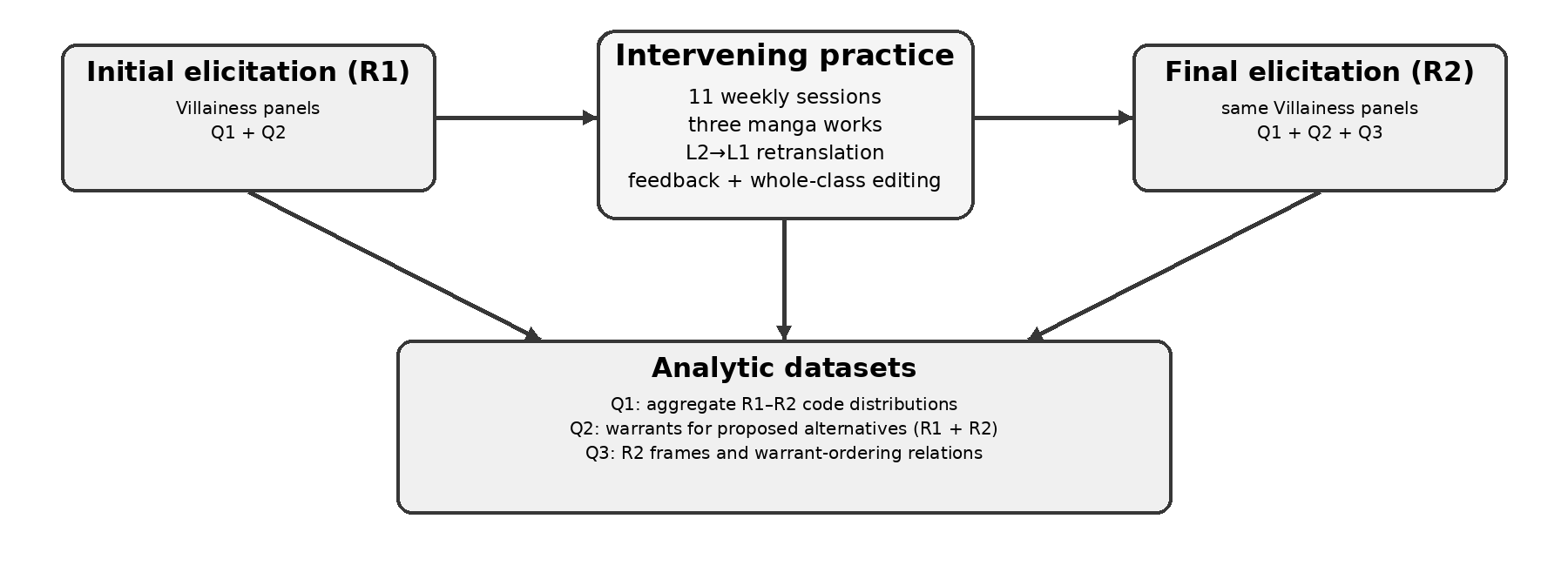
Note. Q1–Q2 used identical My Next Life as a Villainess panels and prompts at R1/R2; Q3 occurred only at R2. The 11 practice sessions used three works for English-only, panel-supported retranslation followed by feedback/editing.
2.4 Data Status Clarification
Q1 responses from R1 and R2 are analysed as aggregate distributions of verbalised noticing. Q2 responses from both endpoints are analysed as stated warrants for participants’ proposed alternatives; they are not treated as participants’ retrospective reports of change. Q3 was administered only at R2 and is analysed as justificatory discourse concerning published renderings judged especially skilful. Across all three analyses, written accounts are treated as discourse through which participants make judgements accountable, not as transparent access to cognition (Kußmaul & Tirkkonen-Condit, 1995).
R1/R2 contrasts are descriptive, not evidence of learning gains. Reused stimuli, repeated practice, feedback/editing, variable elaboration, and unmeasured lexical uncertainty may contribute to Q1 redistribution; response length was not modelled.
2.5 Analytical Procedure
The endpoint worksheets generated three analytic objects: Q1 coded noticing, Q2 stated warrants, and Q3 frames and ordering relations. For Q2/Q3, each line-specific proposal or positive evaluation plus its written reason was treated as a separate analytic unit.
Appendix A reproduces the prompts. Their broad examples sensitised attention but did not supply the operational Q1 subcodes, the four Q2 themes, or the Q3 chain criterion. Q1 was codebook-guided; Q2 themes were constructed through iterative engagement with the full response corpus; and Q3 used a directed frame analysis followed by a separate pass for ordering relations. Prompt wording therefore formed part of elicitation, not the analysis itself.
Auditability was supported through analytic memos, co-author audit sessions, and a log of unclear or contested assignments; Appendix C illustrates selected data-to-claim transitions (Lincoln & Guba, 1985).
2.5.1 Q1 Analysis: Qualitative Content Analysis
Q1 responses were analysed through qualitative content analysis (Mayring, 2000; Hsieh & Shannon, 2005) focusing on what aspects of source–target differences were noticed and how they were articulated.
Six upper-level categories (A–F) with nested subcodes (A1–F3) were applied to each coding segment (typically clause- or sentence-sized). As a default, one code was assigned per segment. Multi-coding was permitted only when participants explicitly juxtaposed distinct differences or when a descriptive operation (A/B/C/F) was inseparably linked to an interpretive effect (D/E). In ambiguous cases, descriptive codes were prioritised, and coding did not go beyond what was explicitly stated; Appendix C illustrates representative coding decisions.
R1 and R2 datasets were coded using the same codebook, and contrasts are reported descriptively through distribution tables by (a) upper-level categories, (b) subcodes, and (c) line-pair patterns. Frequency information is used to summarise distributions and to guide exemplar selection, not to support inferential claims. A second coder independently audited a stratified 10% subset (n = 62; 31 per round), balanced across elicitation rounds and line-pair positions, at the A–F level; common disagreements concerned the A/E boundary and were resolved by adding a tie-breaking rule before finalising the full dataset. The independent audit addressed upper-level category boundaries; subcode assignments were developed by the first author and reviewed during co-author audit sessions.
2.5.2 Q2 Analysis: Reflexive Thematic Analysis
After blank and ‘none’ entries were excluded, the Q2 corpus contained 122 substantive responses (52 at R1 and 70 at R2). Responses were organised by participant, round, and line, then analysed using reflexive thematic analysis (Braun & Clarke, 2006, 2019) to identify recurrent warrants for proposed alternatives. The themes (English-input alignment, voice/stance calibration, contextual or multimodal fit, and reader-oriented economy/clarity) were constructed through iterative familiarisation, coding, theme development, and refinement. The Q2 analysis was prompt-sensitised rather than wholly inductive: the final themes analytically elaborated, rather than simply reproduced, the broad examples included in the shared Q2 prompt used at both endpoints. They describe reasons stated in the answers themselves and are not interpreted as self-reports of an earlier/current orientation. Inter-rater agreement was not sought; round counts are descriptive only.
2.5.3 Q3 Analysis: Directed Qualitative Content Analysis
Q3 was administered at R2 only. After blank and ‘none’ entries were excluded, 100 substantive responses were analysed through directed qualitative content analysis (Hsieh & Shannon, 2005). The prompt examples and the study’s theoretical framework sensitised an initial frame set covering characterisation, situational or multimodal context, interpersonal stance, and anticipated uptake. A second pass traced ordering relations among frames. Co-occurrence alone was not evidence of chaining: a warranting chain was coded only when one warrant causally, conditionally, concessively, or consequentially licensed, limited, or re-ranked another.
During refinement, interpersonal stance was not retained as a separate reporting frame: stance concerning persona, emotion, or status was subsumed under characterisation, whereas stance concerning interlocutor positioning or anticipated response was subsumed under pragmatic effect and audience uptake. The final reporting framework therefore comprised three frames: characterisation, pragmatic effect and audience uptake, and situational or multimodal context.
Responses that mentioned several frames without such ordering were treated as co-occurrences. van Leeuwen (2008) served as a discourse-analytic point of reference rather than a coding template. The strict chain criterion was applied across all 100 substantive responses in a dataset-wide audit, with co-author review of contested assignments.
3. Results
3.1 Metalinguistic Noticing in the Source–Target Comparison Task (RQ1; Q1)
Across the 306 participant–line units at each time point, the R2 corpus contained more coded mentions per participant–line unit than the R1 corpus (R1: 0.92; R2: 1.18). This difference may reflect greater written elaboration, fewer uncodable responses, or a higher incidence of multi-focus accounts; it does not by itself establish greater analytic complexity within individual responses. At the upper-category level (Table 1), two foci dominated at both time points: information/meaning operations (Category A) and nuance/implicature (Category D). However, their relative prominence differed. In the R1 dataset, Category A accounted for 40.64% of all coded mentions, whereas in the R2 dataset it accounted for 29.28%. By contrast, Category D increased from 25.09% to 29.01% of coded mentions (Table 1). Interpersonal effect (Category E) and form/typography (Category F) also increased in relative share, consistent with greater foregrounding of relational and interpersonal-effect perspectives in the later descriptions.
The same tendency is visible in unit coverage. Nuance/implicature (Category D) appeared in 68 units (22.22%) at R1 but in 99 units (32.35%) at R2 (Table 1). In parallel, interpersonal effect (Category E) expanded from 28 units (9.15%) to 47 units (15.36%). Together, these distributions suggest that R2 accounts were more likely to frame source–target differences in terms of pragmatic and interpersonal implications, rather than restricting noticing to whether elements were added, omitted, or rendered explicit.
Table 1
Upper-Level Distribution of Noticing Categories in Q1 Descriptions (R1 versus R2)
| Category and focus | R1 mentions | R1 units | R2 mentions | R2 units | ΔM | ΔU |
|---|---|---|---|---|---|---|
|
A Information/ meaning |
115 (40.64%) |
101 (33.01%) |
106 (29.28%) |
95 (31.05%) |
-9 | -6 |
|
B Sentence structure |
20 (7.07%) |
20 (6.54%) |
31 (8.56%) |
30 (9.80%) |
+11 | +10 |
|
C Reference/ perspective |
35 (12.37%) |
35 (11.44%) |
41 (11.33%) |
41 (13.40%) |
+6 | +6 |
|
D Nuance/ implicature |
71 (25.09%) |
68 (22.22%) |
105 (29.01%) |
99 (32.35%) |
+34 | +31 |
|
E Interpersonal effect |
28 (9.89%) |
28 (9.15%) |
52 (14.36%) |
47 (15.36%) |
+24 | +19 |
|
F Form/ typography |
14 (4.95%) |
13 (4.25%) |
27 (7.46%) |
26 (8.50%) |
+13 | +13 |
Note. Mentions = total coded mentions (multi-label possible). Units = participant–line units (N = 306 per elicitation point) with at least one code from the category. ΔM and ΔU denote R2 − R1 differences in mentions and units. Percentages for Mentions are based on total mentions (R1: 283; R2: 362), and percentages for Units on total units (306). The counts are descriptive summaries used to characterise the distribution of noticing foci and guide exemplar selection; they are not treated as inferential evidence.
To specify what participants attended to within each upper-level focus, Table 2 reports the distribution of all subcodes (A1–F3) for the R1 and R2 datasets. At this finer grain, three recurring patterns in the aggregate R1–R2 code distributions were visible: (i) form-to-function re-description, (ii) voice-to-context integration, and (iii) interpersonal-effect evaluation. These labels summarise corpus-level redistributions; they are not individual trajectories or transition paths.
Within Category A (information/meaning operations), omission decreased from 26 mentions to 15 (A1), and addition from 21 to 15 (A2), whereas paraphrase/lexical shift increased from 47 to 57 (A3) and became the largest Category A subcode at R2. Thus the R2 corpus more often described aligned propositional content through reformulation rather than only through the presence or absence of discrete elements.
A parallel concentration appeared in Category B. B4 (word order or information positioning) increased from 7 to 22 mentions and accounted for most Category B mentions at R2. The R2 corpus therefore contained more references to ordering and placement as descriptive resources, even where propositional content remained broadly aligned.
Table 2
Subcode Breakdown Within Each Upper-Level Category in Q1 Descriptions (R1 versus R2)
| Code | Subcategory | R1→R2 (n) | Δ |
|---|---|---|---|
| A1 | Omission | 26→15 | -11 |
| A2 | Addition | 21→15 | -6 |
| A3 | Paraphrase/lexical shift | 47→57 | +10 |
| A4 | Change in explicitness/specificity | 21→19 | -2 |
| B1 | Sentence splitting/merging | 1→2 | +1 |
| B2 | Linking/continuity across sentences | 6→4 | -2 |
| B3 | Completeness (fragment versus full clause) | 6→3 | -3 |
| B4 | Word order/information positioning | 7→22 | +15 |
| C1 | Reference/terms of address | 22→21 | -1 |
| C2 | Perspective locus (speaker versus setting) | 13→13 | 0 |
| C3 | Stance shift (subjective versus objective framing) | 0→7 | +7 |
| D1 | Politeness/distance | 14→36 | +22 |
| D2 | Strength/mitigation/definiteness | 24→40 | +16 |
| D3 | Implied meaning markers (e.g., mushiro, chanto) | 16→6 | -10 |
| D4 | Semantic broadening/narrowing | 17→23 | +6 |
| E1 | Speech act shift (command versus request) | 9→1 | -8 |
| E2 | Speech act form (question versus statement/monologue) | 4→3 | -1 |
| E3 | Character voice/persona | 4→25 | +21 |
| E4 | Perceived audience/recipient effect | 11→23 | +12 |
| F1 | Punctuation/symbols (... ! ? etc.) | 5→15 | +10 |
| F2 | Typographic emphasis (bold, caps, font size) | 9→9 | 0 |
| F3 | Other stylistic/visual effects | 0→3 | +3 |
Note. Counts represent coded mentions; Δ = R2 − R1. For space, within-category percentages are omitted and can be calculated from the category totals in Table 1. The counts are descriptive summaries used to characterise the distribution of noticing foci and guide exemplar selection; they are not treated as inferential evidence.
Noticing foci were not evenly distributed across the 17 Q1 line pairs (labelled Line 1–Line 17 on the worksheet; see Appendix B for a non-copyrighted inventory of speaker roles and functional cues). Line 15 illustrates how a surface mismatch became an account of stance, continuity, and character voice. A01 wrote that Japanese oshiete ageru carried a slightly patronising nuance, and jaa connected the line to the prior exchange and contributed to characterisation (R2, Q1, Line 15). The clauses concerning ageru were coded D1/E3, while the account of jaa was coded B2/E3. Appendix C also presents a boundary case from Line 6, multi-coded A4/E4 because it both identified reduced explicitness and evaluated that reduction as sufficient for reader comprehension.
These corpus-level redistributions are not individual developmental trajectories.
3.2 Warrants for Alternative Renderings (RQ2; Q2)
The Q2 analysis concerns the reasons participants stated for their own proposed alternatives, not retrospective narratives of change. Across 122 substantive responses, four recurrent warranting orientations were constructed: English-input alignment, voice/stance calibration, contextual or multimodal fit, and reader-oriented economy/clarity. These orientations classify warrants; cue uptake was recorded separately using the criterion in Section 1.2.
English-input-alignment warrants appealed to recoverable lexical meaning, grammatical perspective, or an explicit item in the English line. One R2 response proposed misete ageru (‘I’ll show you’) rather than oshiete ageru because the English used ‘show’ (Line 15); another proposed a Japanese rendering glossed as ‘I am in the … world’ because the English explicitly encoded ‘I’m in’ (Line 5). Such accounts used English-input wording as a reason for revision without treating literalness as an absolute rule.
Voice-and-stance calibration warranted alternatives through persona, emotion, politeness, or social position. Participants strengthened disbelief, resistance, excitement, or confidence, and adjusted honorific or sentence-final forms to make a line sound more consistent with the character. An R2 respondent, for example, replaced a repeated masaka with sonna hazu wa nai to intensify disbelief (Line 3), while another proposed a more confident and playful formulation for Line 15 to foreground the protagonist’s voice.
Contextual or multimodal fit appealed to panel information, sequential flow, or scene and world coherence. A03 proposed omitting ‘Father’ from Line 9 because the image already identified the addressee; the panel was therefore used as a licence for verbal omission. Other responses justified alternatives through their fit with the following line or with the otome-game world. This theme treats context as an explicit warrant, not merely as background information.
Reader-oriented economy and clarity foregrounded concision, readability, naturalness, or ease of interpretation. Participants defended shorter formulations, simpler vocabulary, or more idiomatic phrasing when they believed the relevant meaning would remain recoverable. These warrants sometimes competed with English-input alignment or explicit address, making Q2 a useful site for observing how participants balanced competing criteria rather than maximised any single one.
The themes were not mutually exclusive. The A03 example was coded for contextual/multimodal fit and reader-oriented economy because visual information licensed omission and the omission was defended through concision and readability. R2 yielded more substantive proposals than R1 (70 versus 52), but this difference is reported only as corpus description; Q2 was not analysed as a paired developmental sequence. The result is a repertoire of warrants used to make alternative renderings defensible.
3.3 Justificatory Frames and Warrant Ordering (RQ3; Q3)
Q3 was administered at R2 only and yielded 100 substantive responses. Participants identified a published rendering they considered especially skilful and explained why. The prompt offered broad examples—clarity, character, and situational fit—but did not specify the final frame set or any ordering relation among warrants. Cue references were noted separately from the justificatory frames built from them.
Three recurrent justificatory frames were salient: characterisation, pragmatic effect and audience uptake, and situational or multimodal context. Characterisation concerned persona, emotion, status, and role relations; pragmatic effect concerned naturalness, interpretability, and anticipated interpersonal or reader response; and situational or multimodal context concerned scene dynamics, sequential flow, and visually supported circumstances.
Under the strict ordering criterion in Section 2.5.3, 18 of the 100 substantive responses, contributed by 10 of the 18 participants, were coded as warranting chains; the other 82 were retained as single-frame evaluations or multi-frame co-occurrences. Three recurrent ordering patterns were used to describe the chain cases. Of the 18 chain-coded responses, 8 were voice-first, 6 context-anchored, and 4 effect-oriented. In voice-first chaining, a wording feature licensed an inference about character or stance, which in turn licensed an anticipated reader effect. A05 explained that the negated construction built around ‘just going to accept’ conveyed resistance to fate and was therefore forceful enough to raise expectations about what would happen next (R2, Q3, Line 8).
In context-anchored chaining, scene and sequential fit licensed a formulation and its positive evaluation. A07 wrote that ‘Um … so what?’ would not fit the scene, whereas the published rendering was short and connected both to the immediate situation and to the following line (R2, Q3, Line 7). Situational and sequential coherence therefore licensed the concise wording as a skilful choice.
In effect-oriented chaining, anticipated reader impact governed the positive evaluation, while lexical or figurative choice supplied the means. A04 praised a rendering that avoided directly saying ‘trained’ and instead used a metaphor for the character’s former state because the exaggeration produced impact and humour (R2, Q3, Line 17). These labels describe ordering in the 18 chain cases; they are not a frequency hierarchy or a claim that all Q3 responses were chained.
Because Q3 was elicited only with Villainess at R2, the data do not support material-by-frame distributions. Appendix B documents available cues, while coding records cue uptake only when a response meets the cue-uptake criterion defined in Section 1.2; no specific cue is treated as producing a warrant.
4. Discussion
The central finding is that participants’ translation judgements are analytically inspectable through the grounds they invoke, while the three datasets capture different—not developmental—dimensions of warranting discourse. The three analyses provide complementary but non-equivalent views of the written data. Q1 documents aggregate redistribution in coded noticing between R1 and R2; Q2 characterises the warrants stated for participants’ own alternative renderings; and Q3 identifies justificatory frames and explicit ordering relations in final-session positive evaluations. Because these analyses were not integrated at the participant level, Q2 and Q3 should not be treated as explanations of the Q1 redistribution.
Q1 redistribution may reflect easier local decoding, repeated practice, feedback/editing, stimulus familiarity, or different amounts of written elaboration. Processing load, lexical uncertainty, and response length were not measured, so greater code density cannot establish qualitative change in individual repertoires.
Q2 and Q3 nevertheless show why warranting discourse is analytically productive. Q2 alternatives were defended through English-input alignment, voice/stance, contextual or multimodal fit, and reader-oriented economy, while a conservative subset of Q3 responses explicitly ordered warrants into warranting chains. The contribution lies in making these reasons and their relations inspectable, not in constructing a single developmental narrative across the three datasets.
Translational configuration is operationally bounded: Appendix B documents cue availability, while coding records cue uptake only when a response meets the criterion defined in Section 1.2. Edition metadata remain provenance unless shown, preventing mere cue presence from being treated as influence.
Several limitations constrain interpretation. The sample comprises 18 novice, non-specialist undergraduates at one institution. Q3 was administered only at R2; Q2 was analysed as a pooled repertoire rather than a paired developmental sequence; and Q1 response length was not modelled independently of code density. Material, task, feedback, and configuration co-varied, while edition-level crediting was not independently verified as attended to. These constraints preclude causal attribution and broad transfer beyond the present setting; copyright, separately, precludes complete procedural replication of the stimuli.
Within these limits, multimodal materials, repeated comparison, and the task-level display arrangements constituted the ecology within which participants articulated and defended translation judgements. Future work can manipulate specific cues while holding material constant, collect comparable Q3 data at both endpoints, and model response length alongside code distributions. The present study nevertheless demonstrates the analytic payoff of treating warranting discourse as a primary object of translation research.
5. Conclusion
Translation judgements become visible not only in products but also in the discourse that warrants them. RQ1 showed denser reformulation-, stance-, and interpersonal-effect coding at R2; RQ2 identified four warrant orientations; and RQ3 found explicit warrant ordering in 18 of 100 responses.
Methodologically, written responses can be analysed as warranting discourse; conceptually, translational configuration can distinguish documented cue availability from coded cue uptake. The contribution is therefore a bounded task-ecological account of how translation judgements are made accountable, not a causal account of cue effects or a claim about uniform individual development.
Acknowledgements
This work was supported in part by JSPS KAKENHI Grant Number 23K00783.
References
Bialystok, E. (2001). Bilingualism in development: Language, literacy, and cognition. Cambridge University Press.
Braun, V., & Clarke, V. (2006). Using thematic analysis in psychology. Qualitative Research in Psychology, 3(2), 77–101. https://doi.org/10.1191/1478088706qp063oa
Braun, V., & Clarke, V. (2019). Reflecting on reflexive thematic analysis. Qualitative Research in Sport, Exercise and Health, 11(4), 589–597. https://doi.org/10.1080/2159676X.2019.1628806
Chesterman, A. (1993). From "is" to "ought": Laws, norms and strategies in translation studies. Target, 5(1), 1–20. https://doi.org/10.1075/target.5.1.02che
ETS Global. (2025). Mapping table: TOEIC Listening and Reading test scores and the CEFR levels. Retrieved June 21, 2026, from https://www.eu.ets.org/content/dam/ets-org/eu/pdfs/toeic/toeic-4-skills-tests-mapping-table.pdf
Genette, G. (1997). Paratexts: Thresholds of interpretation (J. E. Lewin, Trans.). Cambridge University Press. (Original work published 1987)
Goffman, E. (1974). Frame analysis: An essay on the organization of experience. Harvard University Press.
Hsieh, H.-F., & Shannon, S. E. (2005). Three approaches to qualitative content analysis. Qualitative Health Research, 15(9), 1277–1288. https://doi.org/10.1177/1049732305276687
Kaindl, K. (1999). Thump, whizz, poom: A framework for the study of comics under translation. Target, 11(2), 263–288. https://doi.org/10.1075/target.11.2.03kai
Kinsui, S. (2003). Vācharu nihongo: Yakuwarigo no nazo [Virtual Japanese: The mystery of role language]. Iwanami Shoten.
Kußmaul, P., & Tirkkonen-Condit, S. (1995). Think-aloud protocol analysis in translation studies. TTR: Traduction, Terminologie, Rédaction, 8(1), 177–199. https://doi.org/10.7202/037201ar
Lincoln, Y. S., & Guba, E. G. (1985). Naturalistic inquiry. Sage.
Mayring, P. (2000). Qualitative content analysis. Forum: Qualitative Social Research, 1(2), Article 20. https://doi.org/10.17169/fqs-1.2.1089
Nord, C. (2005). Text analysis in translation: Theory, methodology, and didactic application of a model for translation-oriented text analysis (2nd ed.). Rodopi.
Roehr-Brackin, K. (2018). Metalinguistic awareness and second language acquisition. Routledge.
Slobin, D. I. (1996). From "thought and language" to "thinking for speaking." In J. J. Gumperz & S. C. Levinson (Eds.), Rethinking linguistic relativity (pp. 70–96). Cambridge University Press.
Swain, M. (2006). Languaging, agency and collaboration in advanced language proficiency. In H. Byrnes (Ed.), Advanced language learning: The contribution of Halliday and Vygotsky (pp. 95–108). Continuum.
Swain, M. (2010). Talking-it-through: Languaging as a source of learning. In R. Batstone (Ed.), Sociocognitive perspectives on language use and language learning (pp. 112–130). Oxford University Press.
Toury, G. (1995). Descriptive translation studies and beyond. John Benjamins.
van Leeuwen, T. (2008). Discourse and practice: New tools for critical discourse analysis. Oxford University Press.
Zanettin, F. (Ed.). (2008). Comics in translation. St. Jerome Publishing.
Primary Sources
Hasegawa, M. (2015). Best of bilingual Sazae-san: Blue edition—The Olympic era [Besuto obu taiyaku Sazae-san: Ao-ban—Orinpikku no jidai] (J. Young & D. Young, Trans.). Asahi Shimbun Publications.
Toriyama, A. (1985). Dragon Ball (Vol. 1). Shueisha.
Toriyama, A. (2003). Dragon Ball (Vol. 1; M. Morimoto, Trans.; G. Jones, Adapt.). VIZ Media.
Yamaguchi, S. (2018). Otome gēmu no hametsu furagu shika nai akuyaku reijō ni tensei shite shimatta … [I was reincarnated as the villainess in an otome game with nothing but ruin flags …] (Vol. 1). Ichijinsha.
Yamaguchi, S. (2019). My next life as a villainess: All routes lead to doom! (Vol. 1; E. Ishikawa, Trans.; L. Gray, Adapt.). Seven Seas Entertainment.
Appendix A. Written Q1–Q3 Prompts
Table A1
Endpoint Prompts
| Japanese prompt | English translation |
|---|---|
| Q1:英語と日本語のセリフを比べて、どんな違いに気づきましたか? ※たとえば、 ・語順や文体(かたい/やわらかい、丁寧/カジュアル など) ・セリフの強さやキャラクターらしさ ・言い方のニュアンス ・言われた相手にどう伝わるかの違い など、わかることをできるだけ細かく、具体的に文章で説明してください。 ※(無いところは、「なし」と記述してください) | Q1. Compare the English and Japanese dialogue lines. What differences did you notice? For example, consider word order and style (formal/informal, polite/casual), the strength of the line and character voice, nuances of expression, and differences in how the line may come across to the addressee. Explain as specifically and fully as possible. If there is no difference to report, write ‘None.’ |
|
Q2:ハイライトされた部分の中で、「自分ならこう訳す」と思った箇所はありますか?もしあれば、どんなふうに訳しますか?また、なぜそのように訳したいと思ったのか、その理由も文章で説明してください。 ※(たとえば、「もっとキャラらしくしたい」、「伝わりやすくしたい」、「短くまとめたい」など) ※(無いところは、「なし」と記述してください) |
Q2. Among the highlighted lines, were there any for which you thought, ‘I would translate this differently’? If so, how would you translate them? Please also explain why you would prefer that rendering, for example, to make it more character-consistent, easier to understand, or more concise. If none, write ‘None.’ |
|
Q3:ハイライトされた部分の中で、「これは自分には思いつかない、うまい訳だ」と思った箇所はありますか?もしあれば、どの部分がなぜうまいと思ったのか、具体的に文章で説明してください。 ※(たとえば、「短くてわかりやすい」、「キャラらしさが伝わる」、「状況に合っている」など) ※(無いところは、「なし」と記述してください) |
Q3. Among the highlighted lines, were there any translations that struck you as skilful and that you would not have thought of yourself? If so, explain specifically which part you considered skilful and why, for example, because it is concise and clear, conveys the character, or fits the situation. If none, write ‘None.’ |
Note. Q1 and Q2 were reproduced verbatim at R1 and R2; Q3 was administered at R2 only. The Japanese wording reproduces the worksheet prompts, and the English translations are by the authors.
Appendix B. Operationalisation of Translational Configuration and Material Inventory
Table B1
Operational Matrix for Translational Configuration
| Cue domain | Operational indicator | Analytic treatment |
|---|---|---|
| Verbal input | Endpoint elicitation: Japanese and English wording. Intervening practice: highlighted English wording only. | Uptake only when the cue was explicitly referenced or unambiguously relied on. |
|
Visual/ typographic |
Panel image, addressee, expression, bubble placement, punctuation, or typography. | Uptake only when the cue was explicitly referenced or unambiguously relied on. |
|
Sequential/ contextual |
Preceding/following talk, scene, relationship, or world context. | Uptake only when the cue was explicitly referenced or unambiguously relied on. |
|
Task/ procedural |
Shared prompt wording, highlights, Weblio-only condition, and response format. | Condition documented; uptake only under the same response-based criterion. |
|
Feedback/ editing |
Individual feedback, anonymised whole-class editing, and no single model answer. | Sequence-level condition; uptake only under the same response-based criterion. |
| Edition provenance | Publication format, labels, and credits. | Contextual unless shown; uptake only under the same response-based criterion. |
B2. Q1 Line-Pair Inventory (Identifiers Only; No Copyrighted Dialogue Reproduced)
L01 address/register; L02 mitigation/indirectness; L03 ellipsis, stance and humour; L04 directive softening/intensity; L05 perspective shift; L06 explicitness/reader comprehension; L07 politeness/status; L08 accusation/implicature; L09 reference/address choice; L10 word order/emphasis; L11 visually licensed omission/addition; L12 punctuation/stance; L13 voice/persona; L14 explicitness/paraphrase; L15 ageru/jaa and patronising voice; L16 interjection/intensity; L17 retort/facework/stance. All extracts came from My Next Life as a Villainess: All Routes Lead to Doom! and were shown as Japanese–English manga panels with local visual context.
Table B2
Material Roles and Edition-Level Provenance
| Material | Edition-level provenance | Task-level presentation and role |
|---|---|---|
| My Next Life as a Villainess | Official English edition credits translation and adaptation. | Researcher-arranged parallel Japanese–English panels at R1/R2; during intervening practice, English dialogue with panel context only (Japanese source wording withheld). |
| Sazae-san | Bilingual parallel-text edition. | Panel-supported L2→L1 retranslation from English dialogue only during intervening practice (Japanese source wording withheld). |
| Dragon Ball | Separate translation and English-adaptation credits. | Panel-supported L2→L1 retranslation from English dialogue only during intervening practice (Japanese source wording withheld). |
Note. Table B1 distinguishes cue availability from cue uptake; Table B2 records material provenance and task roles. Cue uptake was recorded only when a response explicitly referred to, or unambiguously relied on, a documented cue. Availability alone did not count as use.
Appendix C. Worked Examples of Data-to-Analysis Decisions
The following cases trace participant wording to codes or themes and then to interpretive claims. Q1 and Q2 examples are from R2; Q3 was administered at R2 only. Participant identifiers are pseudonyms.
C1a. Q1 Multi-Coding Example
(R2, A01, Line 15)
Japanese original. 日本語では「教えてあげる」と少し上からのニュアンスがあるが英語では「SHOW」と見せるニュアンスが大きく感じられる。英語では「PAY ATTENTION.」がほかの文と分離してるが日本語では前の文とつながっている。日本語では「じゃあ」と前の会話と接続し因果関係とキャラ付けを示している。「あげる」もキャラ付けにつながっている。
English translation. “Oshiete ageru is slightly patronising, whereas SHOW foregrounds showing; PAY ATTENTION. is separated in English, while jaa connects the Japanese line to the prior exchange and contributes to characterisation.”
Coding decision. D1/E3 for ageru; B2/E3 for jaa.
Analytic rationale. The response records uptake of verbal-input and sequential/contextual cues and links them to interpersonal stance and character persona rather than reporting a lexical mismatch alone.
C1b. Q1 Boundary Case: Explicitness and Reader Comprehension
(R2, A08, Line 6)
Japanese original. 英語では細かく「私は世界に入ってしまった」という風に書かれているが、日本語では「世界だ」とだけ書かれており、それだけでも読者に意味の伝わる内容になっている。
English translation. “The English states in detail that ‘I have entered this world,’ whereas the Japanese says only ‘this is the world’; even so, the meaning remains clear to the reader.”
Coding decision. A4 + E4.
Analytic rationale. The response records uptake of the English–Japanese explicitness contrast and evaluates the reduced Japanese wording as sufficient for reader comprehension.
C2. Q2 Worked Example: Contextual Fit and Economy (R2, A03, Line 9)
Japanese original. 「も、もちろん!ちゃんと聞いておりますわ」お父様に対して話しているのは絵を見たらわかるのでお父様の部分を省略して簡潔に読みやすくした。
English translation. “I would translate it as, ‘O-of course! I was listening carefully.’ The image already shows that she is speaking to her father, so I would omit ‘Father’ to make the line more concise and readable.”
Coding decision. Contextual/multimodal fit + reader-oriented economy/clarity.
Analytic rationale. The response records uptake of a panel/visual cue: the image licenses omission of the address term, and the omission is defended through concision and readability.
C3. Q3 Worked Example: Voice-First Chaining
(R2, A05, Line 8)
Japanese original. 「just going to accept」という表現の否定形を使うことで、「ただ座して待つだけではない」「簡単に諦めるつもりはない」という、運命に対する明確な反抗の姿勢が示されており、非常に力強く、今後の展開への期待を持たせる「うまい」翻訳だと感じました。
English translation. “The negated construction built around ‘just going to accept’ conveys resistance to fate: she will not simply wait or give up. It is forceful and raises expectations about what happens next.”
Coding decision. Voice-first chaining.
Analytic rationale. The response records uptake of the English wording: the negated construction licenses an inference of resistant stance, and that stance in turn licenses an anticipated reader effect (construction → resistant stance → anticipated reader effect).
書誌情報
|
掲載誌:MEDIA, ENGLISH AND COMMUNICATION, No. 16 (2026, pp. 21-41) 発行元:一般社団法人 日本メディア英語学会 表 題:マンガの翻訳的配置における翻訳判断の根拠づけ 著 者:南津佳広(大阪電気通信大学)、春口淳一(大阪産業大学)、春木茂宏(近畿大学) 要 約:本研究では、マンガ翻訳における判断が、どのような根拠によって説明・正当化されるのかを検討した。分析にあたっては、翻訳的配置(訳文が置かれる版面上・課題上の環境)を、参加者が利用できた手がかりと、回答のなかで実際に参照された手がかりとに区別して扱った。日本人大学生18名は、13回の授業の初回(R1)と最終回(R2)に、同一の『乙女ゲームの破滅フラグしかない悪役令嬢に転生してしまった…』(以下『はめふら』)の日英パネルを用いて、同一文面の設問Q1(気づきの記述)とQ2(代替訳の提案とその理由)に回答した。中間11回では、『はめふら』、『サザエさん』、『ドラゴンボール』の英語台詞とパネルのみを提示し、日本語原文を伏せたまま英日再翻訳を行わせ、提出後に個別フィードバックと匿名での全体添削を実施した。設問Q3(巧みだと感じた訳の同定とその理由)は最終回(R2)のみ行った。分析には、Q1に質的内容分析、Q2に再帰的テーマ分析、Q3に指向的質的内容分析を用いた。R2のQ1では、言い換え、スタンス、対人・受け手効果に関するコードの密度が高かった。Q2では、英語入力との整合、声・スタンス、文脈・視覚情報、簡潔さが代替訳の根拠となった。Q3の回答100件のうち18件には、複数の根拠を順序づける明示的な連鎖が認められた。以上より、手がかりの利用可能性と実際の参照とを区別し、判断が生み出された課題環境に即して分析することの有用性が示された。 キーワード:マンガ翻訳、根拠づけの談話、翻訳的配置 論文カテゴリー:研究論文 CC ライセンス:CC BY-NC 4.0 執筆言語:英語 受理日:2026年8月12日 © 2026 Yoshihiro Minamitsu, Junichi Haruguchi, Shigehiro Haruki |
|---|


