Abstract
Horticulture in Japan 2026 was published as an Extra Issue of The Horticulture Journal. It consists of four chapters: “I. General”, “II. Fruit Trees”, “III. Vegetables”, and “IV. Ornamentals”. Chapter I outlines the history of the Japanese Society for Horticultural Science, a leading force in horticultural research in Japan, and the background of Japanese horticulture, including Japan’s natural environment, society, Japanese personality, market systems, and relevant statistical data regarding horticulture. Chapters II–IV focus on fruit trees, vegetables, and ornamental plants. Each chapter in Chapter II to IV is divided into two sections. The first section comprises articles on the crop items in each category. The second section, titled “New Technology”, introduces new applied techniques in each category. Horticulture in Japan 2026, published to coincide with IHC 2026, will be available via free online access via J-STAGE on September 1st, 2027. The online version includes color-printed photographs. This is expected to help researchers overseas to understand the natural and social context, history, current status, and diversity of Japanese horticulture and horticultural science, as well as the research background of papers published in The Horticulture Journal.
Introduction
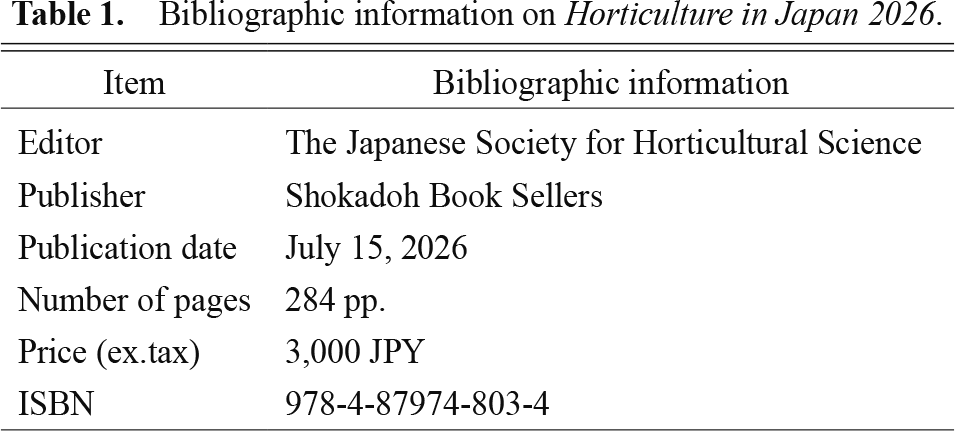
Horticulture in Japan 2026 was published as an Extra Issue of The Horticulture Journal from Shokadoh Book Sellers (Table 1). It is a guidebook for understanding the current status of horticulture in Japan and the research background of articles in The Horticulture Journal consisting of four chapters: “I. General”, “II. Fruit Trees”, “III. Vegetables”, and “IV. Ornamentals”. Each chapter contains 5–53 articles. Chapter I outlines the history of the Japanese Society for Horticultural Science, a leading force in horticultural research in Japan, and the background of Japanese horticulture, including Japan’s natural environment, society, Japanese personality, market systems, and relevant statistical data about horticulture. Chapters II–IV focus on fruit trees, vegetables, and ornamental plants. Each chapter is divided into two sections. The first section comprises articles on the crop items in each category. The second section, titled “New Technology”, introduces new applied techniques in each category. Overall, this book features contributions from over 100 experts on their respective topics.
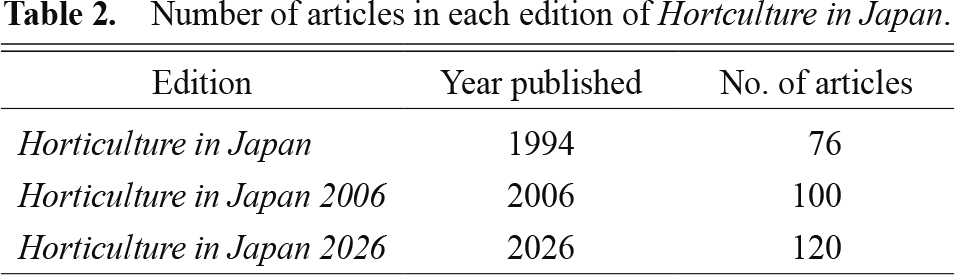
This book is a substantially revised edition of Horticulture in Japan (Organizing Committee XXIV International Horticultural Congress Publication Committee, 1994), published in 1994, and Horticulture in Japan 2006 (The Japanese Society for Horticultural Science, 2006), published in 2006. The 1994 and 2006 editions contained 76 and 100 articles, respectively. However, the current edition contains 120 articles (Table 2). This suggests that contemporary Japanese horticulture has diversified due to changes over time.
General composition of each chapter
Chapter I comprises five topics that explain the background of Japanese horticulture. It introduces the progress made by the Japanese Society for Horticultural Science over the past 100 years, Japanese personality traits, horticultural crops, national land and natural conditions, and the market system for horticultural products. Approximately 20 years have passed since the publication of the 2006 edition, and both the natural conditions and society have undergone significant changes. Global warming has progressed, leading to increased summer heat, warmer winters, and frequent localized heavy rainfall. Information technology has advanced dramatically, and the population has aged significantly. Chapter I explains how these changes in natural and social environments have shaped the current situation regarding Japanese horticulture. Meanwhile, many aspects of traditional Japanese thinking remain unchanged, and this chapter focuses on the traditional Japanese mindset. One such concept is “mottainai” (which means “What a waste!” expressing an ingrained Japanese ethos of cherishing and using things). Chapter 1 addresses both the significant changes and enduring aspects of the horticulture environment.
Chapters II, III, and IV cover fruit trees, vegetables, and ornamental plants. The first section of each chapter discusses crop items in their respective plant categories, while the latter section addresses new technologies. The content of each chapter was determined and updated by specialized editors in each field based on a comprehensive consideration of factors such as economic importance and uniqueness within Japan.
Chapter II discusses fruit trees. Fifteen fruit crops are introduced, along with six topics under “New Technology”. Compared to the 2006 edition, the number of fruit crops did not increase. However, the cultivar composition for each crop has changed significantly, such as the dramatic increase in ‘Shine Muscat’ grape. In the current version, less common crops such as ginkgo and akebi were removed from the contents. Consequently, this edition reflects these changes over the past two decades since the previous edition was published. The “New Technology” section introduces some of Japan’s unique technologies, including enzymatic peeling, research and the practical outcome with β-cryptoxanthin in mandarins and its industrial contributions and the tree joint training system. Most of these technologies were research topics in 2006 but have since been adopted in practice. Smart agricultural applications for fruit trees are also discussed.
Chapter III discusses vegetables. This chapter introduced 41 crop items in 35 categories, with 18 articles presented as “New Technology”. Among vegetables, items such as celery, udo, and water shields were removed from the 2006 edition, and several items such as okra and komatsuna were added. The “New Technology” section for vegetables was divided into two subsections: breeding and cultivation, with a total of 18 articles presented. This section contains ten topics on breeding for specific traits, such as seedless sweet pepper breeding and white radish breeding for processing. The remaining eight articles introduce cultivation, including smart agriculture and greenhouse environmental controls.
Chapter IV covers ornamental plants. Ornamental plants are introduced by classifying the major items into 16 categories. Several categories have been rearranged since the 2006 edition, including gentian, dahlia, sweet peas, and Ranunculus. The Bedding Plants category (labeled Nursery Plants in the 2006 edition) includes pansies, petunias, marigolds, ornamental cabbage, the so-called ha-botan, and primroses. Additionally, the “New Technology” section, which includes five topics, covers a topic related to heat tolerance—a contemporary issue—alongside topics unique to ornamental plants, such as the generation of transgenic plants expressing a novel color, flowering mechanisms, elongation of vase life, and fragrance.
Understanding the research materials and background of studies in The Horticulture Journal
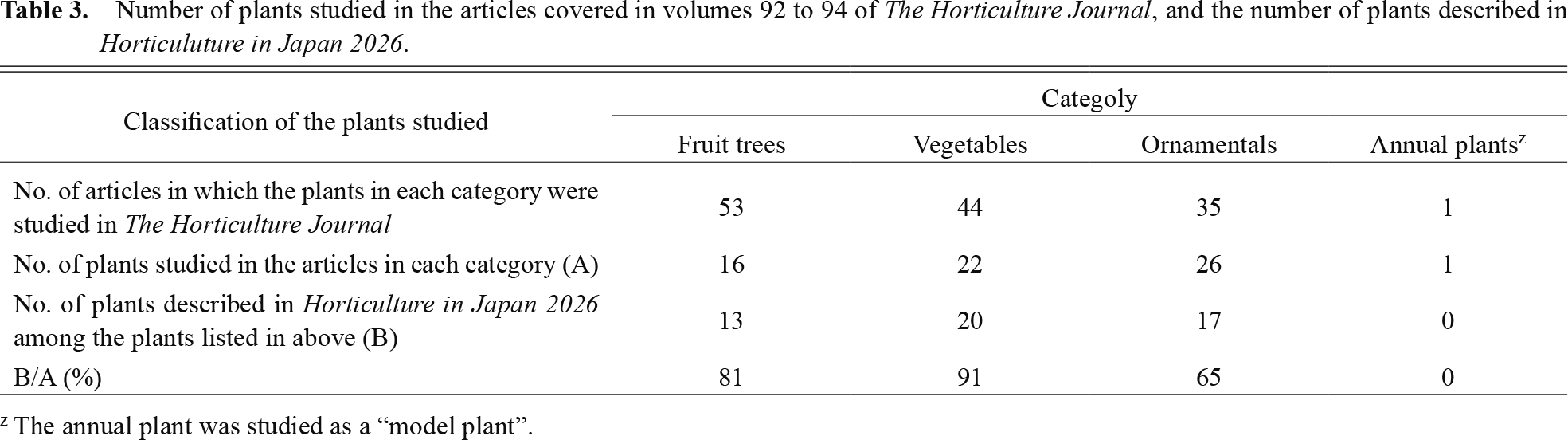
This book is also essential for understanding papers published in The Horticulture Journal. It introduces 81%, 91%, and 65% of fruit trees, vegetables, and ornamental plant materials, respectively, used as plant materials in articles published in The Horticulture Journal from volumes 92 to 94 (Table 3). Naturally, as The Horticulture Journal is open internationally, and includes papers on plants that are not cultivated in Japan, such as abiu (Susant et al., 2023) and salak (Matsuda et al., 2023). However, as many studies have focused on Japanese horticultural plants, the materials and research background may be difficult for readers overseas to understand. Thus, this book will help readers understand the materials and research background of studies in The Horticulture Journal.
Release of free PDF version of Horticulture in Japan 2026
Horticulture in Japan 2026, published to coincide with The 32nd International Horticultural Congress (IHC2026), will be available by free online access via J-Stage on September 1st, 2027. The online version includes color-printed photographs. This is expected to help researchers overseas to understand the natural and social context, history, current status, and diversity of Japanese horticulture and horticultural science, as well as the research background of papers published in The Horticultural Journal. The publication of this book will significantly enhance the international recognition of horticulture and horticultural science in Japan.