Abstract
There is no definite consensus on the most suitable endoscopic treatment for esophageal varices in children. Especially, endoscopic treatment of infants under 1 year of age is very rare. We performed endoscopic injection sclerotherapy (EIS) and endoscopic variceal ligation (EVL) for two 10-month-old infants with liver cirrhosis associated with congenital biliary atresia.
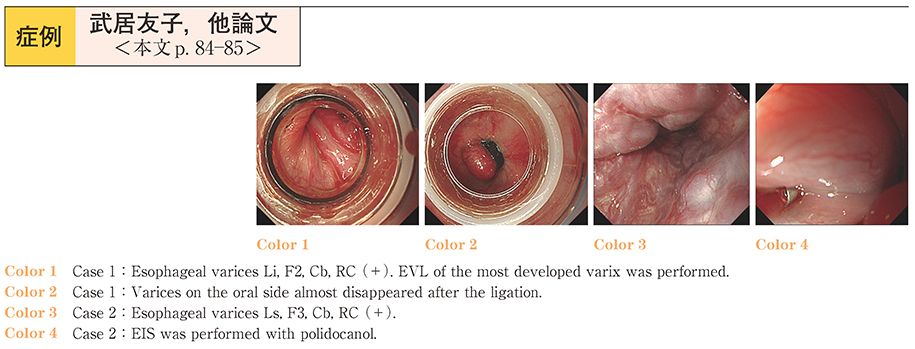
Case 1 was a 10-month-old female infant who was 72 cm in height and weighed 10.0 kg. Endoscopic examination under general anesthesia was performed for melena, The source of the bleeding was identified as esophageal varices 〔Li, F2, Cb, RC (+) 〕. An endoscope with an EVL device could be passed through the narrow opening of the esophagus, and the bleeding varix was ligated by EVL. Case 2 was a 10-month-old female infant who was 65.2 cm in height and weighed 6.6 kg. Endoscopic examination was performed as a screening procedure prior to living donor liver transplantation. Esophageal varices 〔Ls, F3, Cb, RC (+) 〕 were found. An endoscope with an EVL device could not be negotiated through the opening of the esophagus, therefore, EIS was performed.
Because of the scarcity of cases receiving endoscopic treatments among children, it is difficult to evaluate the differential therapeutic outcomes between EIS and EVL in this patient population. Based on previous reports, it would appear that the risk of complications is higher in cases treated by EIS than that in cases treated by EVL. Therefore, we think that EVL might be preferable to EIS in children. In case 1, we succeeded in performing EVL effectively and safely in a 10-month-old infant. Therefore, the endoscopic procedure of first choice for esophageal varices in infants below 1 year of age is EVL, if the EVL device can be negotiated past the opening of the esophagus.