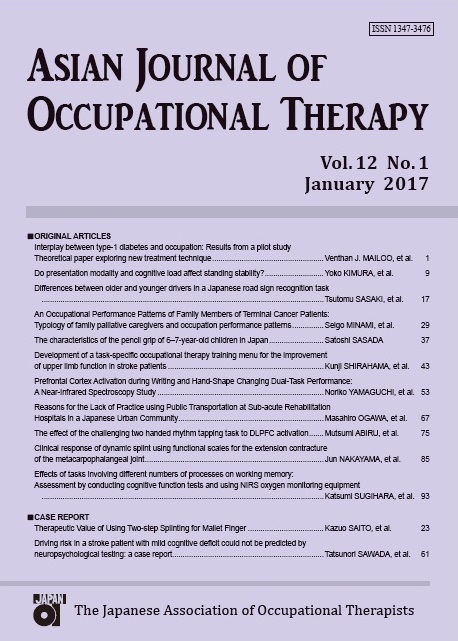
Asian Journal of Occupational Therapy
Online ISSN : 1347-3484
Print ISSN : 1347-3476
ISSN-L : 1347-3476
Volume 20, Issue 1
Displaying 1-18 of 18 articles from this issue
ORIGINAL ARTICLE
  • Takuya Noguchi, Takahiro Yorozu, Suguru Hashizume, Takayuki Kawakami, ...
    2024Volume 20Issue 1 Pages 1-11
    Published: 2024
    Released on J-STAGE: January 30, 2024
    JOURNAL FREE ACCESS

    Objectives: This study aims to examine the treatment effects of Positive Occupation-Based Practice (POBP) in individuals with mental illness using the Engagement Estimation System (EES) of the Assessment of Positive Occupation 15 (APO-15) in a single-group, pre/post-comparison design in a multicenter study.

    Method: This study was a collaboration between day hospitals (two facilities) and psychiatric hospitals (three facilities). The sample consisted of a diverse group of participants, aged 20-80 years, diagnosed with psychiatric disorders and recruited with the consent of their treating physicians. This study examined the treatment effects of POBP with EES applied as an adjunct to day hospital or psychiatric occupational therapy in a single-group, pre/post-comparison design. Participants were asked to attend the standard program and the EES-applied POBP program at each facility. The intervention period was 5 months, starting from baseline, with an additional 1-month follow-up period after completion of the intervention. In this study, the Subjective Well-being Scale was used as the primary outcome measure. In addition, the Positive and Negative Affect Schedule and the APO-15 were used as secondary outcome measures.

    Results: The study included 18 participants. Basic participant information included diagnosis (12 schizophrenia, 5 depression, 1 organic psychosis), gender (9 male, 9 female), age (57.61 [±13.25]), and living environment (12 community, 6 hospital). EES-applied POBP showed a statistically significant therapeutic effect on 7 of the 9 factors in the three outcome measures.

    Conclusion: The EES-applied POBP may contribute to the effective enhancement of subjective well-being and positive emotions in individuals with mental illness.

    Download PDF (377K)
  • Kojiro Kawano, Masayoshi Kobayashi, Saori Haga, Ayako Takehara, Kenji ...
    2024Volume 20Issue 1 Pages 12-20
    Published: 2024
    Released on J-STAGE: February 28, 2024
    JOURNAL FREE ACCESS

    Background: This study aimed to identify factors correlating with the continued employment of people with mental disorders who were hired after the launch of the Employment Support Programme in Cooperation with the Public (ESPCP) employment service.

    Methods: A survey was conducted with 60 participants who were hired within 12 months after the launch of the ESPCP to determine whether they had retained that job or had changed jobs during the 12-month period after being hired. Factors relating to continued employment were then examined using binary logistic regression.

    Results: The participants were classified into two groups: the job-retention (n = 43) and job-turnover (n = 6) groups. Of the participants in the job-retention group, 79.07% used psychiatric day care after securing their jobs. Psychiatric day care was extracted as a predictive factor for continued employment in a logistic regression model, whose variables included psychiatric day care, outreach services, and agency-based counselling services (odds ratio = 1.02, 95% confidence interval = 1.00-1.04, p = 0.04). The job-turnover group included those who wanted to change jobs and those who quit owing to their condition worsening. Two of the four participants whose conditions worsened had adjusted their medication use based on their own judgment.

    Conclusions: The use of psychiatric day care is associated with job retention of people with mental disorders post-ESPCP. Preventing turnover requires paying attention to job satisfaction, desire to change jobs, medication adherence, and follow-up when unable to attend the psychiatric day-care centre.

    Download PDF (284K)
  • Takashi Kariya, Shinichi Noto
    2024Volume 20Issue 1 Pages 21-28
    Published: 2024
    Released on J-STAGE: February 28, 2024
    JOURNAL FREE ACCESS

    Purpose: To determine the relationship between qualitative factors of motivation for rehabilitation and participants' performance of and satisfaction with self-determined goals, healthrelated quality of life, and functional independence in first-episode stroke patients in a convalescent ward.

    Methods: Participants were first-stroke patients admitted to the A Hospital during November 2022–August 2023. Training Motivation Scale score was used as an explanatory variable to assess motivation quality. Canadian Occupational Performance Measure (COPM), MOS 36-Item Short-Form Health Survey (SF-36), and Functional Independence Measure (FIM) scores at baseline and discharge evaluations were used as objective variables for comparison.

    Results: Significant differences were found on two factors related to the amount of change in the SF-36 role/social health component score: the controlled motivation score at baseline (p < 0.01) and the amount of change in the controlled motivation score (p < 0.05). Univariate logistic regression analysis showed a significant association between improvement above the minimum important change in COPM-P score and an increase in the controlled motivation score (odds ratio 6.67, 95% confidence interval 1.05-42.40, p = 0.04), but no increase in the non-motivation score (odds ratio 13, 95% confidence interval 1.27-133, p = 0.03). There was no relationship between motivation for rehabilitation and improvement in FIM score.

    Conclusions: These findings suggest that focusing on controlled motivation as a qualitative aspect of motivation for rehabilitation promotes patients' motivation to reacquire roles and social life activities, positively affects their goal performance, and improves quality of life.

    Download PDF (282K)
REVIEWS
  • Ryu Kobayashi, Sho Maruyama, Takuya Hirose, Hiroaki Ishikawa, Norikazu ...
    2024Volume 20Issue 1 Pages 29-48
    Published: 2024
    Released on J-STAGE: May 07, 2024
    JOURNAL FREE ACCESS

    Objective: A comprehensive overview of prognosis prediction studies on activity and participation among stroke survivors in Japan is currently lacking. This scoping review aimed to identify outcome measures, study characteristics, gaps, and issues in prognosis prediction studies focusing on activity and participation among patients with stroke in Japan. The study sought to provide guidance for future research.

    Methods: The PubMed and Ichushi-web databases were searched. Two reviewers independently selected studies according to set inclusion and exclusion criteria. After study selection, author names, publication year, aims, study type, study design, study scale, setting, sample size, outcomes, main analysis methods, and main findings were extracted, categorized, and summarized.

    Results: Eighty-three articles were finally included. The most frequently covered outcomes were activity of daily living (ADL) scores, such as the Functional Independence Measure (34 studies, 39.5%), followed by walking (26 studies, 30.2%). On the other hand, only few studies covered outcomes related to instrumental ADL and social activities, such as return to work and driving resumption. Although the number of studies has been increasing in recent years, 85.5% of the studies were conducted at single centers. Furthermore, only approximately 15% of the studies examined the validity of prediction models and indicators using a validation group.

    Conclusions: In the future, prognosis prediction studies focusing on multiple aspects of activity and participation, such as instrumental ADL and social activities are required in Japan. Equally important is the generation of high-quality evidence, a goal achievable by promoting multicenter studies and validating existing predictive models and indicators.

    Download PDF (418K)
ORIGINAL ARTICLE
  • Hiromi Sawada, Yusuke Masuda, Keiichiro Shindo, Masahiro Tsujikawa, Ku ...
    2024Volume 20Issue 1 Pages 49-58
    Published: 2024
    Released on J-STAGE: July 09, 2024
    JOURNAL FREE ACCESS

    Background: There is a paucity of reports on task-oriented training in adult day-care centers for patients with chronic stroke.

    Purpose: This study aimed to compare upper-extremity performance pre-, post-implementation, and after 6 months of the program in patients with chronic stroke at our adult day-care center.

    Methods: Ten patients with chronic stroke underwent a voluntary upper-extremity functional training program comprising task-oriented training and transfer package. The frequency of training was 3 hours per day, 1 day per week, for 6 months. Main outcome measures included the Fugl-Meyer Assessment (FMA), Action Research Arm Test (ARAT), Box and Block Test (BBT), and Motor Activity Log (MAL). Repeated measures of one-way ANOVA were conducted for pre-, post-intervention, and after 6 months of upper-extremity functional assessments.

    Results: There were significant improvements in all upper-extremity function assessments pre- and post-intervention (p < .05, effect size (f) = .75–1.04). Conversely, there was no significant improvement between post-intervention and after 6 months.

    Conclusion: Our functional training program affected motor function, performance of the paralyzed upper-extremity, and participation status of the paralyzed upper-extremity in daily life. These results highlight the effectiveness of this program in patients with chronic stroke who are less affected by spontaneous recovery.

    Download PDF (716K)
REVIEWS
  • Yuho Okita, Hirokazu Abe, Koki Kura, Ken Kamogawa, Kounosuke Tomori
    2024Volume 20Issue 1 Pages 59-69
    Published: 2024
    Released on J-STAGE: August 28, 2024
    JOURNAL FREE ACCESS

    Introduction: Goal setting and goal-directed approaches are integral components of client-centered practice in pediatric occupational therapy, but the effectiveness of these approaches has yet to be systematically analyzed. This meta-analysis aimed to determine the effectiveness of goal setting and goal-directed approaches in pediatric occupational therapy practice.

    Methods: We conducted a meta-analysis by searching multiple databases (PubMed, Scopus, Web of Science, ProQuest Central, CINAHL, and AMED) using the PRISMA checklist, the Cochrane Handbook for Systematic Reviews of Interventions, and the Revised Cochrane risk-of-bias tool for randomized trials template.

    Results: Of the 14 studies identified, seven were included in the meta-analysis. The results indicated that a goal-directed approach had small to moderate clinical effects on the Canadian Occupational Performance Measure performance and satisfaction scores. The approach also had a moderate effect on parental self-efficacy, although there was no significant difference between groups in this outcome. However, no significant clinical effect of the goal-directed approach was seen in body structures and function.

    Conclusion: The study's findings suggest that goal-directed approaches can improve parents' perception of their child's development and self-efficacy but may not significantly affect performance or body structures and function. Further research is necessary to develop evidence-based goal-setting approaches in pediatric occupational therapy practice.

    Download PDF (2574K)
ORIGINAL ARTICLE
  • Makoto Suzuki, Takashi Tamura, Atsuko Tanimura, Norikazu Kobayashi, Ya ...
    2024Volume 20Issue 1 Pages 70-76
    Published: 2024
    Released on J-STAGE: August 28, 2024
    JOURNAL FREE ACCESS

    Objective: This study aimed to determine the purpose of occupational therapy for patients with cerebrovascular disorders in Japan and analyze case studies registered with the “Japan Association of Occupational Therapists' Case Report Registration System.”

    Methods: The analyzed cases were selected from the database, and case studies on cerebrovascular disorders registered between 2017 and 2021 were extracted. A topic model was used to analyze the text from the “purpose of report” section of these publicly available case studies. The recovery status was set as an external variable, and topic characteristics for each recovery status were examined.

    Results: A total of 352 case studies (80, 201, and 71 in the acute, recovery, and maintenance phases, respectively) were included. In the acute phase, motor function-related topics were the most prominent, followed by those related to daily living. In the recovery phase, topics related to interventions for improving the activities of daily living, including those addressing higher brain dysfunction and using the Modified Total Dose of Laughter Protocol, were extracted. During the maintenance phase, topics related to interventions aimed at improving activity participation levels, including returning to work, were extracted. Distinctive topics related to driving, returning to work, and improving upper limb function were identified with no significant deviation.

    Conclusion: This study elucidated the objectives of occupational therapy interventions for cerebrovascular diseases and highlighted key topics across different recovery phases. Further analyses of a broader range of diseases may uncover additional aspects of occupational therapy practices in Japan.

    Download PDF (414K)
  • Kengo Fujiwara, Misuzu Oda, Hitomi Ono, Miki Kawaguchi, Toshio Higashi
    2024Volume 20Issue 1 Pages 77-85
    Published: 2024
    Released on J-STAGE: September 13, 2024
    JOURNAL FREE ACCESS

    Objective: To investigate mental practice (MP) with inverse video in combination with functional electrical stimulation in a patient with left-sided hemiplegia with severe upper limb paralysis using a single-case design.

    Methods: In a single case, the total intervention period for the ABA approach was 9 weeks. The participants were patients with stroke and motor paralysis in their upper extremities who could perform MP, and those who consented to the intervention study were recruited. The duration of each phase was 3 weeks, and each session lasted for 60 min/day. Neuromuscular stimulation and peg manipulation, among others, were performed in period A, while MP was performed using inverse video and functional electrical stimulation in period B. The effectiveness of the ABA approach was analyzed using the 2-standard deviation (2-SD) band method.

    Results: The mean values of each efficacy index in period B were as follows: Fugl–Meyer Assessment-upper extremity, 50.3; Motor Activity Log (Amount of Use subscale), 3.8 and Motor Activity Log (Quality of Movement subscale), 3.8; and Action Research Arm Test (left), 44.0, which were higher than the mean + 2-SD values in period A. Furthermore, a significant improvement was observed in the paralyzed upper limb with the application of the integrated volitional control electrical stimulator (IVES) plus MP intervention using inverted video.

    Conclusion: The synergistic effect of IVES and MP intervention using laterally inverted video resulted in an improvement in the function of the paralyzed upper limb.

    Download PDF (1675K)
  • Mitsue Suzuki, Aki Watanabe, Takayuki Kawaguchi, Michinari Fukuda, Ken ...
    2024Volume 20Issue 1 Pages 86-92
    Published: 2024
    Released on J-STAGE: September 13, 2024
    JOURNAL FREE ACCESS

    Objectives: Rehabilitation of inpatients with Parkinson's disease (PD) with occupational dysfunction associated with disease progression is important to prevent decreased quality of life (QOL) in the community. However, the factors associated with changes in QOL before and after hospitalization are not clear. The purpose of this study was to clarify changes in the QOL, occupational dysfunction, and apathy of inpatients with PD before and after hospitalization, and to identify factors associated with changes in QOL.

    Methods: This prospective case series study included inpatients with PD for whom occupational therapy was prescribed. The assessment items included the 39-item Parkinson's Disease Questionnaire (PDQ-39), Classification and Assessment of Occupational Dysfunction (CAOD), and Apathy Scale (AS). These assessments were performed at the time of hospitalization and at 1 month post discharge. A generalized linear mixed model (GLMM) was used to identify factors of change in QOL.

    Results: Twelve patients were included in the analysis (age, 75.3 ± 6.5 years; duration of illness, 56.2 ± 39.2 months; most common H&Y Stage, II and III) and all were discharged home. CAOD was a significant explanatory factor for change in QOL at hospitalization and 1 month after discharge (p = 0.034).

    Conclusions: CAOD was demonstrated to be related to changes in the QOL of inpatients with PD. It was suggested that focusing on and supporting patients' occupational dysfunction contributes to their QOL in the community after discharge from hospital.

    Download PDF (272K)
  • Syun Ito, Akira Sagari, Masaaki Sato, Asaka Domoto, Keisuke Furuhashi, ...
    2024Volume 20Issue 1 Pages 93-101
    Published: 2024
    Released on J-STAGE: November 29, 2024
    JOURNAL FREE ACCESS

    Objective: Considering that cases of brain tumor are increasing globally, addressing anxiety and depression in patients while coping with treatment-related adverse events is important. Hence, in this study, we aimed to test and compare the effectiveness of two types of interventions in patients with brain tumors who underwent craniotomy: (1) an occupation-based intervention designed with an occupational choice-decision support system and (2) an impairment-based intervention.

    Methods: For this prospective parallel-group study, we screened 101 patients who underwent brain tumor resection during the study period; 59 patients were excluded because they did not meet the eligibility criteria (n = 40) or due to missing data (n = 19), and ultimately, 42 patients were included in the analysis. Propensity score matching to pair six cases from each group with a patient with similar background characteristics was performed. The duration of treatment was until discharge. Anxiety and depression were evaluated using the Hospital Anxiety and Depression Scale.

    Results: The occupation-based intervention group showed a significant improvement in anxiety (p < 0.05). Depression was significantly worse after the intervention in a pre- and post-intervention comparison of the occupation-based intervention group (p < 0.05).

    Conclusion: Implementing interventions and guidance targeting meaningful and instrumental activities of daily living based on clear goals that are aligned with patient expectations could influence the psychological state of patients at discharge from the hospital, reducing anxiety after discharge. The depressive symptoms may be influenced by the environment owing to the outbreak of the new coronavirus during the intervention period (UMIN Test ID: UMIN000043614).

    Download PDF (305K)
  • Masahiro Tanaka, Jun-ichi Uemura, Miki Tanikaga, Jumpei Mizuno, Jumpei ...
    2024Volume 20Issue 1 Pages 102-110
    Published: 2024
    Released on J-STAGE: November 29, 2024
    JOURNAL FREE ACCESS

    Background: Quality of life (QOL) for people with dementia is a concept that includes not only functional disability and ability to perform activities of daily living (ADL) but also engagement in activity/participation. Previous studies have not included all variables related to functional disability, ability to perform ADL, and activity/participation in their analyses, and it is unclear the extent to which these factors are associated with QOL. Thus, this study aimed to identify factors associated with the QOL of institutionalized people with dementia by including functional factors and activity/participation reported in previous studies as variables.

    Methods: This was a cross-sectional study. Multiple regression analysis with the forward-backward stepwise selection method was performed to analyze factors associated with QOL of institutionalized people with dementia, including the number of items of activity/participation, cognitive function, ADL independence, behavioral and psychological symptoms of dementia (BPSD), pain, and overall muscle strength, all of which have been reported to be associated with QOL.

    Results: The number of items of activity/participation and BPSD were significantly associated with subjective QOL, wheras BPSD, the number of items of activity/participation, and ADL independence were significantly associated with objective QOL.

    Conclusion: Activity/participation may be one of the significant factors associated with QOL of institutionalized people with dementia. Additionally, BPSD and ADL independence are important factors associated with QOL. A comprehensive combination of approaches that increase activity/participation, reduce BPSD, and improve ADL independence has the potential to improve the QOL of institutionalized people with dementia.

    Download PDF (302K)
  • Takeshi Sasaki, Kazuyoshi Niizumi, Takashi Yamada
    2024Volume 20Issue 1 Pages 111-119
    Published: 2024
    Released on J-STAGE: December 06, 2024
    JOURNAL FREE ACCESS

    Introduction: The Occupational Self-Assessment Short Form (OSA-SF) Japanese version is a measure of the person's occupational competence and self-perception of value, and is a tool to facilitate client-centered practice. Studies on the OSA-SF Japanese version have been limited and its characteristics have not been examined in healthy adults. The purpose of this study was to evaluate the reliability and validity of the Japanese version of the OSA-SF.

    Methods: Participants were recruited through convenience sampling from students affiliated with three occupational therapist training colleges in Japan. Participants were asked to complete the Japanese version of the OSA-SF to assess their self-perception of occupational competence and value. The psychometric properties of the OSA-SF were examined using Rasch analysis (partial credit model).

    Results: Responses were received from 302 respondents. Both the Competence and Value scales fit the Rasch model and showed appropriate rating scale functioning, dimensionality, item and person fit, item hierarchies, and item and person reliability. The Value scale tended to be biased toward high person ability and low item difficulty.

    Conclusion: The OSA-SF Japanese version was shown to be a reliable and valid instrument for evaluating occupational competence and value in healthy adults. In Japan, the use of OSA-SF is expanding to healthy adults. The short form is expected to be utilized in occupational therapy in the field of prevention and in testing the effectiveness of education for students, since it is shorter and easier to complete.

    Download PDF (403K)
REVIEWS
  • Takuya Hirose, Hiromichi Hagihara, Shiho Naga, Kensuke Hara, Keita Shi ...
    2024Volume 20Issue 1 Pages 120-130
    Published: 2024
    Released on J-STAGE: December 06, 2024
    JOURNAL FREE ACCESS

    Objective: This study summarizes the characteristics and evidence of E-learning in occupational therapy and highlights areas needing further research.

    Methods: A scoping review was conducted using the Arksey and O'Malley framework. We accessed the electronic databases PubMed, CINAHL, Web of Science, SCOPUS, and Education Research Complete to collect literature on E-learning in occupational therapy. Two reviewers independently selected studies according to set inclusion and exclusion criteria. The following data points were collected: Article title, Journal of publication, Study design, Resource utilization, Country of origin, Teaching methodology, Educational contents, Educator, Targeted learners, Outcome, and Research question.

    Results: A total of 29 papers met the criteria. This scoping review of E-learning in occupational therapy revealed that a significant number of studies focused on learner outcomes. However, education on occupational therapy expertise was lacking. There was also a paucity of research on international development, cultural exchange, leadership, and management. The methods of education vary from synchronous, asynchronous, face-to-face/non-face-to-face, to blended methods, and it remains unclear which methods are most effective.

    Conclusion: For the advancement of E-learning in occupational therapy, it became clear that education related to the expertise of occupational therapy, promotion of international exchange, leadership, and management, and research on pedagogy and educational content according to the target learner's characteristics are imperative.

    Download PDF (488K)
ORIGINAL ARTICLE
  • Tomoyuki Ota, Kazuyuki Takeda, Hiroaki Enoki, Mime Hashimoto
    2024Volume 20Issue 1 Pages 131-141
    Published: 2024
    Released on J-STAGE: December 06, 2024
    JOURNAL FREE ACCESS

    Objectives: This study aimed to clarify positively how perceptions of living space affect the restructuring of life during the transition to home.

    Methods: We conducted fieldwork on nine older adults with disabilities living in urban areas and suburbs who were discharged from the hospital after receiving rehabilitation, and analyzed their subjective experiences regarding “housing and ways of living.”

    Results: Initially, they felt a sense of openness, but experienced a transformation into an obstructive system due to a sense of insufficiency in daily activities, rationalization by care, and internalized social norms. On the other hand, when the involvement or event of the open system acts on the person, the aspect of introspection and active involvement in the unique living needs and living environment as well as the promotion of the reconstruction of the meaningful living space.

    Conclusions: This study found that older adults with disabilities struggle with feeling at home after transitioning to home-based care due to physical challenges and shifting caregiver relationships. Interventions based on everyday activities can help to redefine these space and relationships. Continuous support is crucial for the adaptation process.

    Download PDF (343K)
  • Hisaaki Ota, Hirofumi Sanada, Toshiki Takeuchi, Megumi Takezawa, Hidek ...
    2024Volume 20Issue 1 Pages 142-148
    Published: 2024
    Released on J-STAGE: December 06, 2024
    JOURNAL FREE ACCESS

    Objective: Recently, we developed a line bisection task (LBT) that could be performed on a tablet personal computer (PC) by recording the results and automatically calculating the lateral deviation from the true center for each trial. The present study aimed to verify the validity and reliability of the LBT on a tablet PC. Additionally, we examined whether there were any differences between the results of the tablet and paper LBTs.

    Methods: The LBT was performed both on paper and tablet PC by 26 right-handed healthy adult volunteers (mean age 21.2 ± 2.1 years). Lines of three different lengths (200, 100, and 50 mm) were presented five-times in a pseudorandom order in each task condition. The participants were asked to mark a subjective midpoint with a pencil or a dedicated pen. Additionally, eight participants performed the LBT on the tablet twice to evaluate reliability.

    Results: Data analysis revealed a significant and “strong” to “very strong” correlation between the results of paper and tablet LBTs for each line length. Additionally, “good” test-retest reliability was confirmed by the results of the tablet LBT. There was no difference in the LBT results for each line length between the two task conditions.

    Conclusions: The validity and reliability of the newly developed tablet LBT were confirmed. Additionally, the LBT performed on the tablet PC yielded results equivalent to those obtained when performed on paper.

    Download PDF (548K)
  • Tsutomu Sasaki, Kyohei Yamada, Tomoki Ikeda, Hatsune Obuchi, Tomoaki Y ...
    2024Volume 20Issue 1 Pages 149-156
    Published: 2024
    Released on J-STAGE: December 25, 2024
    JOURNAL FREE ACCESS

    Occupational therapists use the Road Sign Recognition task (RSR) to assess driving capabilities. The Japanese Version of the Stroke Drivers' Screening Assessment (JSDSA), frequently used to specifically evaluate Japanese individuals' driving ability post-stroke, includes the RSR. However, the RSR in the J-SDSA utilizes signs and illustrations of overseas, making it less suitable for Japan. Therefore, this study developed an RSR using Japanese signs and actual driving photographs to investigate the relation of age, driving experience, and history of safe driving education on task difficulty. The RSR, consisting of 10 questions, was administered to 167 participants, including 62 older adults, 69 young adults, and 36 driving instructors with a driver's license. The results showed that the correct answers in the RSR were the highest in the order of instructors, young adults, and older adults. Similarly, the time required for the RSR was the shortest for instructors followed by young and older adults. The Rasch analysis indicated that the top three most difficult and easiest questions for older adults and young adults were the same. However, the questions deemed difficult or easy for instructors differed from the other two groups. This study indicated that age, driving experience, and safe driving education play important roles in RSR. The findings also highlight the necessity of understanding the examinee's background when applying the RSR to assess driving ability.

    Download PDF (2064K)
  • Katsuyuki Kubo, Yasuhito Sengoku
    2024Volume 20Issue 1 Pages 157-165
    Published: 2024
    Released on J-STAGE: December 25, 2024
    JOURNAL FREE ACCESS

    Objectives: This study aimed to examine differences in tibialis anterior muscle oxygen dynamics during the preparatory, execution, and recovery phases of foot-tapping exercise and clarify the relationship among the speed of foot-tapping, deviation from the index sound stimulus, and ankle joint position sense.

    Methods: We measured oxygen dynamics in the tibialis anterior muscle during the preparatory, execution, and recovery phases of foot-tapping in 15 healthy young adult men. Participants imagined the movement in sync with 0.5-Hz and 1-Hz sound stimuli during the preparatory phase. During the execution phase, measurements were taken under sound synchronization and recall conditions.

    Results: The results revealed that sound intervals, synchronization, and recall conditions affected the oxygen dynamics of the tibialis anterior muscle. In particular, the synchronization and recall conditions at 0.5-Hz and 1-Hz sound intervals had different effects on muscle oxygen dynamics and motor control. However, no relationship was observed among muscle oxygen dynamics, foot-tapping interval deviation, and ankle joint positional sense.

    Conclusion: The sound intervals and conditions of synchronization and recall during the preparatory, execution, and recovery phases of foot-tapping affected oxygen dynamics in the tibialis anterior muscle. In particular, the results suggested that the synchronization and recall conditions at 0.5-Hz and 1-Hz intervals had different effects on muscle oxygen dynamics and motor control. These results are important for understanding the effects of exercise intervals and cognitive loads on muscle oxygen supply and consumption.

    Download PDF (2256K)
  • Yuna Akitaya, Toshio Ohyanagi, Yasuhito Sengoku
    2024Volume 20Issue 1 Pages 166-173
    Published: 2024
    Released on J-STAGE: December 25, 2024
    JOURNAL FREE ACCESS

    Statement of the problem: Vision is crucial for obtaining information about the environment, and eye-head coordination plays a key role in visual processing. Previous studies have struggled to compare eye-head coordination across different tasks due to significant individual differences. This study addresses the challenge of relative comparisons by introducing a new evaluation method.

    Methodology: We introduced the coefficient of the sharing ratio based on the pursuit task (CoSRP) to compare eye-head coordination across different tasks. Ten healthy individuals performed four tasks: pursuit, saccade, visual search, and classification. Eye and head movements were recorded using an eye tracker (TalkEye Lite) and an accelerometer. The sharing ratios were calculated, and the CoSRP was derived to assess differences between tasks.

    Results: The results showed that the CoSRP was significantly smaller in the classification task than in the saccade and visual search tasks, indicating that the CoSRP may reflect the visual characteristics of each task.

    Conclusion: The CoSRP provides a useful index for comparing eye-head coordination across different tasks and may offer insights into task-specific visual strategies. Future studies should include larger participant samples and explore CoSRP in populations with neurodegenerative diseases (e.g. Parkinson's Disease) and children with developmental disabilities to find their visual characteristics.

    Download PDF (1270K)
feedback
Top