Abstract
The agonistic activity of fluorinated and nonfluorinated fentanyl analogs on µ-opioid receptor was investigated using a cell-based assay system. Based on the activity, fentanyl analogs were ranked as follows: fentanyl > isobutyrylfentanyl ≈ butyrylfentanyl ≈ methoxyacetylfentanyl > acetylfentanyl. However, among the fentanyl analogs fluorinated on the N-phenyl ring, 2-fluoro analogs and 3-fluoro analogs showed the strongest and weakest activities, respectively. These results suggest that the 2-fluorinated isomers of fentanyl analogs are more likely to cause poisoning.
INTRODUCTION
In recent years, abuse of opioids has become a serious problem, especially in North America, causing a number of deaths from poisoning.1) Of the different abused opioids, fentanyl analogs are considered to be the major contributors to the current opioid crisis. Lately, various new fentanyl analogs have appeared in the drug market2); many of them have undergone substitution of the N-propionyl group of fentanyl with other N-acyl groups, such as N-butyryl or N-methoxyacetyl groups, or fluorination of N-phenyl group or both. It is important to know the toxicity of these abused opioids to investigate the cause of death; however, the toxicity of newly appeared fentanyl analogs is often unknown; therefore, the identification of the toxicity of new opioids is of utmost importance.
Opioids express their pharmacological effects, such as analgesia, euphoria, and respiratory suppression, by combining with and activating opioid receptors, especially µ-opioid receptor. This means that the pharmacological and toxicological activities of opioids can be evaluated by measuring their agonistic activity on µ-opioid receptor. Opioid receptors belong to the class of G protein-coupled receptors (GPCRs), and it is well known that the activation of opioid receptor leads to the depletion of intracellular cAMP level. Today, numerous assay systems for measuring the agonistic activity of drugs on their target GPCRs are commercially available. In particular, nonradioactive, simple, and robust cell-based assay systems have been developed recently for the screening of GPCR agonists.3)
In this study, the agonistic activity of 20 compounds of fentanyl and fluorinated fentanyl analogs on µ-opioid receptors was evaluated using a cell-based assay system and the structure–activity relationship of these compounds was clarified.
MATERIALS AND METHODS
Chemicals and ReagentsFentanyl and its analogs (Table 1) were chemically synthesized in our laboratory according to a previously reported method with minor modifications.4) For example, fentanyl was synthesized as follows: 1-(2-phenylethyl)-4-piperidone was condensed with aniline in the presence of molecular sieve 3A and the formed imine was reduced with sodium borohydride to obtain despropionylfentanyl. Despropionylfentanyl was propionylated with propionyl chloride to obtain fentanyl free base and this was then converted to the hydrochloride salt using hydrochloric acid. The other compounds (fentanyl analogs) were synthesized using corresponding fluorinated aniline and acyl chloride as materials. When the reaction went slowly, the reaction mixture was heated to 90 °C. All synthesized standards were confirmed by high-resolution positive electrospray ionization mass spectrometry and NMR spectroscopy (supplementary materials).
Table 1. Chemical Structures of Fentanyl and Its Analogs
 |
|---|
| Compound | R1 | R2 | R3 | R4 | R5 |
|---|
| Acetylfentanyl | H | H | H | H | H |
| 2-Fluoro-acetylfentanyl | H | H | F | H | H |
| 3-Fluoro-acetylfentanyl | H | H | H | F | H |
| 4-Fluoro-acetylfentanyl | H | H | H | H | F |
| Fentanyl | CH3 | H | H | H | H |
| 2-Fluoro-fentanyl | CH3 | H | F | H | H |
| 3-Fluoro-fentanyl | CH3 | H | H | F | H |
| 4-Fluoro-fentanyl | CH3 | H | H | H | F |
| Butyrylfentanyl | CH2CH3 | H | H | H | H |
| 2-Fluoro-butyrylfentanyl | CH2CH3 | H | F | H | H |
| 3-Fluoro-butyrylfentanyl | CH2CH3 | H | H | F | H |
| 4-Fluoro-butyrylfentanyl | CH2CH3 | H | H | H | F |
| Isobutyrylfentanyl | CH3 | CH3 | H | H | H |
| 2-Fluoro-isobutyrylfentanyl | CH3 | CH3 | F | H | H |
| 3-Fluoro-isobutyrylfentanyl | CH3 | CH3 | H | F | H |
| 4-Fluoro-isobutyrylfentanyl | CH3 | CH3 | H | H | F |
| Methoxyacetylfentanyl | OCH3 | H | H | H | H |
| 2-Fluoro-methoxyacetylfentanyl | OCH3 | H | F | H | H |
| 3-Fluoro-methoxyacetylfentanyl | OCH3 | H | H | F | H |
| 4-Fluoro-methoxyacetylfentanyl | OCH3 | H | H | H | F |
Cell-based assay kit (cAMP Hunter® eXpress Kit, product code #95-0040CP2M) was purchased from Eurofins DiscoverX Corp. (Fremont, CA, U.S.A.). This kit contained CHO-K1 cells expressing human μ-opioid receptor, cell culture medium, forskolin, and reagents, such as assay buffer, chemiluminescent substrate, antibody, and enzyme. The kit helps to evaluate the agonistic activity of opioid by measuring the intracellular cAMP levels after the interaction of a drug with CHO-K1 cells expressing the human μ-opioid receptor.5)
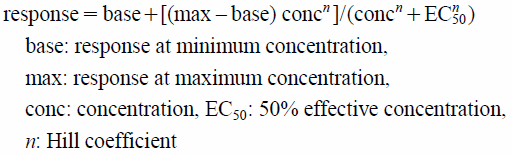
Cell-Based Assay for Evaluating Agonistic Activity of Drugs on μ-Opioid ReceptorsA cell-based assay was basically performed according to the protocol provided in the eXpress kit. As half-area-type 96-well microplates were used in this study, the amount of each reagent used was reduced by half. The outline of the protocol was as follows: CHO-K1 cells were thawed and seeded in a half-area 96-well white microplate and incubated for 20 h at 37 °C and 5% CO2. After complete aspiration of the culture medium, the assay buffer containing drug (0.0013–100 nM, 5-fold serial dilution) and forskolin (15 µM) was added to each well and incubated for 30 min at 37 °C and 5% CO2. Then, “cAMP antibody solution” and “working detection solution” were added, and the plate was stood for 1 h at room temperature. Finally, “cAMP solution A” was added, the plate was stood for 3 h at room temperature, and the luminescence response of each well was measured using a GloMax Navigator microplate luminometer (Promega Corp., Madison, WI, U.S.A.). Fifty percent effective concentration (EC50) of each compound was determined based on a four-parameter logistic regression. The formula used is as follows:
Each parameter (base, max, EC50, n) was determined using the Solver utility in the Excel® software (Microsoft Corp., Redmond, WA, U.S.A.).
Efficacy of each compound was calculated based on the following formula:
RESULTS
Figure 1 shows a dose–response curve for fentanyl. The luminescent responses for each concentration were well fitted with a sigmoid curve (calculated response). Table 2 shows the agonistic activity of the tested compounds on μ-opioid receptor. The EC50 of fentanyl was 0.35 nM, i.e., fentanyl was 31-fold more active than morphine, which had an EC50 of 11 nM. Based on the activity, nonfluorinated fentanyl analogs were ranked as follows: fentanyl (0.35 nM) > isobutyrylfentanyl (1.6 nM) ≈ butyrylfentanyl (2.0 nM) ≈ methoxyacetylfentanyl (2.6 nM) > acetylfentanyl (15 nM). The above tendency was also observed in each group of the fluorinated fentanyl analogs. On the other hand, without exception, 2-fluoro analogs showed the strongest activity among the compounds with the same N-acyl group, while 3-fluoro analogs exhibited the weakest activity. 2-Fluoro-fentanyl was the most active compound in this study, with an EC50 of 0.16 nM, whereas the activity of 3-fluoro-acetylfentanyl was the weakest at only approximately 1/320 of that of 2-fluoro-fentanyl.
Table 2. Agonistic Activity of Fentanyl and Its Analogs on μ-Opioid Receptor
| Compound | EC50a) (nM) | Efficacy a),b) (%) (Fentanyl = 100%) |
|---|
| Acetylfentanyl | 15 ± 1.2 | 103 ± 14 |
| 2-Fluoro-acetylfentanyl | 3.0 ± 0.51 | 105 ± 8.2 |
| 3-Fluoro-acetylfentanyl | 51 ± 20c) | NAd) |
| 4-Fluoro-acetylfentanyl | 19 ± 2.5 | 100 ± 8.7 |
| Fentanyl | 0.35 ± 0.051 | 100 |
| 2-Fluoro-fentanyl | 0.16 ± 0.015 | 97 ± 15 |
| 3-Fluoro-fentanyl | 2.0 ± 0.48 | 95 ± 6.5 |
| 4-Fluoro-fentanyl | 0.51 ± 0.049 | 103 ± 9.3 |
| Butyrylfentanyl | 2.0 ± 0.79 | 98 ± 7.5 |
| 2-Fluoro-butyrylfentanyl | 0.42 ± 0.16 | 90 ± 10 |
| 3-Fluoro-butyrylfentanyl | 2.8 ± 0.58 | 90 ± 4.2 |
| 4-Fluoro-butyrylfentanyl | 1.9 ± 0.48 | 93 ± 8.2 |
| Isobutyrylfentanyl | 1.6 ± 0.29 | 104 ± 10 |
| 2-Fluoro-isobutyrylfentanyl | 0.28 ± 0.13 | 93 ± 14 |
| 3-Fluoro-isobutyrylfentanyl | 3.7 ± 0.64 | 97 ± 9.5 |
| 4-Fluoro-isobutyrylfentanyl | 1.5 ± 0.23 | 94 ± 10 |
| Methoxyacetylfentanyl | 2.6 ± 0.24 | 100 ± 7.2 |
| 2-Fluoro-methoxyacetylfentanyl | 0.36 ± 0.014 | 103 ± 7.5 |
| 3-Fluoro-methoxyacetylfentanyl | 7.8 ± 3.0 | 98 ± 10 |
| 4-Fluoro-methoxyacetylfentanyl | 2.4 ± 0.36 | 96 ± 2.6 |
| Morphine | 11 ± 2.4 | 118 ± 16 |
a) Data are the average ± standard deviation (S.D.) from two independent experiments each performed in duplicates. b) Efficacy = [(base−max)target compound/(base−max)fentanyl] × 100. See Fig. 1. c) EC50 of 3-fluoro-acetylfentanyl was determined on the assumption that this compound was a full agonist (The “max” value of fentanyl was used in the calculation. See Fig. 1). d) Not available.
Table 2 also shows the efficacies of the tested compounds, which were used to determine whether the test compounds were full or partial agonists. Fentanyl was well known as a full agonist of μ-opioid receptor; thus, the efficacy of fentanyl was defined as 100%. Almost all compounds showed more than 90% efficacy, indicating that these compounds were considered to be full agonists.
DISCUSSION
To date, many reports have been published concerning the pharmacological effects of fentanyl and its analogs.6–8) However, to the best of our knowledge, detailed studies that compare the pharmacological effect of the positional isomers of fluorinated fentanyl have not been published. In this study, the agonistic activity of 20 fluorinated and nonfluorinated fentanyl analogs on human μ-opioid receptor was measured and the relationship between the type of the N-acyl group or the position of fluorine on N-phenyl ring and agonistic activity was investigated.
Recently, numerous tools are available for measuring agonistic activity of compounds on GPCRs.3) We used a cell-based assay system that helps to evaluate the agonistic activity of opioid by measuring intracellular cAMP levels, as the system was nonradioactive, simple, and robust. Based on the agonistic activity of each compound, N-acyl groups were ranked as follows: N-propionyl > N-isobutyryl ≈ N-butyryl ≈ N-methoxyacetyl > N-acetyl. According to a previous report, acetylfentanyl, butyrylfentanyl, and isobutyrylfentanyl were approximately 3.4-, 36-, and 43-fold less potent than fentanyl, respectively, in the acetic acid writhing tests in mice.8) In both our study and the above previous study,8) compounds with the N-propionyl group (fentanyl) showed the strongest activity; however, a difference was observed in the order of activity of the other compounds. Acetylfentanyl was the weakest compound in this study, whereas it showed a stronger activity than butyrylfentanyl and isobutyrylfentanyl in the above previous study.8) This difference was possibly due to the different types of evaluation methods used to test the agonistic activity, i.e., one was using the human µ-opioid receptor-expressing cells and the other was using an animal experimental model. Since the human in vivo data of the pharmacological activity of the compounds except for fentanyl have never been available, it is unclear which of above models better reflect the human in vivo responses to fentanyl analogs; however, it is possible that the assay system using the cells expressing human μ-opioid receptor better mimic human in vivo responses rather than animal model.
On the other hand, the positions of fluorination were ranked as follows: 2-fluorinated > nonfluorinated ≈4-fluorinated > 3-fluorinated. To the best of our knowledge, this is the first study that unprecedentedly compares the agonistic activity of the positional isomers of fluorinated fentanyl analogs. Opioids bind to the receptor and express their pharmacological effects by altering the steric structure. Recently, several studies concerning the binding state between opioid and opioid receptor have been published.9,10) According to the study of Lipiński et al., the N-phenyl ring of fentanyl may interact with the active site of μ-opioid receptor at Gln124, Thr218, and Tyr148.10) By introducing fluorine into the N-phenyl ring of fentanyl and its analogs, interactions such as hydrogen bonds between the active site amino acid residues and fluorine are formed. These interactions would affect the steric structure of μ-opioid receptors and may contribute to the agonistic activity of opioids.
CONCLUSION
This study revealed that the 2-fluorinated isomer of fentanyl analogs had a stronger activity than the other isomers, which indicates that the 2-fluorinated isomers of fentanyl analogs are more likely to cause poisoning. Our results will be useful for investigating the death caused by overdose of fentanyl analogs.
Acknowledgments
This work was supported by the Japan Society for the Promotion of Science (JSPS) KAKENHI Grant Number 19K10702.
Conflict of Interest
The authors declare no conflict of interest.
Supplementary Materials
The online version of this article contains supplementary materials.
REFERENCES
- 1) United Nations Office on Drugs and Crime. “World drug report 2019; 3 depressants.”: ‹https://wdr.unodc.org/wdr2019/prelaunch/WDR19_Booklet_3_DEPRESSANTS.pdf›, accessed 24 September, 2020.
- 2) United Nations Office on Drugs and Crime. “Fentanyl and its analogues—50 years on. Global Smart Update.”: ‹http://www.unodc.org/documents/scientific/Global_SMART_Update_17_web.pdf›, accessed 24 September, 2020.
- 3) Zhang R, Xie X. Tools for GPCR drug discovery. Acta Pharmacol. Sin., 33, 372–384 (2012).
- 4) Siegfried. “Synthesis of fentanyl.”: ‹https://erowid.org/archive/rhodium/chemistry/fentanyl.html›, accessed 24 September, 2020.
- 5) Golla R, Seethala R. A homogeneous enzyme fragment complementation cyclic AMP screen for GPCR agonists. J. Biomol. Screen., 7, 515–525 (2002).
- 6) Vardanyan RS, Hruby VJ. Fentanyl-related compounds and derivatives: current status and future prospects for pharmaceutical applications. Future Med. Chem., 6, 385–412 (2014).
- 7) Vucković S, Prostran M, Ivanović M, Dosen-Mićović Lj, Todorović Z, Nesić Z, Stojanović R, Divac N, Miković Z. Fentanyl analogs: structure–activity-relationship study. Curr. Med. Chem., 16, 2468–2474 (2009).
- 8) Higashikawa Y, Suzuki S. Studies on 1-(2-phenethyl)-4-(N-propionylanilino)piperidine (fentanyl) and its related compounds. VI. Structure-analgesic activity relationship for fentanyl, methyl-substituted fentanyls and other analogues. Forensic Toxicol., 26, 1–5 (2008).
- 9) Manglik A. Molecular basis of opioid action: from structures to new leads. Biol. Psychiatry, 87, 6–14 (2020).
- 10) Lipiński PFJ, Jarończyk M, Dobrowolski JC, Sadlej J. Molecular dynamics of fentanyl bound to μ-opioid receptor. J. Mol. Model., 25, 144 (2019).