Abstract
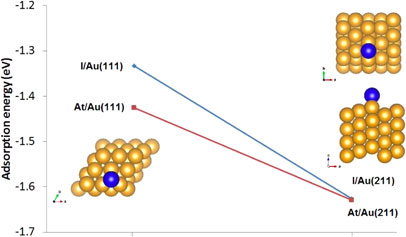
We have performed first principles calculation study based on density functional theory on the adsorption of iodine and astatine on Au(111) and Au(211), including spin-orbit coupling (SOC) effects in some calculations. These surfaces are the dominant surface termination to represent a face-centered cubic nanoparticle. We found that both iodine and astatine adsorb stronger on the edge-bridge site of the Au(211) surface than on the flat Au(111) surface by about 0.2 eV. This result also makes the adsorbate less likely to diffuse after adsorption on the (211) surface as compared to the (111) surface. Additionally, we found that SOC effects, usually a necessity when considering heavy elements, are not significant in these cases, as can be seen by the energy and geometric data. Finally, we found the difference in adsorption energy between iodine and astatine on gold surface can be expected due to the presence of 4f electrons in astatine, which is not present in iodine. The 4f electrons offer less shielding of the nucleus, making the valence electrons of astatine closer to the nucleus, and therefore a smaller atomic radius. This information is useful both for experimental verification and future developments of gold nanoparticles for radiotherapy.