HORT NEW FOCUS: EPIGENETICS UNVEILED: REVIEWS
Recent Advances in the Epigenetics of Ornamental Flowers

2026 Volume 95 Issue 4 Pages 523-532

Details
2026 Volume 95 Issue 4 Pages 523-532
Epigenetics is becoming increasingly pivotal not only in model plant species, but also in agricultural crop species. The foundational study in ornamental plant epigenetics was the discovery of co-suppression in petunia, where overexpression of the chalcone synthase A gene in pigmented petals resulted in white petals and/or patterned flowers with white or non-clonal sectors. Recent studies have revealed that epigenetic mechanisms are involved in important agricultural characteristics, including those of ornamental flowers. This review provides an overview of epigenetic studies on flower color, floral morphogenesis, flowering, vernalization, and somaclonal variation in representative ornamental species, including petunia, morning glory, chrysanthemum, rose and African violet. We also discuss techniques for artificially inducing epigenetic modifications as well as methodological considerations. Recently, whole genome sequencing or chromosome-level sequencing has been conducted in ornamental flowers. Utilizing these genomic sequences will further facilitate epigenetic analyses, and epigenetic research in ornamental flowers is expected to expand substantially in the future. Translating advancements from model plants to ornamental flowers will be crucial for generating novel variations and ensuring uniform production, thereby enhancing commercial value.
The importance of epigenetics has been increasingly recognized not only in model plant species, but also in agricultural crops. Several studies have demonstrated that epigenetic mechanisms underlie important agricultural traits such as somaclonal variation in African oil palm (Elaeis guineensis) (Ong-Abdullah et al., 2015), the Colorless non-ripening (Cnr) locus in tomato (Solanum lycopersicum) (Manning et al., 2006) and anthocyanin pigmentation in apple (Malus domestica) (Jiang et al., 2020). In ornamental flowers, floral symmetry in toadflax (Linaria vulgaris) is known to be controlled by epigenetic mechanisms (Cubas et al., 1999). In addition, among variable characteristics in ornamental flowers, phenomena such as unstable pigmentation in flowers, bracts of the same plant and clonally propagated plants have been observed (Jorgensen, 1995; Ohno et al., 2016, 2021; Okuda et al., 2026). These phenomena cannot be explained by genetic mutations and therefore suggest the involvement of epigenetic mechanisms (Ohno, 2025).
Epigenetics is defined as the mechanism through which gene expression can be altered without changes in the DNA sequence and includes DNA methylation and histone modifications. DNA methylation is the addition of a methyl group to a cytosine residue and is classified as CG, CHG and CHH methylation (H represents A, T, or C). Histone modifications are post-translational modifications of histone proteins that regulate gene expression by altering DNA accessibility. Several different types of modifications such as methylation and acetylation have been discovered. For example, histone H3 lysine 4 (H3K4) and H3K36 methylation are generally recognized as active marks, whereas H3K9 and H3K27 methylation are recognized as repressive marks (for details, please see Nishimura et al., 2026).
Epigenetics is involved in various plant responses, but analytical techniques have been limited. Until recently, techniques were largely restricted to methods such as methylation-sensitive amplified polymorphism (MSAP) (Reyna-López et al., 1997; Fulneček and Kovařík, 2014) and McrBC-PCR using the McrBC restriction enzyme (Rabinowicz et al., 2003). However, with the advent of next-generation sequencing and genome editing technologies, detailed analyses such as bisulfite sequencing (bisulfite-seq) (Cokus et al., 2008), chromatin immunoprecipitation sequencing (ChIP-seq) (Kaufmann et al., 2010) and the deactivated Cas9–TET1 demethylase (dCas9-TET1) system (Choudhury et al., 2016) have become possible, and many studies are being conducted not only on vegetables and fruit trees, but also on ornamental flowers. This review provides an overview of epigenetic studies on flower color, floral morphogenesis, flowering, vernalization, and somaclonal variation in ornamental flowers, in addition to techniques for artificially inducing epigenetic modifications and technical considerations for DNA methylation analysis.
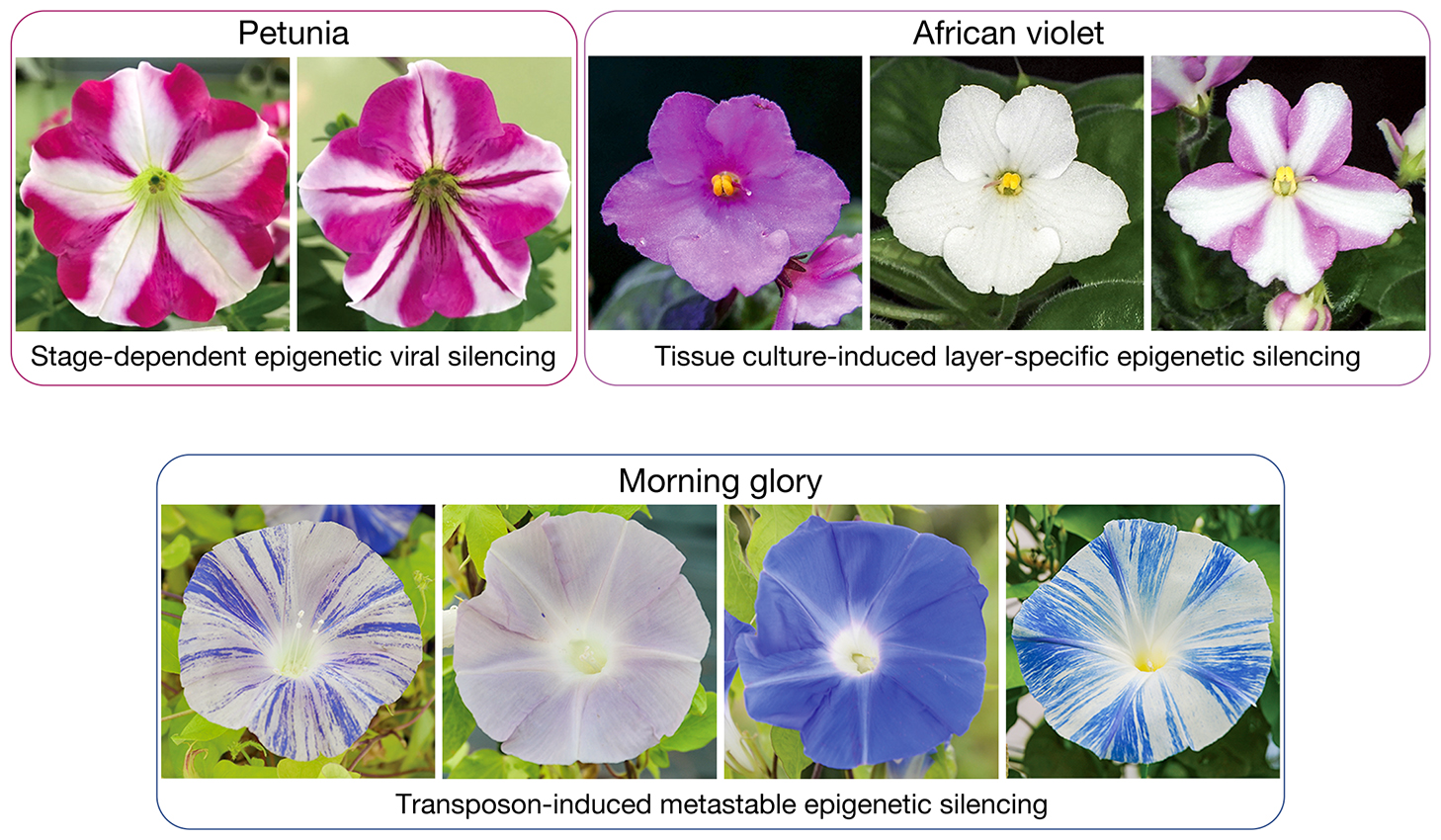
Flower color is one of the most important traits in ornamental flowers. Not only genetic mutations, but also epigenetic regulation, contributes to the diversity of flower color (Fig. 1). The foundational study in ornamental plant epigenetics was in petunia, where overexpression of the chalcone synthase A (CHS-A) gene in pigmented petals resulted in white petals and/or patterned flowers with white or non-clonal sectors (Napoli et al., 1990). This phenomenon is known as “co-suppression”, in which transgenes often induce turnover of homologous endogenous transcripts, and the erratic and reversible nature of this phenomenon suggested the possible involvement of DNA methylation. Interestingly, a co-suppression petunia line produced pure white flowers and, over time and generations, yielded a wide variety of different flower color patterns. Jorgensen (1995) interpreted this metastability of the co-suppressed plants as indicating that shoot meristems can exist in two physiological states, and that the epigenetic state producing the predominantly pigmented pattern is labile in one meristematic state and stable in the other. Later, the involvement of small interfering RNA (siRNA) in co-suppression of petunia was elucidated (De Paoli et al., 2009). Small RNAs induce not only post-transcriptional gene silencing (PTGS) via cleavage of transcripts, but also transcriptional gene silencing (TGS) via DNA methylation, which is referred to as RNA-dependent DNA methylation (RdDM) (Sijen et al., 2001). The most abundant small RNAs were 21-nt and 24-nt in co-suppression petunia flowers (De Paoli et al., 2009). In general, 21-nt small RNAs are involved in PTGS, while 24-nt small RNAs are involved in TGS (Vaucheret and Voinnet, 2024). Therefore, this phenomenon can be interpreted as follows: overexpression of CHS-A induced co-suppression, producing siRNAs that subsequently caused PTGS and TGS, thereby inhibiting anthocyanin biosynthesis resulting in the white sectors in flowers.
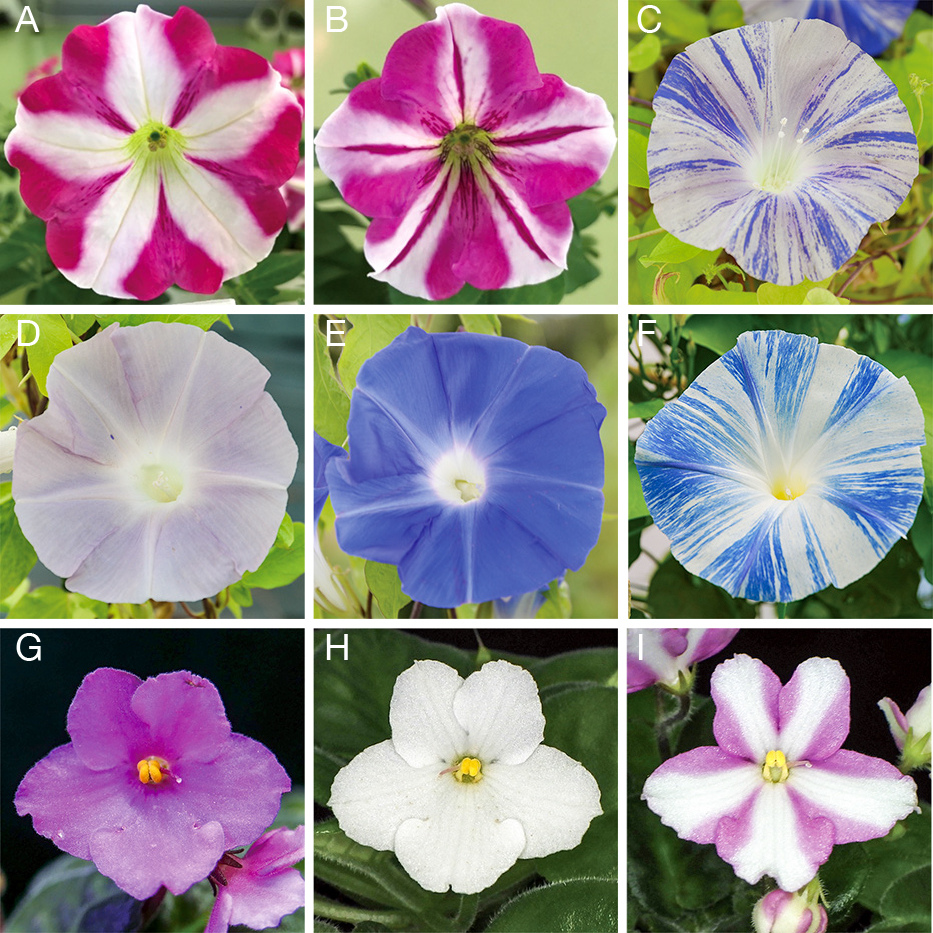
Epigenetic regulation of flower coloration. (A–B) In petunia, floral patterns are generated by post-transcriptional gene silencing (PTGS)-mediated repression of chalcone synthase (CHS) genes (A). In aged plants (B), an endogenous pararetrovirus becomes hypomethylated and activated, leading to the production of a silencing suppressor that inhibits PTGS. (A and B: Courtesy of Dr. Toshiyuki Fukuhara). (C–E) Phenotypes of an Ipomoea nil mutant carrying a transposon insertion in the promoter of the UDP-glucose:flavonoid 3-O-glucosyltransferase gene. Even in the absence of transposition, flowers exhibit variegation (ruled or sectored) (C), pale pigmentation (D), or intense pigmentation similar to the wild type (E). (F) An I. tricolor mutant with a transposon insertion in the promoter of the dihydroflavonol 4-reductase gene. Variegation is observed without excision of the transposon. (G–I) Somaclonal variation in African violet results in intensely pigmented flowers (G), white flowers (H), and striped flowers (I). (G–I: Courtesy of Dr. Munetaka Hosokawa).
Kuriyama et al. (2020) reported that DNA methylation is involved in blotched flowers and a vein-clearing symptom in aged petunia, via activation and inactivation of an endogenous pararetrovirus, the petunia vein clearing virus (PVCV). As the host plants aged, the PVCV region became hypomethylated and PVCV was activated (Fig. 1A–B). Since PVCV likely possesses a silencing suppressor, accumulation of PVCV transcripts resulted in blotched pigmentation due to inhibition of CHS gene PTGS.
In petunia, the flower color regulation described above is associated with the suppression of transgenes or endogenous genes mediated by RNA silencing. In contrast, in morning glory, epigenetic regulation is frequently observed in the context of transposon activity. Variegated flower patterns in Japanese morning glory (Ipomoea nil) have been genetically analyzed for more than a century, and many of them are caused by transposon insertions (Iida et al., 2004; Morita and Hoshino, 2018). Insertion of a transposon into a gene involved in anthocyanin biosynthesis can lead to somatic excision events that generate revertant sectors, resulting in chimeric variegation. In contrast, insertion of a transposon into the promoter of the UDP-glucose:flavonoid 3-O-glucosyltransferase (UF3GT) gene causes variegation known as “ruled”, which occurs independently of transposon excision and is therefore considered to be under epigenetic regulation (Fig. 1C–E) (Morita et al., 2015; Morita and Hoshino, 2018). In 1935, Y. Imai described the ruled variegation as follows: “It seems that the variable expression of variegation on the flowers of a given ruled individual is effected by the plasm under the control of the genes carried by the stock, generally without any changes in the genes themselves. The changed plasm is distributed in the sporophyte through cell-division, exhibiting mosaic flowers with different degrees of variegation”. (Imai, 1935). This concept of a heritable “plasm” transmitted through cell division without changes in the genes themselves closely parallels the modern notion of epigenetic regulation. Remarkably, Imai anticipated epigenetic phenomena nearly a decade before Waddington coined the term “epigenetics” in 1942 (Waddington, 1942).
In the related species I. tricolor, a mutation caused by the insertion of a transposon into the promoter of the dihydroflavonol 4-reductase (DFR) gene also resulted in epigenetic regulation of DFR expression, leading to variegation independently of transposon excision (Fig. 1F) (Iida et al., 2004). A similar phenomenon is also known in maize, where a Robertson’s Mutator element inserted in the promoter of the high chlorophyll fluorescence 106 (hcf106) gene can epigenetically modulate the transcription of this neighboring gene without transposition, giving rise to striped leaves (Martienssen et al., 1990). Such modulation is closely correlated with DNA modification, most likely cytosine methylation, within the Mutator element itself, which is associated with the epigenetic silencing of hcf106 expression. Further studies are expected to elucidate the molecular mechanisms underlying such epigenetically regulated variegated patterns in morning glory.
Besides RNA silencing and transposon activity, DNA methylation of transcription factor promoters has been identified as another mechanism regulating flower color. Tang et al. (2022) reported that flower color difference between a yellow-flower and a pink-flower line both propagated vegetatively from the same cultivar is due to the difference in anthocyanin content in chrysanthemum (Chrysanthemum morifolium). The CHH methylation status of the promoter region of C. morifolium MYB6 (CmMYB6), encoding a MYB transcription factor, contributes to the difference in anthocyanin content. The dCas9-TET1 system confirmed the importance of DNA methylation in CmMYB6. The dCas9-TET1 system is a programmable CRISPR-Cas9 based demethylase tool containing deactivated Cas9 (dCas9) fused to the catalytic domain (CD) of Ten-Eleven Translocation (TET) dioxygenase 1 (Choudhury et al., 2016), and this technique enables targeted DNA demethylation of specific genomic regions. CHH methylation is maintained by DRM2 (DOMAINS REARRANGED METHYLTRANSFERASE 2) or CMT2 (CHROMOMETHYLASE 2), depending on the genomic region in Arabidopsis thaliana (Stroud et al., 2014). Li et al. (2025) reported that CmDRM2a was associated with increased DNA methylation of the CmMYB6 promoter, leading to lower expression of CmMYB6 and resulting in a lighter flower color. In contrast, CmDRM2b and CmCMT2 enhanced the DNA methylation level of the CmMYB6 promoter, resulting in higher expression of CmMYB6 and a deeper flower color. CmDRM2a methylated four out of six regions of the CmMYB6 promoter, while CmDRM2b/CmCMT2 methylated all six regions of the CmMYB6 promoter; therefore, the authors hypothesized that this difference in effect on CmMYB6 expression was due to a functional difference between CmDRM2a and CmDRM2b/CmCMT2. This functional diversification is likely associated with gene duplication events common in domesticated crops (Panchy et al., 2016). Thus, gene function in horticultural plants also can differ from that in model plants, partly due to increased gene copy number, highlighting the importance of studying epigenetic regulation directly in ornamental flowers.
In addition to flower color, floral morphogenesis is another crucial trait determining the ornamental value of flowers. Epigenetic regulation has been shown to be involved in defining floral architecture, particularly in floral symmetry and organ identity.
CYCLOIDEA is one of the important genes for dorsoventral asymmetry in snapdragon (Antirrhinum majus) flowers (Luo et al., 1996). In Asteraceae species such as sunflower (Helianthus annuus) and gerbera (Gerbera hybrida), CYCLOIDEA 2 plays an important role in the differentiation and development of two types of florets, ray and tubular florets (Broholm et al., 2008; Fambrini et al., 2011; Chapman et al., 2012). Cubas et al. (1999) reported that a naturally occurring epimutation affecting the cycloidea (Lcyc) gene of toadflax, closely related to snapdragon, is due to transcriptional silencing by DNA methylation resulting in loss of floral asymmetry. The epimutant lost asymmetry and had a peloric phenotype in flowers; however, interestingly, the peloric mutant showed somatic instability, producing some flowers with semipeloric or near wild-type phenotypes. This epimutation is associated with DNA methylation extending from the promoter into the downstream coding region of Lcyc. These various degrees of somatic reversion seem to reflect the instability of DNA methylation. The DNA methylation at this locus was stably transmitted from generation to generation, indicating that this phenomenon is an epimutation.
Currently, flower organ formation is explained by the ABCE model (reviewed by Kanno, 2016). In this model, floral organ identity is specified mainly by combinations of MADS-box transcription factors belonging to the A-, B-, C-, and E-function groups, although APETALA2 (AP2) represents an exceptional non–MADS-box component historically associated with the A-function. Ma et al. (2015) reported that low temperature led to an increase in petal number via increased production of petaloid stamens in rose (Rosa hybrida). In that study, expression of the rose C-class MADS-box gene R. hybrida AGAMOUS (RhAG) was reduced under low temperature conditions. Low temperature conditions enhanced CHH methylation in the promoter region of the RhAG gene, indicating that low temperature increases petal number via epigenetic regulation.
Epigenetic mechanisms also play an important role in the flowering process in chrysanthemum. Xue et al. (2025) reported that C. morifolium FLOWERING LOCUS D a (CmFDa) inhibits flowering by cooperating with POLYCOMB REPRESSIVE COMPLEX 2 (PRC2), which mediates the deposition of H3K27me3, to regulate the expression of floral promoter genes such as C. morifolium SUPPRESSOR OF OVEREXPRESSION OF CONSTANS1 a (CmSOC1a) and C. morifolium APETALA1 a (CmAP1a) in C. morifolium. Higher expression of CmFDa in the late flowering mutant is associated with low DNA methylation in the CmFDa promoter (Fig. 2A).

Epigenetic regulation of flowering in chrysanthemum. (A) Demethylation of the Chrysanthemum morifolium FDa promoter upregulates FDa expression. Increased FDa recruits the PRC2 complex to the SOC1a and AP1a promoters, leading to the deposition of H3K27me3. This repressive mark suppresses SOC1a and AP1a expression, ultimately delaying flowering. (B) In juvenile plants of C. indicum, NF-YB8 activates MIR156ab expression. As plants age, reduced NF-YB8 expression promotes the formation of an NF–LDL1 heterotrimer, which decreases H3K4me2 levels at the MIR156ab locus and establishes stable epigenetic silencing.
Gao et al. (2025) reported that LYSINE-SPECIFIC DEMETHYLASE 1-LIKE 1 (LDL1) forms a heterotrimer with CiNF-YA3 and CiNF-YC1 and reduces H3K4me2 levels at the MIR156ab locus (a, b represent two precursor hairpins with a specific genomic arrangement in C. indicum), causing its temporal silencing during aging in C. indicum (Fig. 2B). In Arabidopsis, microRNA miR156 functions as a key component of the flowering aging pathway, and a decrease in miR156 levels over time results in the accumulation of the transcripts for its target, SQUAMOSA PROMOTER BINDING PROTEIN-LIKE (SPL) genes, which promote the juvenile-to-adult transition and flowering (Wang et al., 2009a). LDL1 is a histone demethylase that is involved in H3K4 methylation in target gene chromatin (Jiang et al., 2007). These reports indicate that the principal components are conserved and have similar functions in both Arabidopsis and chrysanthemum.
Epigenetic mechanisms are also important in vernalization. FLOWERING LOCUS C (FLC) represses the expression of FLOWERING LOCUS T (FT), SUPPRESSOR OF OVEREXPRESSION OF CONSTANS1 (SOC1)/AGAMOUS-LIKE 20 (AGL20) and FD under ambient temperature in Arabidopsis (Lee et al., 2000; Helliwell et al., 2006; Searle et al., 2006). When plants are exposed to cold temperatures, FLC expression is decreased due to H3K27me3 accumulation (Sung et al., 2006). Lack of maintenance of H3K27me3 marks after vernalization in Arabis alpina PERPETUAL FLOWERING 1, an orthologue of A. thaliana FLC, is one of the key factors for perenniality (Wang et al., 2009b).
Sweet peas (Lathyrus odoratus) and statice (Limonium sinuatum) also show a vernalization response. Sweet peas are seed-vernalized plants and respond to low temperatures from the germinating seed stage. Statice is also a seed-vernalized plant, and when exposed to low temperatures followed by high temperatures, it shows a devernalization response that counteracts the effects of low temperatures (Azuma et al., 1983). Interestingly, not only exposure to high temperature, but also repeated subculture during in vitro multiplication after low temperature treatment, decreased the bolting percentage (Miyama et al., 1998). These results imply that repeated subculture may have an effect similar to devernalization. Although the genome sequences of these species have not yet been determined, obtaining the genome sequence and subsequent epigenetic analysis will elucidate the molecular mechanisms of the vernalization response and lead to the development of cultivation applications.
As described in the previous section, environmental stresses during tissue culture can alter epigenetic states, as seen in the devernalization of statice (Miyama et al., 1998). Tissue culture is an important technique for mass propagation of ornamental plants, but somaclonal variation could be an obstacle to uniform production. Not only genetic mutations, but also epigenetic changes during the cell differentiation process, are involved in somaclonal variation (reviewed by Miguel and Marum, 2011; Bednarek and Orłowska, 2020). In rose, Gentiana pannonica and freesia (Freesia hybrida), in vitro cellular differentiation or micropropagation affected DNA methylation status (Xu et al., 2004; Fiuk et al., 2010; Gao et al., 2010). A representative example of epigenetic somaclonal variation—although not from an ornamental plant—is the mantled phenotype in African oil palm. This phenotype arises from DNA hypomethylation at the MANTLED locus, where a LINE retrotransposon inserted in the intron of the homeotic gene DEFICIENS, a B-class MADS-box gene, becomes demethylated, and thereby generates the KARMA epiallele responsible for abnormal flower and fruit formation (Ong-Abdullah et al., 2015). This study serves as a key model for ornamental flowers, demonstrating that tissue culture can induce epigenetic abnormalities in genes regulating floral traits. This finding provides important insights into the mechanisms of floral somaclonal variations, suggesting that epigenetic regulation could be a common factor underlying both undesirable “off-types” and valuable homeotic transformations resembling double flowers.
Such variation is particularly relevant to African violet (Saintpaulia ionantha), which has the ability to regenerate from any part of the plant; therefore, tissue culture is used for mass propagation. Somatic variations due to genetic changes were also reported in African violet. For example, ‘Thamires’ has pink petals with blue splotches, but after tissue culture, plants with solid-blue and solid-pink flowers have been observed. Tissue culture of ‘Thamires’ elicits transposon excision, resulting in altered F3′5′H expression levels and flower colors (Sato et al., 2011). In this case, the involvement of plant growth regulators in the occurrence of somatic variation was suggested (Matsuda et al., 2014). In addition to genetic mutations, Kurata et al. (2025) reported the involvement of DNA methylation in petal color variation among tissue cultured plants in the African violet ‘Kilauea’, which has white-striped petals with blue spots on a pink background at the margins. After tissue culture, not only plants with the original flower color, but also plants with solid pink flowers or solid white flowers, were observed. The difference in flower color is due to anthocyanin accumulation, and expression of the R2R3-MYB transcription factor gene SiMYB2 was responsible for the anthocyanin accumulation. DNA methylation in the exon 2 region of SiMYB2 induces transcriptional selectivity, generating a truncated transcript (SiMYB2-Short). This transcript encodes a protein that lacks the R2R3 DNA-binding domain, thereby losing the ability to activate anthocyanin biosynthetic genes. When SiMYB2 is unmethylated in the shoot apical meristem (SAM), the flower becomes pigmented (Fig. 1G). When SiMYB2 is methylated throughout all SAM layers, the flower becomes white (Fig. 1H). When SiMYB2 is methylated only in the L2 layer and below (subepidermal layers), the flower becomes striped (Fig. 1I). Therefore, layer-specific differences in DNA methylation of SiMYB2 appear to influence flower color among tissue cultured plants.
Methodologies for artificially inducing epigenetic modifications range from broad-spectrum chemical inhibitors to precise, sequence-specific targeting using molecular biological tools. For a long time, chemical compounds such as 5-azacytidine and zebularine have been used to artificially alter DNA methylation. These compounds inhibit DNA methylation through inhibition of DNA methyltransferase (Jones and Taylor, 1980; Zhou et al., 2002). In addition to these chemical compounds, molecular biological technologies can also be used to modify the epigenetic state.
In ornamental flowers, chemical DNA demethylation has been shown to affect flower-related traits. In Japanese morning glory, application of 5-azacytidine and zebularine to the shoot apex induced flowering even under non-inductive photoperiod conditions, indicating that DNA demethylation can transiently override environmental control of flowering (Iwase et al., 2010). Under plant tissue culture conditions, application of 5-azacytidine induced somaclonal variation affecting flowering time and floral morphology in chrysanthemum, with genotype- and cultivar-dependent responses (Kang et al., 2019a, b). Furthermore, in anemone species (Anemone coronaria and A. biflora), pre-treatment of tubers with 5-azacytidine was reported to promote flowering (Yari et al., 2021). Notably, these studies focused on phenotypic outcomes, and the relationship between DNA demethylation and the observed phenotypic changes remains unclear.
Transcriptional repression via epigenetic modification can be induced by the RdDM pathway. In this pathway, small RNAs (mainly 24 nt) induce DNA methylation and histone modification (Molnar et al., 2010). Based on this mechanism, heritable gene silencing via DNA methylation and histone modification could be induced by small RNA induction using a Cucumber Mosaic virus-based vector (Kanazawa et al., 2011). In that study, transcriptional repression of CHS-A in petunia was inherited, and histone modification (H3K9me2) and partial DNA methylation in the promoter region of CHS-A were detected in the progenies.
Another interesting method is grafting. Expression of double-stranded RNA corresponding to the promoter region of a gene induced TGS, and when these TGS-inducing plants were grafted, TGS was transmitted to the grafted partner. This induced TGS was maintained after regeneration through tissue culture (Bai et al., 2011).
As described above, CRISPR-based tools have also enabled artificial manipulation of epigenetic states in chrysanthemum (Tang et al., 2022). In addition to TET1-mediated demethylation, targeted DNA methylation has been demonstrated in model plants, as reviewed by Nishimura et al. (2026). For example, the catalytic domain of Nicotiana tabacum DRM methyltransferase has been recruited to specific genomic loci to induce de novo CHG methylation (Papikian et al., 2019), and a bacterial CG-specific methyltransferase (M.SssI/MQ1) has been recruited to specific genomic loci in plants. Specifically, Liu et al. (2021) utilized zinc finger proteins to recruit SssI, whereas Ghoshal et al. (2021) employed a CRISPR-Cas9 system with an engineered MQ1 variant to improve specificity. These studies demonstrate that diverse epigenetic enzymes can be manipulated in a locus-specific manner and suggest that epigenome-editing approaches—encompassing targeted DNA methylation, demethylation, and eventually histone modifications—will become applicable to ornamental species in the near future.
Accurate analysis of DNA methylation is essential for epigenetic studies in ornamental plants. Among the available approaches, bisulfite sequencing is widely used to determine cytosine methylation levels, in which unmethylated cytosines are converted to uracil (read as thymine after PCR), whereas methylated cytosines remain unchanged. This principle was first established by Frommer et al. (1992) and subsequently improved in terms of sensitivity (Clark et al., 1994) and reaction conditions (Olek et al., 1996; Shiraishi and Hayatsu, 2004). When designing primers for bisulfite-converted DNA, it is important to consider these base conversions to avoid PCR bias, a technical issue that has been overlooked in some previous studies. In practice, primers should incorporate degenerate bases at potential conversion sites: cytosines on the top strand should be coded as Y (C/T), and guanines on the bottom strand as R (G/A). To facilitate such design, several online tools are available. For example, MethPrimer (Li and Dahiya, 2002; https://methprimer.com) and Kismeth (Gruntman et al., 2008; https://katahdin.girihlet.com/kismeth/revpage.pl) provide user-friendly web platforms for designing primers adapted to bisulfite-treated DNA, and using such resources is recommended to ensure reliable experimental outcomes.
Recently, whole genome sequencing or chromosome-level sequencing has been conducted in ornamental flowers including carnation (Dianthus caryophyllus), Japanese morning glory, petunia, chrysanthemum (C. seticuspe and C. morifolium) and Chinese rose (Rosa chinensis) (Yagi et al., 2014; Bombarely et al., 2016; Hoshino et al., 2016; Raymond et al., 2018; Hirakawa et al., 2019; Nakano et al., 2021; Song et al., 2023). Using these genomic sequences will further facilitate epigenetic analyses, and epigenetic research in ornamental flowers is expected to expand substantially in the future. Genomic and epigenetic analyses of many ornamental plants are challenging due to characteristics such as high polyploidy, self-incompatibility, and extensive heterogeneity resulting from vegetative propagation. However, with the development of new technologies such as long-read sequencing, these issues are likely to be progressively resolved.
In morning glory, insertion of endogenous transposons into the promoter regions of flower color genes results in variegated pigmentation patterns in flowers (Iida et al., 2004; Morita et al., 2015; Morita and Hoshino, 2018). This raises the possibility that similar floral patterns could be generated in other ornamental flowers by exploiting endogenous transposons. Studies in model plants have revealed that transposons are closely regulated by epigenetic mechanisms, and release of such epigenetic repression can activate transposon mobility (Lisch, 2009; Mirouze and Vitte, 2014). Manipulating epigenetic regulation of endogenous transposons may therefore provide a novel strategy not only for generating epigenetic variegation, but also for creating new phenotypic diversity in ornamental breeding. Recent work in Arabidopsis has shown that transposons can be hotspots of recurrent hypomethylation, generating heritable epigenetic variants (epialleles) that impact neighboring gene expression and heritable phenotypic variation (Baduel et al., 2025). Such findings highlight the relevance of transposon-related epigenetic variation in plants and provide conceptual frameworks that may inform similar investigations in ornamental flowers.
Even though many epigenetic studies on ornamental flowers have been published recently, many curious and important phenomena remain unclarified such as unstable pigmentation in flowers, non-uniform flowering, and occurrence of somaclonal variations. These traits are assumed to be influenced by environmental factors, and as climate change becomes more severe, it will become increasingly important to clarify the relationship between epigenetic traits and environmental factors. Advances in epigenetics in ornamental flowers are expected to contribute to uniform production and enhanced commercial value.


