抄録
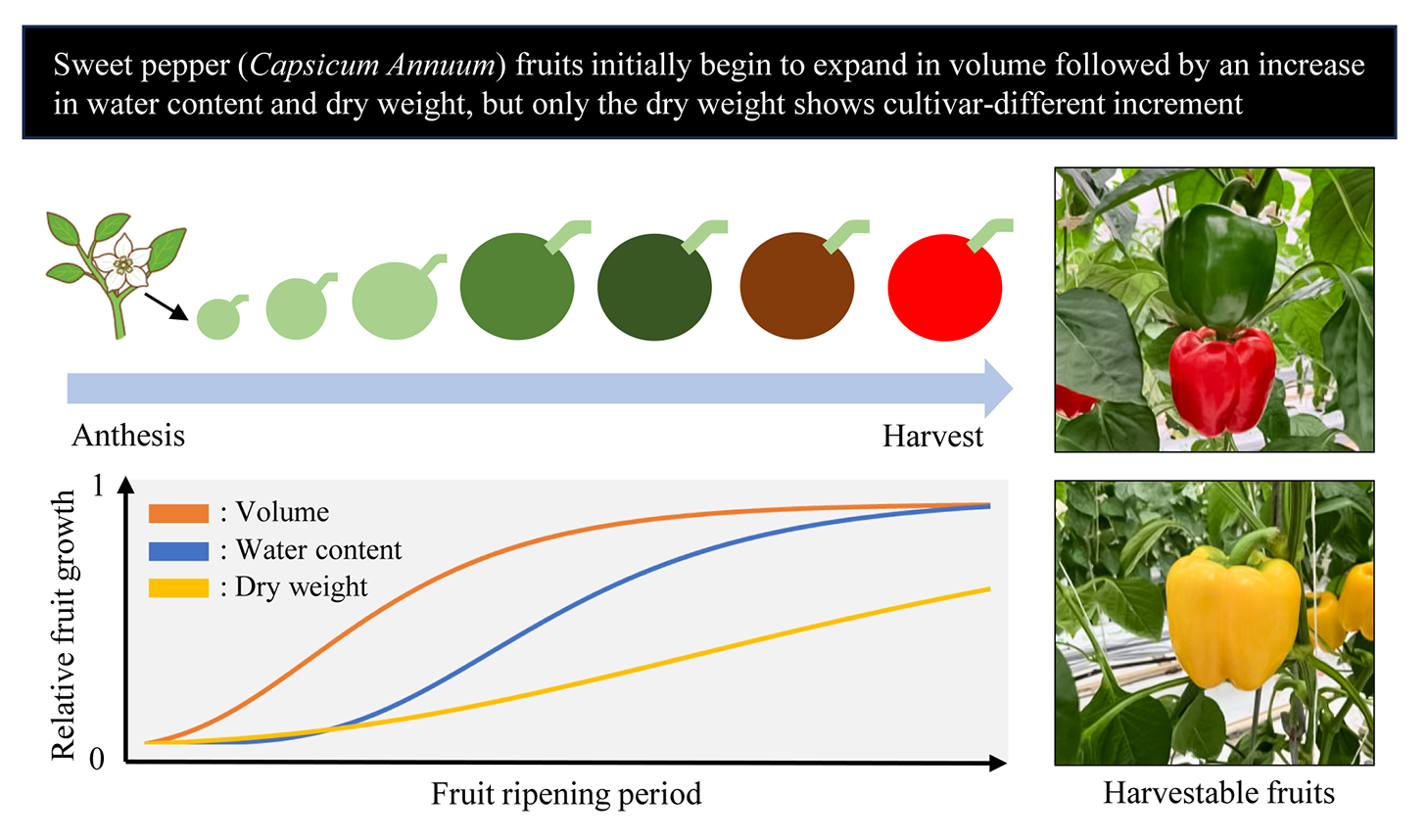
Understanding fruit growth and thermal requirements from anthesis to ripening can provide insights into the developmental process and productivity of whole plants. Fruit growth in sweet peppers (Capsicum annuum) can be estimated using sigmoid functions. The present study aimed to clarify the growth patterns of sweet pepper fruit using these functions. In a greenhouse, we hydroponically grew 10 sweet pepper cultivars that have a wide range of fruit dry matter content. Fruits at different growth stages were destructively sampled and measured for their length, width, dry and fresh weights, as well as dry matter content. Using the data, fruit growth curves in terms of length, width, water content, dry weight, and dry matter content were modeled using the Gompertz function. Results showed that fruit volume (i.e., fruit length and width), fruit water content, and fruit dry weight rapidly increased from 200–600, 400–800, and 600–1,200°C·d days after anthesis (DAA), respectively, in all the cultivar types. However, the increase in fruit dry weight from 600–1,200°C·d DAA differed among the cultivar types. Fruit dry matter content decreased to 0.04–0.05 g·g−1 until about 600°C·d DAA regardless of the cultivar types, and thereafter it increased from 600–1,200°C·d DAA for the cultivars with high dry weight increase, but it barely increased for the cultivars with low dry weight increase. In conclusion, sweet pepper fruit initially began to expand in volume, followed by an increase in water content and dry weight. However, the increase in the fruit dry weight from 600–1,200°C·d DAA showed differences among the cultivar types, and this trait determined the cultivar-specific fruit dry matter content at harvest. The cultivar-specific dry matter increase affects the fruit load; therefore, it is probably related to the number of harvestable fruits (i.e., fresh yield) and plant exhaustion during production. The results of this study are expected to enable more precise growth prediction and plant management.