Abstract
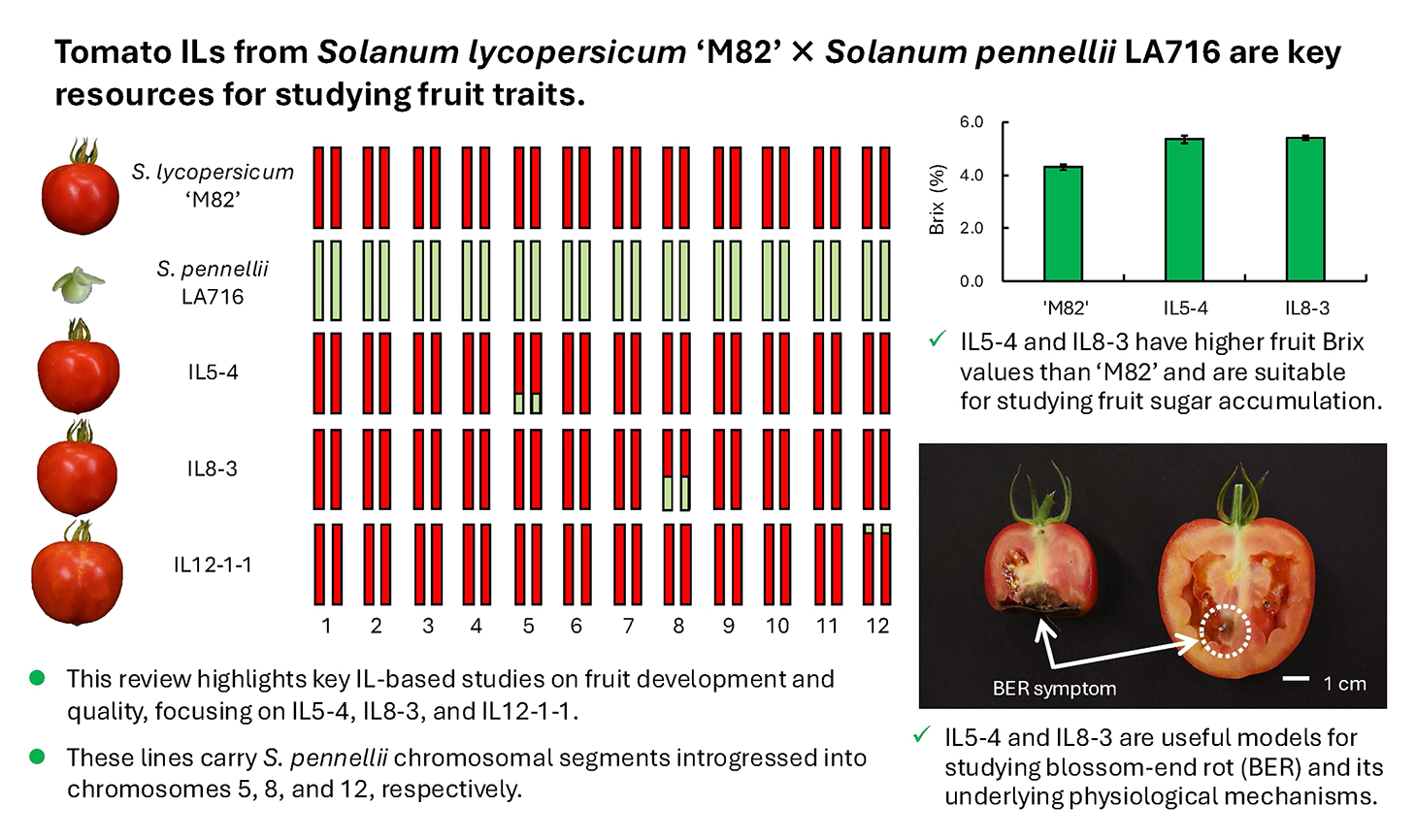
Tomatoes, Solanum lycopersicum, are globally important crops, valued for their nutritional, economic, and scientific importance. However, domestication has narrowed their genetic diversity, limiting advancements in key traits, such as yield, quality, and stress resistance. Their wild relatives, such as Solanum pennellii, are vital genetic resources, harboring traits for enhanced fruit size, sugar accumulation, and stress tolerance. S. pennellii-derived introgression lines (ILs), developed by crossing the S. lycopersicum cultivar ‘M82’ with S. pennellii accession LA716, have been instrumental in dissecting complex traits controlled by quantitative trait loci (QTLs). This review highlights key IL-based studies on fruit development and quality, focusing on IL5-4, IL8-3, and IL12-1-1. IL5-4, harboring a chromosomal segment from S. pennellii when introgressed into chromosome 5 of S. lycopersicum, exhibits elevated Brix values because of enhanced vegetative biomass. IL8-3, which carries a chromosomal segment from S. pennellii when introgressed into chromosome 8 of S. lycopersicum, also demonstrates high Brix values, which is linked to the increased expression of cell wall invertase and sucrose synthase during fruit ripening. Additionally, IL5-4 and IL8-3 differ from ‘M82’ in their susceptibility to blossom-end rot (BER), a serious physiological disorder in tomatoes, making them valuable resources for investigating the mechanisms underlying the incidence of BER. IL12-1-1, a derivative of IL12-1, produces substantially larger fruits with higher mean weights and sizes, attributed to the increased cell division and elevated levels of auxin and cytokinin during early development. Candidate genes, including Solyc12g005250 and Solyc12g005310, within the chromosomal region of S. pennellii in IL12-1-1, have been proposed to contribute to these traits. In recent years, the use of advanced methods, such as genome-wide association studies (GWASs), has facilitated QTL identification. However, GWASs require comprehensive phenotypic data and analyses of diverse accessions, which are hindered by low genomic diversity in cultivated tomatoes. Conversely, IL-based QTL analysis remains a robust approach for uncovering genetic mechanisms and advancing tomato breeding programs.