Abstract
In recent years, the stable supply of natural rubber has been threatened by a new leaf fall disease (LFD) caused by filamentous fungi. We screened pesticides to control the growth of Neopestalotiopsis sp. and Colletotrichum sp., which are considered to be the causal agents of LFD in rubber trees. We identified two effective pesticides, Quinondo 80% WP and Topsin M WP. When these two candidate pesticides were used in combination at 10 ppm each, there was enhanced inhibition of growth of both fungal species. Furthermore, the use of Quinondo 80% WP was shown to suppress the development of necrotic lesions caused by Neopestalotiopsis in rubber seedlings. These results suggest that Quinondo 80% WP is effective in controlling the spread of damage caused by LFD infection in rubber trees, and further verification of the concentration and method of application is needed to further demonstrate its effectiveness.
Introduction
Natural rubber is synthesized in the latex of the Para rubber tree (Hevea brasiliensis Muell. Arg).1) More than 4,000 products are made from natural rubber, including medical products and aircraft tires, and it is indispensable to our present society.2–4) Natural rubber has excellent elasticity and resistance to mechanical stress which are not found in synthetic rubber. Furthermore, because natural rubber is derived from plants, it is an ideal material to contribute to a low-carbon environment. The area of natural rubber plantations in the world is about 11 million ha, and dry natural rubber is produced at about 12 million tonnes per year with Thailand, Indonesia, Vietnam and Malaysia in Southeast Asia accounting for more than 90% of the total.5) The demand for natural rubber is increasing year by year due to the development of the world’s transportation networks.6) However, the facts that cultivation of the Para rubber tree is limited to Southeast Asian countries and that it lacks genetic diversity caused by clonal propagation are serious risks to the sustainable supply of natural rubber.
Rubber tree diseases affect the quality and yield of rubber. The major diseases include white root rot, Southern American leaf blight (SALB), leaf fall disease (LFD), Corynespora leaf fall, and Fusicoccum leaf blight. In recent years, leaf fall disease (LFD) has been widespread in rubber trees. The leaves have symptom of circlar spots and blades turn yellow sporadically and then the leaves fall off. Severe infection can cause leaf fall to continue until the plant canopy is dramatically reduced.7) The spread is very fast; mature leaves, all clones and plants of all ages are attacked. LFD was first reported in nurseries in Malaysia in 1975. Similar LFDs have been reported in Malaysia, Thailand, Vietnam, China, India, and Sri Lanka, and various putative causative pathogens have been isolated in each country.8–16) In Indonesia, this disease was first detected in 2016 in North Sumatra, spreading to South Sumatra at the end of 2017. At the beginning of 2018, the LFD infected area was 22,000 ha; by the end of 2018, it had increased to 103,000 ha. In June 2019, there was a further increase to 382,000 ha.7) The escalating damage caused by LFD is having a serious impact on global natural rubber production. Based on data from the Sembawa Rubber Research Center, the reduction in production in May 2018 was around 27% compared to 2017 and in June 2018 it fell by 45.8%.7) Losses due to this disease in 2019 caused a decrease in production of up to 41% (ITRC, Indonesia - December 2019). There are also reports of a link between rising temperatures and LFD outbreaks, raising concerns about further damage in the future.17)
To address this LFD problem, Indonesian and Japanese institutions have collaborated to launch a joint international project, “Project for Development of Complex Technologies for Prevention and Control of Rubber Tree Leaf Fall Diseases”, under the SATREPS program—Science and Technology Research Partnership for Sustainable Development (https://www.jst.go.jp/global/english/kadai/r0206_indonesia.html). The project is testing a method to evaluate rubber tree diseases from hyperspectral images and developing several technologies to control rubber tree defoliation diseases.18) As part of this project, pesticides were selected for their effectiveness in controlling filamentous fungi, the causal agent of LFD on rubber trees. Here, we report on LFD on rubber trees in Indonesia and demonstrate the results of the pesticide screening. We also report that the selected candidate pesticides, Quinondo 80% WP and Topsin M WP, showed effective control of LFD on leaves of rubber seedlings in a field in Indonesia.
Materials and methods
1. Fungi strains and growth conditionsWe used six Japanese isolates, Neopestalotiopsis longiseta; MAFF237486, Neopestalotiopsis longiseta; MAFF237680, Pseudopestalotiopsis theae; MAFF238264, Colletotrichum tropicale; MAFF 305995, Colletotrichum aeniguma; MAFF 306011, and Colletotrichum gloeosporiodes; MAFF 306534, obtained from NARO (National Agriculture and Food Research Organization), Japan. Two Indonesian isolates of Neopestalotiopsis sp. and Colletotrichum sp. isolated from the rubber leaves of GT1 infected with LFD. Leaves showing LFD symptoms were collected, washed, and surface sterilized with 70% ethanol for 60 sec, followed by rinsing with sterile distilled water. Leaf segments (0.5 cm healthy and 0.5 cm diseased) were placed on PDA plates with antibiotics and incubated at room temperature for 3–7 days. Fungal colonies were microscopically examined and identified, then pure isolates were transferred to fresh PDA plates and incubated for 2–7 days until fully grown. They were maintained in the dark on Potato Dextrose Agar (PDA) mediumat 30°C. To prepare PDA medium plate, dissolve 39.0 g of PDA powder (BD Difco) and 3.0 g of agar in 1 L of distilled water, autoclave at 121°C for 21 min, and then pour into petri dishes to solidify. For long-term conservation, mycelial plugs were kept in 50% glycerol at −80°C.
2. Pathogenecity test on rubber plantsPestalotipsis sp. or Colletotrichum sp. isolated from rubber tree GT1 plants were used. GT1 is male sterile clone using for cross breeding. It is also widely grown in East Asian Countries. The rubber tree used was the BPM clone.19,20) The leaf surface was sterilized by spraying the leaf surface with 0.5% NaOCl solution, then 70% ethanol, and finally distilled water. Tests were conducted on the underside of the leaf. The lower part of the leaf was wounded with a sterile needle, and mycelium on PDA medium was allowed to adhere to the wounded portion of the leaf. The attached mycelium was covered with sterile cotton moistened with sterile water to prevent the mycelium from falling off. Sample leaves were covered with a plastic bag and incubated for 24 hr. After 24 hr, the cover was opened and allowed to grow for 5 days.
3. Pesticide plate assayWe evaluated the sensitivity of the fungal isolates to 12 fungicides with different modes of action listed in Table 1 and Supplymentary Table 1. Pesticides were dissolved in water and PDA plates containing appropriate concentrations of pesticides (10, 100, and 1000 ppm) was prepared; mycelial pieces (0.5 mm squares) of each fungal isolate were cut out from their colonies on PDA plates with a scalpel and transferred to PDA plates containing the pesticides. The plates were incubated at 30°C for 48 hr and images were obtained with a digital camera.
Table 1. List of pesticide of the screening.
| Pesticide name | Active ingredient |
|---|
| A | Hosetyl WP (wattable powder) | 80.0% Hosetyl |
| B | Kasugamycin copper WP | 5.7% Kasugamycin monohydrochloride (as kasugamycin—5.0%) |
| 75.6% Basic copper chloride (as copper—45.0%) |
| C | Copper oxine WP | 80.0% Organic copper (8-hydroxyquinoline copper) |
| D | Thiophanate methyl WP | 70.0% Thiophanate methyl |
| E | Basic copper sulfate WP | 58.0 Basic copper sulfate (32.0% as copper) |
| F | Penthiopyrad WP | 20.0% Pentiopyrad |
| G | Fluopyram SC | 41.7% Fluopyram |
| H | TPN SC | 40% Tetrachloroinsophthalonitrile (TPN) |
| I | Validamycin L | 5.0% Validamycin |
| J | Manzipropamide SC | 23.0% Manzipropamide |
| K | Mancozeb WP | 80.0% Mancozeb |
Disease suppression of the fungicides was evaluated on rubber seedlings. Seedlings of the IRR112 clone21,22) were germinated and grown in polythene bags for 4 months. Each pesticide at 800 ppm was sprayed on both sides of leaves of the seedlings until run-off and then air dried. These leaves were wounded at six points with a syringe needle and inoculated with mycelial plugs of the Pestalotiopsis sp. and Colletotrichum sp. isolates from the LFD-susceptible clone GT1. The seedlings were returned to the polythene bag and leaves were cut off 11 days after inoculation, and images were obtained.
Necrotic areas in the images were measured with Image J (https://imagej.net/ij/).
Results and discussion
1. Disease symptoms and isolated filamentous fungi of LFD on rubber treeLFD tends to spread to the mature leaves of rubber trees, causing them to yellow or red and fall off, reducing photosynthetic capacity and rubber productivity (Fig. 1A). This disease is characterized by the formation of blotches on the leaves which continue to widen so that the tissue around the spots undergoes necrosis (Fig. 1B). The filamentous fungi isolated from LFD-affected leaves of rubber trees were Neopestalotiopsis sp. and Colletotrichum sp. These fungi isolated from diseased rubber tree were inoculated on the underside of leaves of healthy trees to confirm pathogenicity. When rubber tree inoculated with Neopestalotiopsis sp. and Colletotrichum sp. on the underside of leaves, respectively, were grown for 5 days, disease symptoms appeared on the leaves (Fig. 1C). Neopestalotiopsis sp. was characterized by having three appendages at the tip and one at the base, with four septa and by the production of black conidiophores.23,24) Colletotrichum conidia of the isolates were aseptate, smooth-walled, and straight, colored clear. Neopestalotiopsis sp. and Colletotrichum sp. spores were observed on infected leaves where disease symptoms appeared (Fig. 1D).
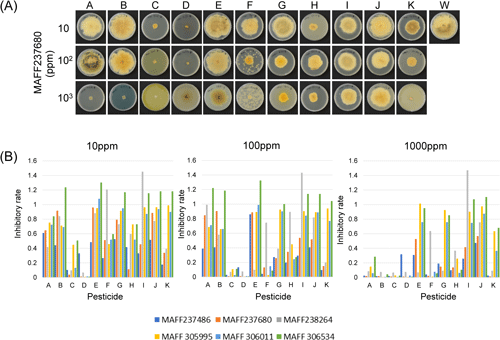
2. Screening for pesticides that inhibit the growth of Neopestalotiopsis sp. and Colletotrichum spThe inhibitory activity of the fungicides commercially available in the Japanese market on the hyphal growth of Japanese isolates of Neopestalotiopsis sp., Pseudopestalotiopsis sp. and Colletotrichum sp. was evaluated in Japan. To select pesticides effective in inhibiting the growth of filamentous fungi, pesticide A-K was treated at dilution rates of 10, 100, and 1000 ppm and the growth of filamentous fungi was observed. Pesticide W was added to PDA plates with water as a control. As an example of screening results, growth of MAFF237680 on pesticide plates are shown in Fig. 2A. To quantify the degree of growth of the spreading filamentous fungi, the area of the fungal colony on the plates was measured and calculated using the colony area on the control plate as 1 (Fig. 2B). The results showed that even at a considerable dilution of 10 ppm, the pesticide C (Quinondo 80% WP, oxine copper; 80.0% 8-hydroxyquinoline copper) was present in less than 10% of the colony area of three Neopestalotiopsis isolates compared to those in the control. On the other hand, for Colletotrichum MAFF305995 and MAFF306534, the growth inhibition rate was about half that of the control. The pesticide D (Topsin M WP, Thiopnanate metyl hydrate; 70.0% Thiophanate metyl), at 10 ppm, inhibited the growth of Neopestalotiopsis, Pseudopestalotiopsis and all three species of Colletotrichum to approximately 1% of the control. On the other hand, for Neopestalotiopsis MAFF237486, the inhibition rate was about 30% that of the control. All pesticides showed concentration-dependent growth inhibition against filamentous fungi. Quinondo 80% WP broadly suppressed the growth of Neoptiopsis and Topsin M WP suppressed the growth of Colletotrichum. Therefore, we tested the effect of combining Quinondo 80% WP and Topsin M WP on Neopestalotiopsis sp. and Colletotrichum sp. isolated from Indonesian rubber trees. The results showed that the growth of Neopestalotiopsis sp. was inhibited by Quinondo 80% WP and Topsin M WP at concentrations as low as 10–50 ppm. The growth of Colletotrichum sp. was not completely inhibited by Topsin M WP alone, but was inhibited by the combination of Quinondo 80% WP and Topsin M WP at concentrations as low as 25–50 ppm (Fig. 4).
3. Inhibition of LFD pathogen growth by combination of candidate pesticidesBased on the results of the first screening, Quinondo 80% WP and Topsin M were selected as effective pesticides candidates for rubber LFD. Figure 3 shows that Quinondo 80% WP has a greater ability to inhibit the growth of Neopestalotiopsis sp. and a lower ability to inhibit Colletotrichum sp. On the other hand, Topsin M WP, showed little growth of Colletotrichum sp. However, it did not inhibit the growth of Neopestalotiopsis sp. strain MAFF237486. Therefore, to investigate whether there is a synergistic effect of the two pesticides against fungi causing LFD, a mixture of Quinondo 80% WP and Topsin M WP was tested for its efficacy. As shown in Fig. 4a and 4b, the growth of every fungus was considerably suppressed in the medium to which both Quinondo 80% WP and Topsin M had been added at 5 ppm and it was completely suppressed in medium containing 10 ppm of each. The efficacy of the combination of Quinondo 80% WP and Topsin M was also tested against LFD pathogens isolated from rubber trees (Fig. 5). Neopestalotiopsis sp. isolated from GT1 showed growth inhibition with a mix of Quinondo 80% WP and Topsin M each at 0.5 ppm. Both Neopestalotiopsis sp. and Colletotrichum sp. isolated from PB260 were also inhibited by 0.5 ppm and the combination of Quinondo 80% WP and Topsin M at 10 ppm against Colletotrichum sp. isolates from GT1 almost stopped the growth of the fungus.
4. Efficacy of Quinondo 80% WP against Neopestalotiopsis LFD on young tree saplingsAs described above, Quinondo 80% WP exhibited the highest inhibitory effect against Neopestalotiopsis sp. Therefore, we evaluated the control effect of organic copper hydrate (the active ingredient in Quinondo) against the disease caused by Indonesian isolate of Neopestalotiopsis sp. on young tree saplings of the IRR112 clone. Since Quinondo 80% WP is a prophylactic against fungal infections, the leaves were first sprayed with it and then inoculated with mycelial plugs of the pathogen. The results showed that necrotic lesions hardly spread on leaves pretreated with a spray of Quinondo 80% WP solution (Fig. 6A). The area of necrotic lesions on organic copper hydrate-treated leaves was suppressed to about one-tenth the size of the control (Fig. 6B). Based on the plate assay experiment, which was also conducted with young rubber tree saplings, Quinondo 80% WP significantly inhibited necrosis caused by Neopestalotiopsis sp.
Conclusion
In this research, a chemical screening was conducted to identify pesticides that inhibit the growth of Neopestalotiopsis sp. and Colletotrichum sp. Although no pesticide screenings have been conducted to date for rubber tree LFD, two pesticides were selected through this experiment: Quinondo 80% WP (oxine copper) and Topsin M WP (thiophanate methyl). A combination of these two inhibited fungal growth at lower concentrations than Quinondo 80% WP nor Topsin M WP alone. Quinondo 80% WP is a prophylactic and should be applied before the filamentous fungus is infected.25) There is also concern about re-infection from leaves that have fallen from trees affected by LFD. Considering that Quinondo 80% WP is a prophylactic agent and Topsin M is a fungicide, the two combinations are expected to have broad efficacy against both Neopestalotiopsis sp. and Colletotrichum sp. throughout the life cycle. The causal pathogens of rubber tree LFD from vary from country to country and region to region. However, it is expected that multiple combinations of pesticides can be used to suppress the growth of the various species of Neopestalotiopsis sp. and Colletotrichum sp. In fact, efficacy was observed for Neopestalotiopsis sp. and Colletotrichum sp. isolated from rubber trees in Indonesia. Thus, the effect of Quinondo 80% WP was also shown at the individual plant level.
Since LFD has already spread, changes in disease severity over time should also be verified using diseased trees. Verification of the efficacy of Quinondo 80% WP and Topsin M WP will be done using multiple clones, and field trials will be conducted in rubber plantations in Indonesia to evaluate disease severity.26) However, in the case of field experiments, it will be necessary to consider conditions such as the spray interval and amount of pesticide applications. Since it is critical that the pesticide adheres to the entire plant, the method and frequency of application need to be examined in detail to establish their effectiveness. It is also anticipated that local dry and humid conditions and climate associated with the El Niño phenomenon will have to be carefully checked and judged before spraying.
Acknowledgements
We express our gratitude to all members of the SATREPS project who engaged in meaningful discussions to achieve our goals. We also appreciate the support provided by the SATREPS grant, Japan Science and Technology Agency (JST)/Japan International Cooperation Agency (JICA). We are grateful to Agrokanesho Co., Ltd., for providing Quinodo for this research and for offering valuable information and advice on mechanisms of action. Special thanks to Dr. Genta Nakamura (Agrokanesho Co., Ltd.) for his contributions and support.
Funding
This research was supported by Science and Technology Research Partnership for Sustainable Development (SATREPS), Japan Science and Technology Agency (JST)/Japan International Cooperation Agency (JICA), JPMJSA2006 (M. M).
Declarations for conflict of interest
The authors declare that they have no conflicts of interest.
Ethical standards
This article does not contain any studies with human participants or animals by any of the authors.
Author contributions
E. O-K and F. T-R planned and conducted all experiments, and writing the manuscript. F.D contributed for import Quinondo into Indonesia. F.D. and K.A conducted experiments in Indonesia. Y. Y, E. O, and T. K conducted experiments in Japan. M. S provided guidance for leaf infection experiments and contributed to manuscript writing. M. M supervised, guided, and summarized all experiments.
Electronic supplementary materials
The online version of this article contains supplementary material (Supplementary Table 1), which is available at https://www.jstage.jst.go.jp/browse/jpestics/.
References
- 1) B. L. Archer, B. G. Audley, E. G. Cockbain and G. P. McSweeney: The biosynthesis of rubber. Incorporation of mevalonate and isopentenyl pyrophosphate into rubber by Hevea brasiliensis-latex fractions. Biochem. J. 89, 565–574 (1963).
- 2) Y. Hayashi: Production of natural rubber from Para rubber tree. Plant Biotechnol. (Tokyo) 26, 67–70 (2009).
- 3) N. B. Guerra, G. Sant’Ana Pegorin, M. H. Boratto, N. R. de Barros, C. F. de Oliveira Graeff and R. D. Herculano: Biomedical applications of natural rubber latex from the rubber tree Hevea brasiliensis. Mater. Sci. Eng. C 126, 112126 (2021).
- 4) K. Herath, S. Samita and W. Wijesuriya: Identification of common trends in prices, demand and supply of natural rubber: An approach using dynamic factor model. Trop. Agric. Res.; Proc... Annu. Congress Postgrad. Inst. Agric., Peradeniya. Univ. Peradeniya. Postgrad. Inst. Agric. Congress 24, 54–70 (2012).
- 5) H. Chen, Z. F. Yi, D. Schmidt-Vogt, A. Ahrends, P. Beckschäfer, C. Kleinn, S. Ranjitkar and J. Xu: Pushing the limits: The pattern and dynamics of rubber monoculture expansion in Xishuangbanna, SW China. PLoS One 11, e0150062 (2016).
- 6) C. Hicks, S. Voladeth, W. Shi, Z. Guifeng, S. Lei, P. Q. Tu and M. Kalina: Rubber investments and market linkages in Lao PDR: Approaches for sustainability. International Union for Conservation Nature, DOI: 10.13140/RG.2.2.12584.19204 (2009).
- 7) T. R. Febbiyanti and Z. Fairuza: Identification of causes of rubber leaves outbreak in Indonesia. Indones. J. Nat. Rubber. Res. 37, 193–206 (2019).
- 8) S. S. S. Aliya, S. A. Nusaibah, M. M. Mahyudin, W. M. Yun and M. R. Yusop: Colletotrichum siamense and Pestalotiopsis jesteri as potential pathogens of new rubber leaf spot disease via detached leaf assay. J. Rubber Res. Kuala Lumpur Malaysia 25, 195–212 (2022).
- 9) M. M. Mahyudin, A. S. Noran, M. Z. H. Ismail and K. Ahmad: Diseases of rubber trees: Malaysia as a case study. Forest Microbiology 3, 401–414 (2023).
- 10) C. Pornsuriya, T. Chairin, N. Thaochan and A. Sunpapao: Identification and characterization of Neopestalotiopsis fungi associated with a novel leaf fall disease of rubber trees (Hevea brasiliensis) in Thailand. J. Phytopathol. 168, 416–427 (2020).
- 11) N. Thaochan, C. Pornsuriya, T. Chairin, P. Chomnunti and A. Sunpapao: Morphological and molecular characterization of Calonectria foliicola associated with leaf blight on rubber tree (Hevea brasiliensis) in Thailand. J. Fungi (Basel) 8, 986 (2022).
- 12) P. J. K. Alchemi and S. Jamin: Impact of Pestalotiopsis leaf fall disease on leaf area index and rubber plant production. IOP Conf. Ser. Earth Environ. Sci. 995, 012030 (2022).
- 13) T. C. Solpot, J. D. Villanueva, M. P. Abello and J. B. M. Zuñiga: First report of Neopestalotiopsis clavispora causing foliar disease of rubber (Hevea brasiliensis) in the Philippines. J. Phytopathol. 172, e13238 (2024).
- 14) B. Li, X. Liu, J. Cai, Y. Feng and G. Huang: First Report on Neopestalotiopsis aotearoa of rubber tree in China. Plant Dis. 105, 1223 (2020). doi:10.1094/PDIS-09-20-1930-PDN
- 15) X. Liang, Y. Peng, Y. Liu, M. Wang, Y. Yang and Y. Zhang: First report of Bipolaris bicolor causing a leaf spot disease on rubber tree. J. Phytopathol. 167, 553–557 (2019).
- 16) X. Li, J. Li, Y. H. Bai, K. C. Xu, R. Q. Zhang and Q. Huang: First report of wilt of rubber tree caused by Chalaropsis thielavioides in China. Plant Dis. 105, 1221 (2021).
- 17) F. A. Azizan, I. S. Astuti, A. Young and A. A. Aziz: Rubber leaf fall phenomenon linked to increased temperature. Agric. Ecosyst. Environ. 352, 108531 (2023).
- 18) M. D. Manessa, S. Rokhmatuloh, I. P. A. Shidiq, R. Nagasawa, F. Ayu, A. F. Efriana, R. Lestari, A. Bustamam, M. Matsui, K. Kase, Y. Makita, T. R. Febbiyanti, F. Oktavia and C. T. Stevanus: Study of rubber leaf disease using hyperspectral reflectance. Proc. SPIE Future Sensing Technologies 12327, 123270F (2023).
- 19) E. Herlinawati, M. Aji and Kuswanhadi: Some of the alternative tapping system on BPM24 clone. Indonesian J. Nat. Rubb. Res. 36, 109–116 (2018).
- 20) M. O. Nugrahani, A. Rouf and Y. B. S. Aji: Response pf latex rubber clone BMP24 to differences in stimulant application time at the frequency of D4 tapping. Warta Perkaretan 41, 79–88 (2022).
- 21) A. Daslin and S. A. Pasaribu: Addaptation test of IRR100 series rubber clones at dry agroclimate in sungei Baleh Estate Asahan district North Smatra. Indonesian J. Nat. Rubb. Res. 33, 25–34 (2015).
- 22) M. R. Darojat and S. Sayurandi: The Status of IRR Series Rubber Clones from Indonesia Breeding Activity and Its Adoption in Indonesia Rubber Plantation. Perspektif 17, 101–116 (2018).
- 23) A. Darapanit, N. Boonyuen, W. Leesutthiphonchai, S. Nuankaew and O. Piasai: Identifcation, pathogenicity and efects of plant extracts on Neopestalotiopsis and Pseudopestalotiopsis causing fruit diseases. Sci. Rep. 11, 22606 (2021).
- 24) C. Norphanphoun, R. S. Jayawardena, Y. Chen, T. C. Wen, W. Meepol and K. D. Hyde: Morphological and phylogenetic characterization of novel pestalotioid species associated with mangroves in Thailand. Mycosphere 10, 531–578 (2019).
- 25) R. G. Esposito and A. M. Fletcher: The relationship of pteridine biosynthesis to the action of copper 8-hydroxyquinolate on fungal spores. Arch. Biochem. Biophys. 93, 369–376 (1961).
- 26) N. Damiri, Y. Pratama, T. R. Febbiyanti, S. E. Rahim, D. T. Astuti and Y. Purwanti: Pestalotiopsis sp. infection causes leaf fall disease of new arrivals in several clones of rubber plants. Biodiversitas (Surak.) 23, 3943–3949 (2022).