Abstract
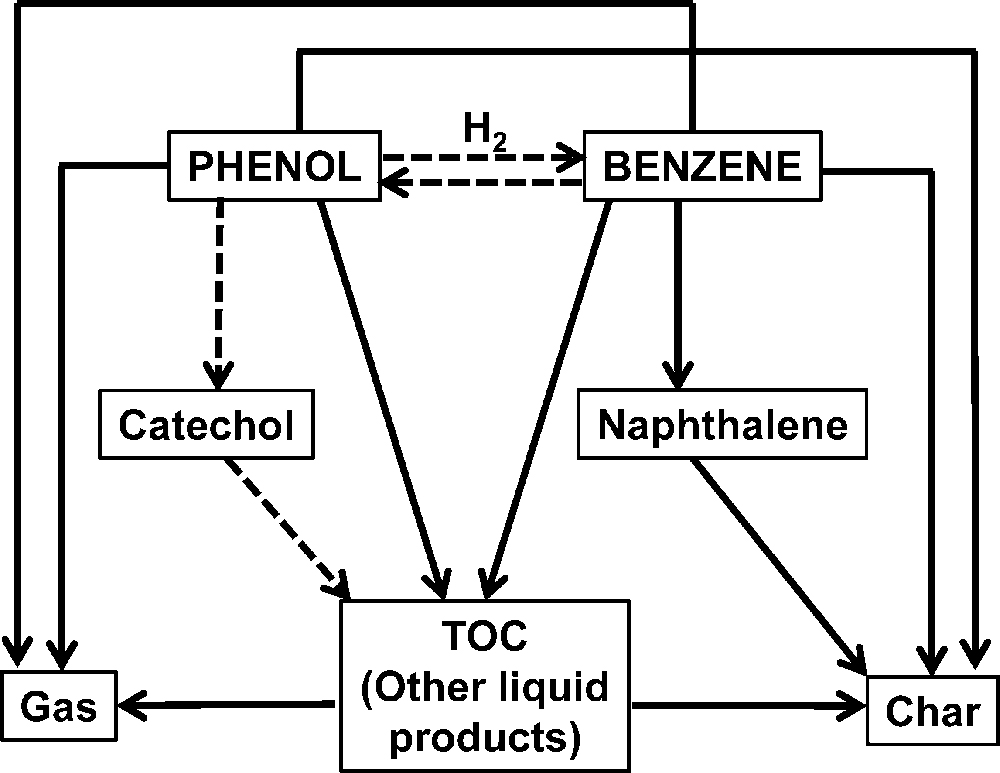
The effect of temperature (370-450 °C) and residence time (0.5-100 s) on phenol and benzene decomposition in supercritical water (SCW) at a pressure of 25 MPa was investigated. Although the rates of phenol and benzene decomposition are relatively low under the conditions used in this study, char and gas formation occurred at a residence time of 20 s and was enhanced with an increase in the temperature and residence time. Char formation from phenol and benzene competes with gas formation. Benzene decomposes in SCW, although the reaction is slower than the decomposition of phenol. The formation of resonance-stabilized phenoxy radicals is believed to play a key role in promoting its decomposition. In the supercritical water gasification (SCWG) of phenol, direct gasification occurring primarily through pyrolysis was more likely. However, in the SCWG of benzene, gasification occurred through two different pathways. Direct gasification mainly occurred through pyrolysis within the first few seconds, and ring opening of the aromatic compounds occurred during longer residence times, ultimately affording gaseous compounds through intermediates such as formic and acetic acid. The formation of phenol from benzene showed Arrhenius behavior, but benzene formation from phenol decreased with temperature in SCW (non-Arrhenius behavior). Based on the deduced mechanisms, we proposed reaction pathways for the decomposition of phenol and benzene in SCW.