2020 Volume 63 Issue 4 Pages 204-212
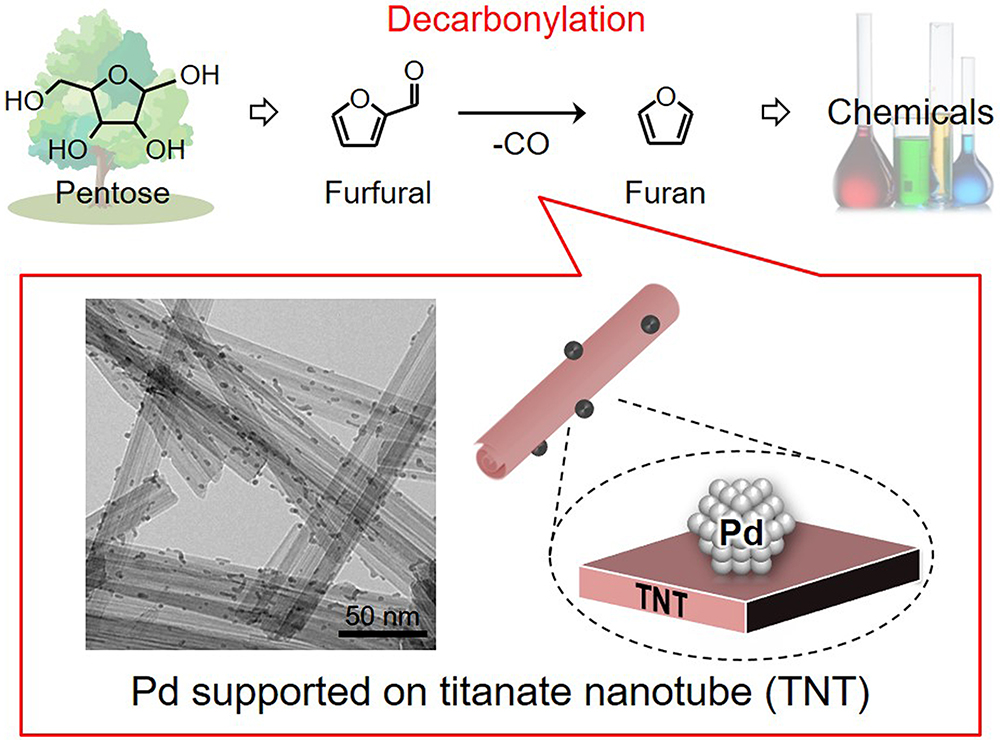
Decarbonylation of biomass-derived furfural to furan is one of the attractive transformation reactions for valorization of biomass, since furan can be used as a feedstock chemical for the synthesis of solvent, fuel and polymer. Previous researches have manifested that Pd nanoparticles (NPs) act as an effective catalyst for this reaction; however, severe reaction conditions, such as high temperature and high pressure, have been required for accelerating reaction rate. In this study, we prepared small Pd NPs supported on several titania supports by a photo-assisted metal deposition (PAD) method utilizing their photo-responsive property. Transmission electron microscopy and X-ray absorption fine structure measurements disclosed that uniformly-dispersed Pd NPs with a smaller diameter could be obtained when Pd NPs were deposited on titania supports via PAD method compared with those prepared by the conventional wet impregnation method. In particular, Na+-type titanate nanotube (TNT) with tubular nanostructure and the associated high-surface-area served as an effective support to create highly-active Pd NPs, which exhibited superior catalytic performance in the liquid-phase decarbonylation of furfural compared with the conventional supported Pd catalysts. A clear relationship was observed between reaction rates and sizes of Pd NPs, and further detailed analysis suggested that coordinatively-unsaturated Pd atoms locating at the edge/corner sites of Pd0 NPs are the active species for this reaction.