Abstract
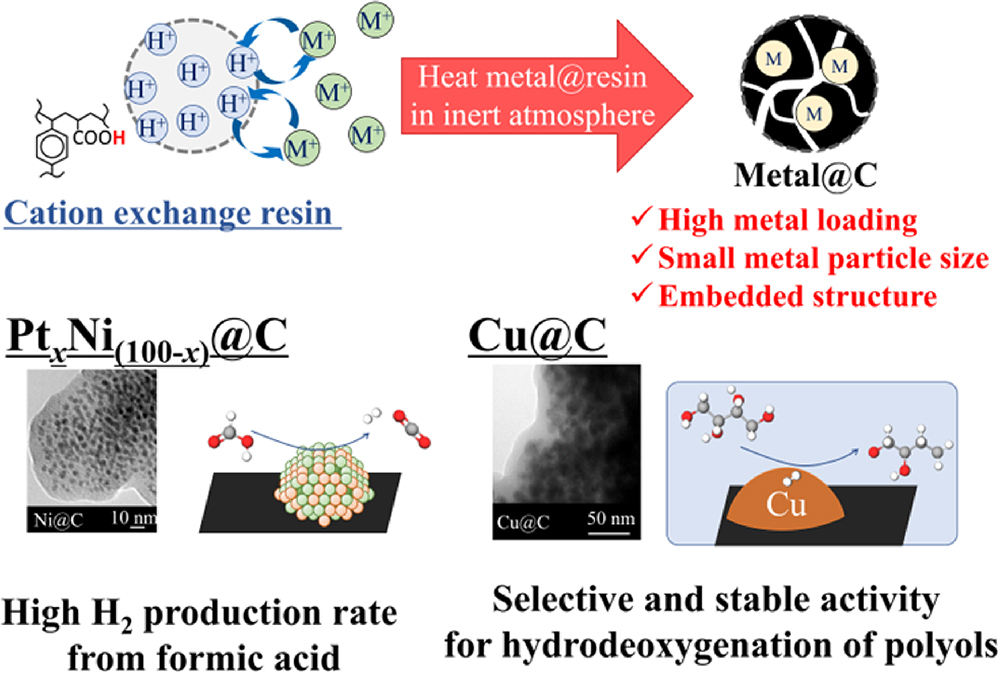
Carbon supports are frequently used for catalyst supports due to their large surface areas and inert nature, which allows selective reactions on metal catalysts. However, carbon-supported metal catalysts exhibit poor stability because the interaction between the metal and carbon is not strong, and agglomeration of metal nanoparticles is likely to occur. To overcome this problem, the author focused on a new synthesis method for carbon-supported metal nanoparticle catalysts (metal@C) which uses ion-exchange resin as the carbon source. This method involves an ion-exchange step followed by a carbonization step. The carbon support and metal nanoparticles are formed simultaneously, so the metal nanoparticles are partially embedded in the carbon support. In this paper, the preparation procedure of metal@C catalysts and their physicochemical properties are described. The prepared PtNi@C exhibited high hydrogen production rate from formic acid because of the concentrated active sites, and the Cu@C showed high selectivity and stable activity for hydrodeoxygenation of polyols because of the inertness of the carbon support and metal embedded in the carbon structure, respectively.