INTRODUCTION
Over the last four decades persistent organic pollutants (POPs) have come under increasingly stringent control through national and regional regulations.1,2) In 2001, twelve POPs were targeted for worldwide elimination or control under the Stockholm Convention and another ten substances were added since 2009.1) These efforts have reduced “primary” emissions of POPs into the environment and levels have declined in the atmosphere3,4) and arctic biota.5) While encouraging, monitoring data for organochlorine pesticides in arctic air suggest that downward trends have slowed and in some cases reversed since ∼2000,3,4,6) buffered by “secondary” emissions from residues deposited in soil, water, ice and vegetation during former years of usage.6–12) Secondary sources are expected to dominate in the future, when POPs transport and accumulation will be controlled by air-surface exchange and the biogeochemical cycle of carbon.7,13) Several publications in recent years discuss predicted impacts of climate change on sources, transport and fate of POPs.2,13–17) POPs are expected to experience increased mobility from primary and secondary sources due to higher temperatures, loss of ice cover in polar regions, melting glaciers and ice caps, and increased frequency of extreme events such as flooding. Shifts in wind patterns, ocean currents, and precipitation amount and distribution influence POPs transport pathways. Fate processes are impacted through changes in temperature, UV radiation, albedo, and soil and water microbial communities which affect degradation rates. Changes in these physical and chemical factors will be felt throughout the biological realm, resulting in altered bioaccumulation and biomagnification of POPs.13,15,18–20) One consequence is to confound interpretation of environmental monitoring records, which would otherwise be expected to show declines following POPs control measures.15,16) Suggestions have been made to include the influence of climate change on the environmental behaviour of chemicals in regulatory decision-making.2)
This article and our recent review21) present the rationale for employing chiral POPs in the investigation of climate-mediated air-surface exchange and degradation processes. Enantiomers of chiral POPs have identical vapour pressures, water solubilities and partition coefficients among air, water and octanol. Transport (advection, deposition, volatilisation, diffusion) and reactions (photolysis, hydrolysis, OH radical attack) will not change enantiomer proportions provided they take place in achiral environments. However, enzymes are chiral and enantioselective metabolism is the “rule rather than the exception.”22) A list of chiral POPs in the Stockholm Convention and some of their chiral metabolites is given in Table 1. Other chemical classes not in the Stockholm Convention which have chiral members are currently used pesticides, brominated flame retardants (other than brominated diphenyl ethers), polycyclic musks and pharmaceuticals. At least one industrial organophosphorus compound is chiral, tris(2-chloro-1-methylethyl) phosphate (TCPP).23) Most chiral compounds are produced as racemates (equal proportion of enantiomers), and nonracemic residues in the environment indicate enantioselective microbial degradation in soil and water or processes in higher organisms (e.g., absorption, translocation, metabolism, excretion, preferential membrane transport). Separation of individual enantiomers by chromatography on chiral stationary phases, with detection by mass spectrometry, provides the ability to distinguish emission of chemicals from two source types: racemic (newly released or not subjected to microbial attack) and nonracemic (enantioselectively degraded by microbial action in soil and water).
Table 1. Chiral POPs in the Stockholm Convention and some of their chiral metabolites.
| Typea |
|---|
| Atropisomeric PCBs | I |
| Atropisomeric PCB methyl sulfones and OH-PCBs | M |
| Perfluorooctane sulfonate (PFOS) and precursors | I |
| α-Hexachlorocyclohexane (α-HCH) | P, Bb |
| β-Pentachlorocyclohexene | Mc |
| γ-Pentachlorocyclohexene | Md |
| Chlordane | Pe |
| Oxychlordane | M |
| Heptachlor | P |
| Heptachlor exo-epoxide | M |
| Toxaphene | Pe |
| o,p′-DDT | P, Bf |
| o,p′-DDD | M |
a) I=industrial chemical, P=pesticide, B=unintentional by-product, M=metabolite.b) By-product from production of lindane (γ-HCH). c) Chiral metabolite of α-HCH.d) Chiral metabolite of achiral γ-HCH. e) Complex mixture, some components are chiral.f) By-product from production of the pesticide dicofol.
MATERIALS AND METHODS
Most information in this paper is taken from our review21) and other published papers. Our analytical methods for the chiral organochlorine pesticides (OCPs) mentioned here are based on capillary gas chromatography using columns with chiral stationary phases and detection by low-resolution mass spectrometry in the electron capture negative ion mode (GC-ECNI-LRMS) with selected monitoring of two ions for each compound.24–26) Columns typically employed are BGB-172 (20% tert-butyldimethylsilyl-β-cyclodextrin in OV-1701, 15 m×0.25 mm i.d., 0.25 µm film, BGB Analytik AG, Switzerland), Betadex-120 (20% permethylated β-cyclodextrin in SPB-25, 30 m×0.25 mm i.d., 0.25 µm film, Supelco, U.S.A.) and Rtx β-DEXcst (proprietary phase, 30 m×0.25 mm i.d., 0.25 µm film thickness, Restek, U.S.A.), BGB-172 is the primary column for enantiomer separations of α-hexachlorocyclohexane (α-HCH), cis- and trans-chlordane (CC, TC), heptachlor exo-epoxide (HEPX), oxychlordane (OXY) and o,p′-DDT. Due to differences in enantiomer elution order, the Betadex-120 column is used for confirmatory analysis of the chlordanes24–26) and either Rtx β-DEXcst or Betadex-120 for α-HCH.24,26) Monitored ions are given in these references. Analytical methods for PCB atropisomers by other research groups27–32) involve chromatography on chiral-phase columns with detection by electron impact MS. The most popular column is Chirasil-Dex (10% permethylated 2,3,6-tri-O-methyl β-cyclodextrin as chiral selector in polysiloxane, 25 or 30 m×0.25 mm i.d., 0.25 µm film, Chrompack or Varian), and in one case29) Cyclosil-B (30% heptakis (2,3-di-O-methyl-6-O-tert-butyldimethylsilyl)-β-cyclodextrin in 14% cyanopropylphenyl/86% methylpolysiloxane, 30 m×0.25 mm i.d., 0.5 µm film, Agilent, U.S.A.) was also used. Two-dimensional GCxGC (heartcut)27,28,30) and MS/MS methods have also been used.27–30) Enantiomer proportions are expressed as enantiomer fraction, EF=(+)/[(+)+(‒)] (optical signs), or E1/(E1+E2) (chromatographic elution order if optical signs are not known).
RESULTS AND DISCUSSION
Enantioselective degradation in soil and waterChiral POPs undergo enantioselective degradation in soil, resulting in accumulation of nonracemic residues. Frequencies of enantiomer depletions for organochlorine pesticides (OCPs) in agricultural and background soils worldwide are summarised in Fig. 1.21) Dominant depletions are (−)α-HCH), (−)CC and (+)TC, although opposite preferences and racemic residues are also common. Residues of o,p′-DDT are almost equally divided among (+) depletion, (−) depletion or racemic. Strong preference for enrichment of the (+) enantiomer has been reported for metabolites HEPX (97%) and OXY (81%), which may reflect their preferential formation from parent compounds rather than degradation of the (−) enantiomer.21,26) Average EFs and pooled standard deviations from merging individual data sets of research groups21) are: α-HCH 0.530±0.097, CC 0.531±0.073, TC 0.480±0.067, HEPX 0.668±0.032, OXY 0.554±0.033, and o,p′-DDT 0.511±0.064.

Enantioselective degradation in soils has been associated with higher humus and organic nitrogen content, clay vs. sand, and microbial biomass/activity.28) Our review of the literature21) found that soil organic matter and pH were significant factors in some studies, but not in others. Soil pH affects carbon and nutrient availability, solubility of metals, and microbial and fungal communities.33) Climate change may impact soil microbial diversity and respiration by altering CO2, soil temperature, precipitation patterns, soil moisture, vegetation communities and productivity, and the rate of organic matter decomposition.34,35) The relative abundance of bacteria and fungi in soil was changed by manipulating CO2, temperature and precipitation,36) pH33) and soil frost.37) Effects of such changes on the diagenesis of chiral POPs are poorly known, but evidence suggests that enantioselectivity will be affected. Changes in the enantiomer degradation preference of the organophosphate pesticide cruformate and the phenoxy herbicide methyl dichlorprop were found when these compounds were incubated in soils which had received simulated climate change manipulations (warming the soil by 5°C), nutrient amendments or changes in land use (conversion of forest to pasture).38) Enantiomer fractions (EFs) of atropisomeric PCBs in 101 soils from Switzerland varied with land use categories which included deciduous and coniferous forest, permanent and pasture grassland, various agricultural operations, marshland and urban parks.27) Wide variations in enantioselective degradation were found, with depletions of either enantiomer. Median EFs showed the following trends: PCB-95 <0.5 in most land use types but racemic in coniferous forests and marshland; PCB-149 racemic in deciduous forests, viticulture and horticulture farms, <0.5 in coniferous forests and >0.5 in other categories; PCB-132 racemic in city parks and >0.5 elsewhere; PCB-174 racemic in most cases, slightly >0.5 in coniferous forests and slightly <0.5 in marshland.
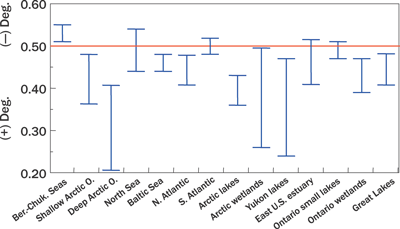
The most investigated chiral compound in marine and fresh water is α-HCH. Degradation of (+)α-HCH is preferred in most cases, but loss of (−)α-HCH has been found in some regions21) (Fig. 2). Enantioselective degradation is favoured in oligotrophic systems with higher α-HCH concentrations, long water residence time and higher dissolved inorganic carbon, while more nearly racemic α-HCH is found in mesotrophic and eutrophic systems with higher particulate organic carbon and total phosphorus.39) Oligotrophic systems may contain bacteria that survive under low nutrient conditions by inducing multiple enzymes, shifting metabolic pathways, and taking up and using carbon from mixed sources.39) Other chiral OCPs in water have been less investigated. TC and CC were racemic in arctic–subarctic waters between 1994–2001.26,40) The EF of CC averaged 0.497 in the North Atlantic–Greenland Sea in 2004,41) while mean EFs of CC (0.516) and TC (0.469) were found south of Iceland in 2008.42) Depletion of (+)TC was found in the Laurentian Great Lakes Superior, Erie and Ontario (mean EFs 0.474–0.478). CC was racemic in lakes Superior and Erie and (+)CC was depleted in Lake Ontario (mean EF 0.480).43) Enrichment of (+)HEPX was found in the central Arctic Ocean (mean EF 0.608),26) the North Atlantic (mean EF 0.596)42) and the Great Lakes (mean EFs 0.647–0.658),43) while HEPX was racemic in the Beaufort Sea.40) Climate warming is likely to impact algal and microbial communities in aquatic systems through loss of ice cover and consequent increased light intensity, earlier spring phytoplankton blooms, hydrological changes in wetlands which drain into rivers and lakes; and in the ocean, freshening due to lowered salinity.15)
Emissions of chiral POPs from secondary sources involve enantioselective degradation in soil and water, and exchanges with the atmosphere. Because enantiomers have the same physicochemical properties, EFs are not changed and retain the signature of their source when chiral compounds volatilise. We reviewed applications of organochlorine pesticide enantiomers to tracer nonracemic emissions to the atmosphere; e.g., volatilisation from soil and water.21) Speciation of primary vs. secondary (soil volatilisation) sources of PCBs based on enantiomer profiles was also reviewed21) and this concept was further applied in a recent study to identify sources near a hazardous waste incinerator.29) Although PCB residues in soil are frequently nonracemic,27–32) racemic PCBs are found in air29–31,44) except very close to the soil surface and in grass.45) This suggests that primary emissions still control PCB levels in the bulk atmosphere.
Here we expand on chlordane and α-HCH transport by reporting summer–winter shifts of EFs in arctic air and possible relationships to seasonally changing sources. EFs in recent and historic atmospheric samples25,46) and in sediment cores46–48) have provided evidence of changing chlordane sources over the last 40 years. Figure 3 shows the nearly racemic EFs of TC in atmospheric deposition from Sweden, Iceland and Slovakia during 1971–73, contrasted with nonracemic TC in air samples from southern Sweden and arctic Finland (Pallas) during 1998–2001.46) TC was also nonracemic in all seasons in arctic air samples from Alert (82°30′N, 62°20′W), Ellesmere Island, Canadian Archipelago during 1994–2000. Digital filtration analysis3) of the EF data revealed seasonal cycles with winter maxima 0.473–0.487 (mean of maxima 0.483±0.005) and summer minima 0.445–0.464 (mean of minima 0.455±0.007) (Fig. 3). The difference is significant at p<0.0001. Chlordanes tend to be nonracemic in agricultural and background soils (Fig. 1) and in air samples collected above such soils,49,50) while chlordanes are racemic in soil near house foundations where chlordane was applied for termite control51) and in the air of treated homes.52) Potential sources of TC to the atmosphere are nonracemic emissions from soils, which show preference for EFs <0.5 (Fig. 1), and racemic emissions from termiticide usage. The cycles of EFs in Alert air (closer to racemic in winter and farther in summer) suggest greater contribution of termiticides from home air ventilation in winter vs. volatilisation from soil in summer.

Levels of α-HCH in arctic air have declined in step with reduced production and emissions of technical HCH after 1983,53) and today releases from soil and water are estimated to be the greatest contributors to atmospheric levels.54) Water bodies that were net receivers of α-HCH during the high production years of the 1970s–early 1980s became net sources to the atmosphere in the early 1990s.55–57) The (+) enantiomer of α-HCH is depleted in most aquatic systems that have been so far investigated, with exceptions of the Bering-Chukchi seas, and parts of the North Sea and south Atlantic where depletion of (–)α-HCH is prevalent (Fig. 2). Many studies have traced volatilisation of nonracemic α-HCH from oceans and large lakes by measuring its appearance in the air boundary layer, and findings are summarised in our review.21) The effect of ice cover on this process is particularly dramatic in the Arctic. Shipboard expeditions traversing open water areas have measured nonracemic α-HCH in air, whereas nearly racemic α-HCH was found in ice-covered regions.58–61) In the Canadian Arctic at Resolute Bay in 199959) and Banks Island in 200860) concentrations of α-HCH in air over the ocean increased upon spring–summer ice breakup, which was accompanied by a switch from nearly racemic to nonracemic α-HCH in air (Fig. 4).
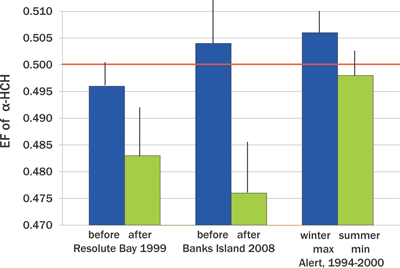
EFs of α-HCH at Alert, Canada showed seasonal cycles from 1994–2000 with higher values in winter (0.500–0.508, mean of annual maxima 0.506±0.003) and lower in summer (0.493–0.504, mean of annual minima 0.498±0.005). Although this seasonal difference is less than for TC, it is significant at p<0.01. Alert is a land station and the nearby Arctic Ocean is usually under ice cover which dampens local volatilisation of nonracemic α-HCH. Nonetheless, the seasonal cycles can be identified at Alert by digital filtration data analysis. These suggest that background air in winter contains racemic α-HCH with some contribution from soil-derived α-HCH, which tends to be depleted in the (–) enantiomer (Fig. 1). This EF signature is lowered in summer when α-HCH depleted in the (+) enantiomer is volatilised from ice-free areas of the Arctic Ocean and advected to Alert.
Climate change and chiral POPsThe seasonal cycling of TC and α-HCH EFs in arctic air suggests that emission and transport of these and other POPs could be influenced by climate change. The EFs and degradation preference frequencies in soil and water (Figs. 1 and 2) reflect the present composition and activity of microbial communities and can serve as a baseline to assess future changes. Including enantiomer-specific analysis in atmospheric monitoring programs for POPs could reveal large-scale impacts of microbial degradation of POPs in soil and water, as well as continuing primary–secondary source transitions.21) Enantiospecific analysis of chiral POPs can enhance investigations of air-surface exchange and degradation processes that may be mediated by climatic conditions. Examples are:
a) Chiral compounds have been used in determining microbial degradation rates in soil and following the formation of “bound residues,” i.e. movement of chemicals from exchangeable to sequestered pools.21,62,63)
b) Climate change is predicted to impact accumulation and release of POPs from the forest canopy,64) and chiral POPs might be useful for following cycling within the forest ecosystem21); e.g., volatilisation from soil, atmospheric deposition, foliar uptake and release, and metabolism within plant tissues.
c) Summer ice cover is decreasing in the Arctic Ocean, as a whole65) and in the Canadian Archipelago-Beaufort Sea,66) and September 2012 was the lowest coverage on record.65) More open water area increases the opportunity for air–water gas exchange, either through deposition or evasion.15,16) We have shown that α-HCH is a sensitive indicator of re-emission during ice breakup59,60) (Fig. 4) and this concept could be applied to other chiral POPs in the Arctic Ocean and large seasonally frozen lakes.
d) Melting glaciers release stored POPs into receiving waters and downstream sediments.67–69) Snow/ice cores and glacial runoff might be examined for chlordanes and other chiral POPs to determine their diagenetic history.


