Progress of Digestive Endoscopy
Online ISSN : 2187-4999
Print ISSN : 1348-9844
ISSN-L : 1348-9844
A case of gastric carcinoid tumor associated with atrophic gastritis treated by endoscopic submucosal dissection followed by eradication of H. pylori infection
Santaro SagaeTetsuya NakamuraNaoyuki KobayashiJunichi SaitoAiko NagayamaHiroko MurataKei KawagoeHitomi HorikawaHidetomo MutoMitsuhiro SaitoYoshito UeyamaKenji IwataEiji Kurihara
Author information
Keywords: H. pylori
JOURNAL FREE ACCESS

2011 Volume 78 Issue 2 Pages 70-73

Details

Abstract
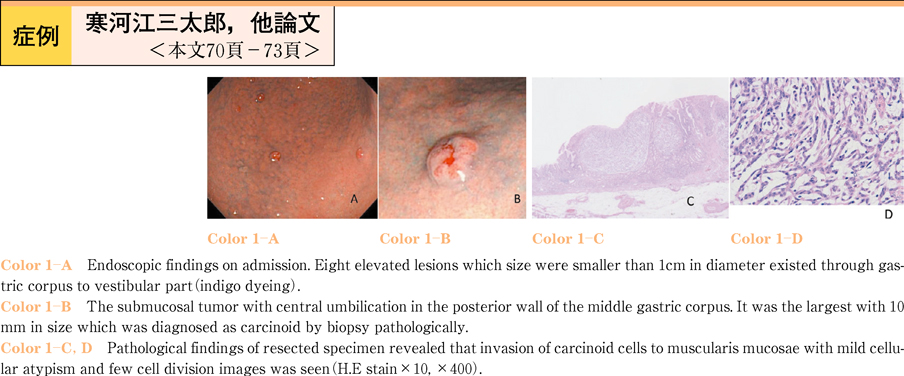
We report a case of gastric carcinoid tumor associated with atrophic gastritis which was treated by endoscopic submucosal dissection followed by eradication of H. pylori infection. A 71-year-old male visited our hospital for further examination and treatment of eight elevated lesions which size were smaller than 1cm in diameter existing through gastric corpus to vestibular part which were detected by gastoroscopy in health examination. His blood gastrin level was high (243pg/ml) . The submucosal tumor with central umbilication in the posterior wall of the middle gastric corpus was the largest with 10 mm in size. Pathological examination of biopsied specimen revealed carcinoid cells and immunohistologically, Chromogranin A was positive. In the other polypoid lesions, carcinoid compositions were not recognized and diagnosed as atrophic gastritis. Consequently, a diagnosis of sporadic gastric carcinoid was made, and the endoscopic submucosal dissection was performed. Pathologically, invasion of carcinoid cells to muscularis mucosae with mild cellular atypism and few cell division images was seen. Therefore, we did not perform additional resection. H. pylori eradication therapy resulted in diminishing polypoid lesions and normal blood gastrin level. After two-year follow-up, recurrence of carcinoid has not been seen. We propose that it is possible that H. pylori eradication which follows endoscopic resection for patients with gastric carcinoid with H. pylori infection and high gastrinemia is effective for prevention of tumor recurrence.
Fullsize Image
Content from these authors
© 2011 Japan Gastroenterological Endoscopy Society Kanto Chapter
Previous article Next article
feedback
Top