Abstract
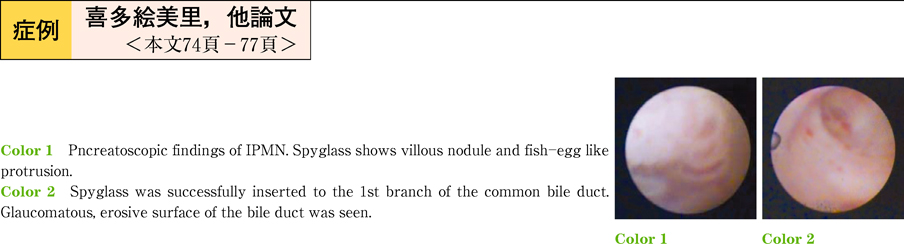
Backgrounds and Aims : Cholangiopancreatoscopy is used to visualize directly the biliary and pancreatic duct, snd make precise diagnosis of pancreato-biliary diseases. However, conventional scopes had a limitation due to poor usability and fragility. Recently, the newly developed cholangiopancreatoscope : Spyglass? has been introduced to Japan. The aim of this study was to evaluate diagnostic value of Spyglass in the diagnosis of IPMNs and biliary strictures.
Methods : Subjects were 5 patients with IPMN and 5 with biliary stricture. Using Spygrass, examination was conducted by mother-baby method.
Results : Insertion of the scope via duodenal papilla and direct visualization of the main lesion was succeeded in all cases. The scope was inserted to the proximal pancreatic duct from the lesion in 2 of IPMN and to the 1st branch of the common bile duct in 4. Assessment of the tumor extension was successful in 1/1 of cholangiocarcinoma and 3 (60%) of IPMN. Adequate specimen for clinic-pathological examination taken under direct vision were collected in 8 out of 9 attempted cases. Final diagnosis could be made in 9 (90.0%) by Spyglass examination.
Conclusion : Spyglass was shown to be effective for the diagnosis of IPMN and biliary stricture, however further evaluation is needed for obtaining its actual value.