抄録
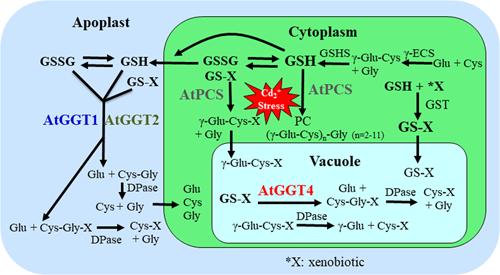
Glutathione (GSH, γ-L-glutamyl-L-cysteinyl-glycine) has been implicated in a multitude of cellular functions, such as protection of cells against oxidative stress, detoxification of xenobiotics via degradation of GSH S-conjugates, and disease resistance. Glutathione also serves as a precursor of phytochelatins, and thereby plays an essential role in heavy metal detoxification. The Arabidopsis genome encodes three functional γ-glutamyltransferase genes (AtGGT1, AtGGT2, AtGGT4) and two phytochelatin synthase genes (AtPCS1, AtPCS2). The function of plant GGT has not yet been clearly defined, although it is thought to be involved in GSH and GSH S-conjugate catabolism. On the other hand, besides its role in heavy metal detoxification, PCS has also been involved in GSH S-conjugate catabolism. Herein we describe the HPLC characterization of GSH and GSH S-conjugate catabolism in Arabidopsis mutants deficient in GSH biosynthesis (pad2-1/gsh1), atggt and atpcs1 T-DNA insertion mutants, atggt pad2-1, atggt atpcs1 double mutants, and the atggt1 atggt4 atpcs1 triple mutant. The results of our HPLC analysis confirm that AtGGT and AtPCS play important roles in two different pathways related with GSH and GSH S-conjugate (GS-bimane) catabolism in Arabidopsis.