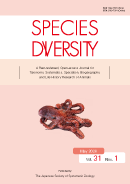
Species Diversity
A peer-reviewed, open-access journal for taxonomy, systematics, speciation, biogeography, and life history research of animals.
Please refer to the journal site for details.
https://www.speciesdiversity.org/
Aims and Scope
Species Diversity is an open-access journal that publishes new and significant findings on zoological diversity, with its primary focus on the terrestrial, freshwater, and marine fauna of Japan, East Asia, and the surrounding regions and seas. The journal also strives to contribute to an understanding of the faunal diversity of all parts of the world.
The editors actively encourage the submission of papers dealing with all aspects of animal taxonomy, systematics, speciation, biogeography, and life history. Various styles of paper are sought, ranging from voluminous revisions and review articles to single species descriptions, other short research reports, and essays concerning zoological nomenclature.
Species Diversity is published by the Japanese Society of Systematic Zoology (JSSZ). It was founded in 1996 as the English-language successor to the Proceedings of the Japanese Society of Systematic Zoology (Dōbutsu Bunrui Gakkai Shi: ISSN 0287-0223) [Apr. 1965–Dec. 1996], which is now published by JSSZ under the title Taxa as a Japanese-language journal.
Journal History and Publication Format
In order to facilitate prompt publication, with Vol. 5 in 2000 Species Diversity switched from publishing physical issues twice a year to four times each year. With Vol. 17 in 2012 the publishing schedule for physical issues (increased in size from A5 to A4 format) reverted to twice a year, with strict adherence then and subsequently to the target dates of May 25 and November 25. A more significant change that year was the introduction of an online-first model for electronic publication.
In order to reduce the financial burden on JSSZ and in recognition of the growing importance of electronic publication, it was decided in 2022 to publish a single combined physical issue of Species Diversity on November 25 each year while still strictly observing the publication dates of May 25 and November 25 for the virtual issues.
The Article Processing Charge (APC)
Submissions from outside Japan
At least one JSSZ member must be among the authors of any submitted manuscript. An overseas author who pays the Article Processing Charge (APC) of 5,000 Japanese yen (JPY) will receive membership in the JSSZ until December of the current year. During this time, the author may submit any number of additional articles without paying any page charges.
Submissions from within Japan
At least one JSSZ member must be among the authors of any submitted manuscript. From 2023 the annual membership dues are 8,000 JPY, which includes subscriptions to both Species Diversity and the Japanese serial Taxa.
Notice about Copyright
From Volume 28 Issue No. 2, in which the first article was published on 25th July 2023, all articles of Species Diversity are published under a Creative Commons Attribution 4.0 License (CC BY, https://creativecommons.org/licenses/by/4.0/), which permits unrestricted use, distribution, and reproduction in any medium of format, as long as you give appropriate credit to the original author(s) and the source. The contents of the articles are licensed under the CC BY 4.0, unless indicated otherwise in a credit line to the material. If material is not included in the articles' CC BY 4.0 and your intended use is not permitted by statutory regulation or exceeds the permitted use, you or your organization will need to obtain permission directly from the copyright holder.
All articles published in Volume 1 in 1996 to Volume 28 Issue No. 1, of which the last work was published on 25th May 2023, are archived for free access in J-Stage. The Japanese Society of Systematic Zoology reserves all rights of the works in Volume 1 to Volume 28 Issue No. 1 under copyright law.
In order to photocopy any work from Volume 1 to Volume 28 Issue No. 1 of Species Diversity, therefore, you or your organization must obtain permission from JAACC (except in the USA) or CCC (in the USA) which have been delegated for copyright clearance by the copyright owner of this journal.
Read more
Please refer to the journal site for details.
https://www.speciesdiversity.org/
Aims and Scope
Species Diversity is an open-access journal that publishes new and significant findings on zoological diversity, with its primary focus on the terrestrial, freshwater, and marine fauna of Japan, East Asia, and the surrounding regions and seas. The journal also strives to contribute to an understanding of the faunal diversity of all parts of the world.
The editors actively encourage the submission of papers dealing with all aspects of animal taxonomy, systematics, speciation, biogeography, and life history. Various styles of paper are sought, ranging from voluminous revisions and review articles to single species descriptions, other short research reports, and essays concerning zoological nomenclature.
Species Diversity is published by the Japanese Society of Systematic Zoology (JSSZ). It was founded in 1996 as the English-language successor to the Proceedings of the Japanese Society of Systematic Zoology (Dōbutsu Bunrui Gakkai Shi: ISSN 0287-0223) [Apr. 1965–Dec. 1996], which is now published by JSSZ under the title Taxa as a Japanese-language journal.
Journal History and Publication Format
In order to facilitate prompt publication, with Vol. 5 in 2000 Species Diversity switched from publishing physical issues twice a year to four times each year. With Vol. 17 in 2012 the publishing schedule for physical issues (increased in size from A5 to A4 format) reverted to twice a year, with strict adherence then and subsequently to the target dates of May 25 and November 25. A more significant change that year was the introduction of an online-first model for electronic publication.
In order to reduce the financial burden on JSSZ and in recognition of the growing importance of electronic publication, it was decided in 2022 to publish a single combined physical issue of Species Diversity on November 25 each year while still strictly observing the publication dates of May 25 and November 25 for the virtual issues.
The Article Processing Charge (APC)
Submissions from outside Japan
At least one JSSZ member must be among the authors of any submitted manuscript. An overseas author who pays the Article Processing Charge (APC) of 5,000 Japanese yen (JPY) will receive membership in the JSSZ until December of the current year. During this time, the author may submit any number of additional articles without paying any page charges.
Submissions from within Japan
At least one JSSZ member must be among the authors of any submitted manuscript. From 2023 the annual membership dues are 8,000 JPY, which includes subscriptions to both Species Diversity and the Japanese serial Taxa.
Notice about Copyright
From Volume 28 Issue No. 2, in which the first article was published on 25th July 2023, all articles of Species Diversity are published under a Creative Commons Attribution 4.0 License (CC BY, https://creativecommons.org/licenses/by/4.0/), which permits unrestricted use, distribution, and reproduction in any medium of format, as long as you give appropriate credit to the original author(s) and the source. The contents of the articles are licensed under the CC BY 4.0, unless indicated otherwise in a credit line to the material. If material is not included in the articles' CC BY 4.0 and your intended use is not permitted by statutory regulation or exceeds the permitted use, you or your organization will need to obtain permission directly from the copyright holder.
All articles published in Volume 1 in 1996 to Volume 28 Issue No. 1, of which the last work was published on 25th May 2023, are archived for free access in J-Stage. The Japanese Society of Systematic Zoology reserves all rights of the works in Volume 1 to Volume 28 Issue No. 1 under copyright law.
In order to photocopy any work from Volume 1 to Volume 28 Issue No. 1 of Species Diversity, therefore, you or your organization must obtain permission from JAACC (except in the USA) or CCC (in the USA) which have been delegated for copyright clearance by the copyright owner of this journal.
Published by
The Japanese Society of Systematic Zoology
761 registered articles
(updated on September 16, 2026)
(updated on September 16, 2026)
Online ISSN : 2189-7301
Print ISSN : 1342-1670
Print ISSN : 1342-1670