Biological and Pharmaceutical Bulletin
Online ISSN : 1347-5215
Print ISSN : 0918-6158
ISSN-L : 0918-6158
Notes
Evaluation of Antiemetic Therapy for Hepatic Transcatheter Arterial Infusion Chemotherapy with Cisplatin
Junya Hashizume, Norihide Higuchi , Kayoko Sato, Yukinobu Kodama, Noriko Matsunaga, Toshiaki Sakamoto, Kentaro Yamaguchi, Tadahiro Nakamura, Takashi Kitahara, Hitoshi Sasaki
Author information
JOURNAL FREE ACCESS FULL-TEXT HTML

2016 Volume 39 Issue 4 Pages 611-614

Details

Abstract
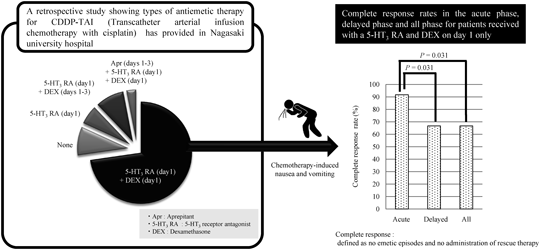
Antiemetic prophylaxis with aprepitant, a 5-hydroxytryptamine3 (5-HT3) receptor antagonist and dexamethasone is recommended for patients receiving intravenous cisplatin chemotherapy. Whether the same antiemetic regime is superior for hepatic transcatheter arterial infusion chemotherapy with cisplatin (CDDP-TAI) is unknown. We conducted a retrospective study of antiemetic prophylaxis protection against chemotherapy-induced nausea and vomiting (CINV) in CDDP-TAI at Nagasaki University Hospital. The rate of complete response (CR) to antiemetics in the acute (<24 h) and delayed phases (24–120 h) was measured. Twenty-four patients were treated with a 5-HT3 receptor antagonist (granisetron or azasetron) and dexamethasone on the day of chemotherapy (day 1 only). There was a significant difference between the CR rates in the acute and delayed phases, 91.6, and 69.7%, respectively. Combination of a 5-HT3 antagonist and dexamethasone on day 1 is effective against acute CINV, but not delayed CINV during CDDP-TAI. These results may help guide the management of nausea and vomiting during CDDP-TAI to achieve better tolerance and compliance for fewer interventions and increased favorable therapeutic outcomes.
Graphical Abstract Fullsize Image
Content from these authors
© 2016 The Pharmaceutical Society of Japan
Previous article Next article
feedback
Top