Abstract
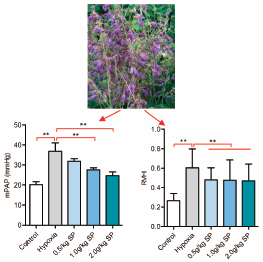
Salvia przewalskii Maxim is a traditional Chinese herbal medicine and is known to have antibacterial, antiviral, anti-oxidant, anti-thrombotic and anti-depressant properties. However, the major active components of S. przewalskii and its anti-hypoxic effects are still unclear. This study probed the major active component and anti-hypoxic activity of S. przewalskii. The major active components of S. przewalskii were detected by HPLC. The anti-hypoxic effects of S. przewalskii were detected in mice and a rat model of hypoxic preconditioning. The results showed that there are eight active components, including sodium danshensu, rosmarinic acid, lithospermic acid, salvianolic acid B, dihydrotanshinone I, cryptotanshinone, tanshinone I and tanshinone IIA, and each component showed a certain anti-hypoxic effect. Moreover, S. przewalskii enhanced anti-hypoxia in mice, which was manifested as prolonged survival time in acute hypoxic preconditioning and the amelioration of acute hypoxia-induced changes in the activity of superoxide dismutase (SOD) and lactate dehydrogenase (LDH). In addition, S. przewalskii also repaired tissue damage in chronic hypoxia by downregulating hypoxia inducible factor-1α (HIF-1α), proliferating cell nuclear antigen (PCNA), Bcl-2, CDK4, CyclinD1 and P27Kip1 and inhibiting pro-inflammatory cytokines and the RhoA–Rho-associated protein kinase (ROCK) signalling pathway. Our findings provide new insight into the anti-hypoxic effect of S. przewalskii as a promising agent for high-altitude pulmonary hypertension treatment.