Abstract
In this study, we aimed to develop a clinically applicable risk score using demographic and clinical data available at hospital admission for decompensated heart failure (HF) to identify patients at high risk of medication non-adherence after discharge. In total, 795 patients with HF were enrolled from a prospective, multicenter cohort study. A logistic regression model identified independent predictors of medication non-adherence leading to hospitalization, and we derived a risk score from the partial regression coefficients of these factors. Hospitalization due to medication non-adherence occurred in 6.4% of patients. Independent predictors included dementia (odds ratio [OR]: 2.79; 95% confidence interval [CI]: 1.38–5.65), male sex (OR: 2.50; 95% CI: 1.30–4.79), current smoking (OR: 2.17; 95% CI: 1.07–4.41), non-assisted living (OR: 2.14; 95% CI: 1.17–3.94), and prior HF hospitalization (OR: 1.91; 95% CI: 1.05–3.46). The predictive model showed good discrimination (area under the receiver operating characteristic curve = 0.704). Patients with higher risk scores (4–6 points) had significantly higher rates of all-cause and cardiovascular mortality over 2 years. In conclusion, this pragmatic, admission-based risk score enables early identification of patients at risk for medication non-adherence and may support targeted interventions to improve long-term HF outcomes. Incorporating this score into routine admission processes may help prioritize adherence support for high-risk patients, guide multidisciplinary care planning, and reduce post-discharge complications in HF management.
INTRODUCTION
Heart failure (HF) affects approximately 64 million individuals globally and significantly impairs QOL.1,2) Pharmacotherapy is central to HF management,3,4) making medication adherence essential for optimal outcomes. Medication non-adherence may exacerbate disease progression, reduce physical function, and increase the risk of hospitalization and death.3,4) However, studies—including previous work by our team5)—have demonstrated that strong social support can improve medication adherence in this patient population.6)
Despite the clinical importance of adherence, few studies have developed models to predict hospitalizations specifically due to medication non-adherence in patients with HF.
In this study, we aimed to identify individuals at high risk of medication non-adherence after discharge for decompensated HF to enable timely, targeted support.
We used data from a prospective, multicenter cohort of older adults hospitalized with acute decompensated HF (ADHF), drawn from the Kochi YOSACOI Study in Japan.5,7,8) Our goal was to develop a predictive tool to identify individuals at elevated risk of medication non-adherence.
MATERIALS AND METHODS
Patient Selection
The Kochi YOSACOI Study prospectively enrolled 1061 consecutive patients hospitalized for ADHF at six hospitals in Kochi Prefecture, Japan, between May 2017 and December 2019. If a patient had more than one hospitalization during the study period, only the first admission was included in the analysis. Subsequent hospitalizations were excluded to prevent duplication of events and ensure the independence of observations. Patients were followed up for 2 years to assess long-term clinical outcomes. Details of the study protocol have been published previously.7,8) The participating hospitals provide acute cardiovascular care in Kochi Prefecture, a region notable for its aging population, with 34.7% of residents aged ≥65 years in 2018.7)
All patients received standard guideline-directed therapy for ADHF. Eligible participants were aged ≥20 years and met the diagnostic criteria for ADHF, defined as at least two major Framingham criteria or one major criterion supported by clinical findings, chest radiography, and echocardiography.
Ethical approval was obtained from the Medical Research Ethics Committee of Kochi University of Medical Sciences (Approval No. 28-68). Informed consent was obtained from all patients or their families in accordance with the Declaration of Helsinki. Confidentiality and data anonymity were strictly maintained.
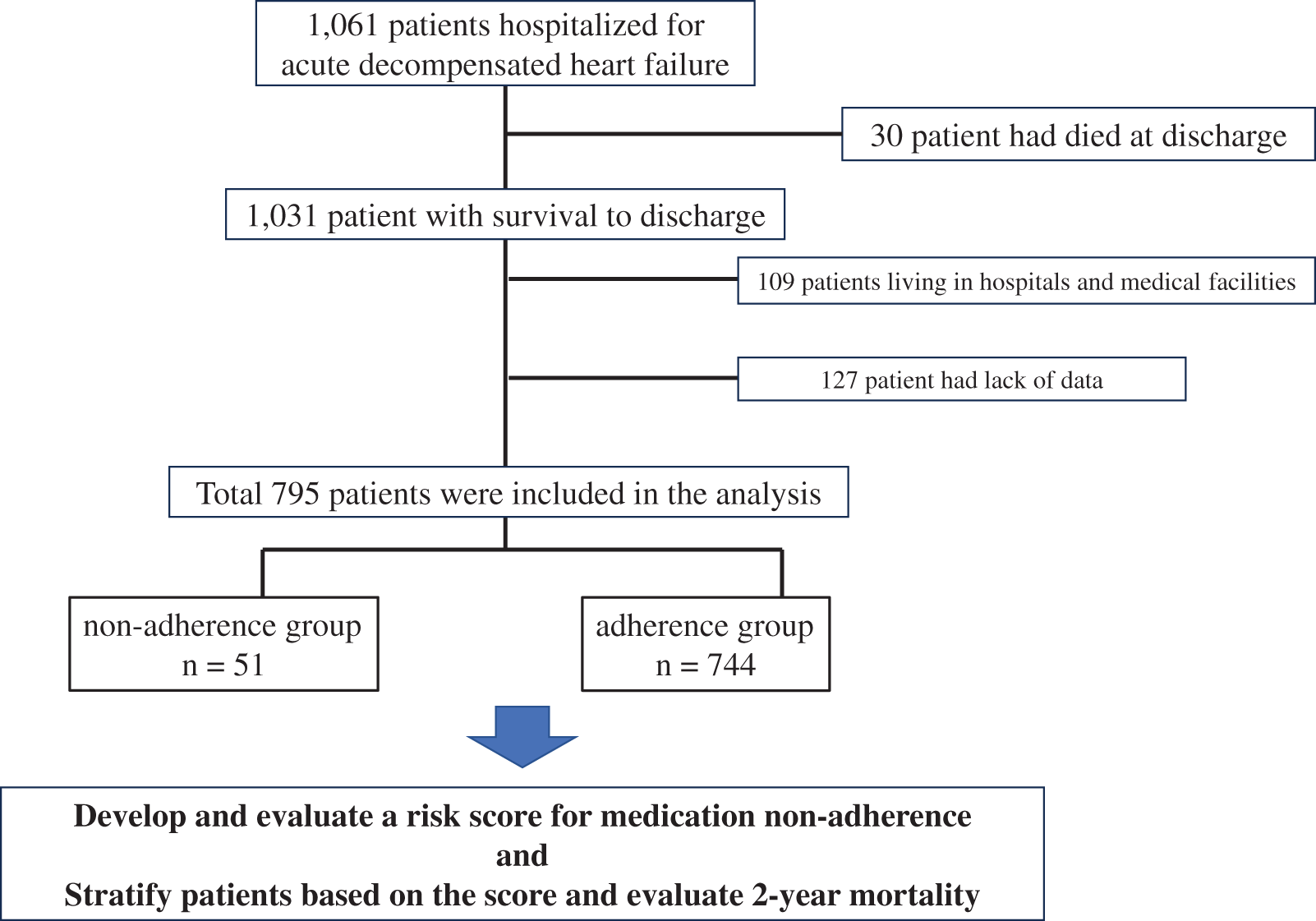
Exclusion criteria were as follows: in-hospital death (n = 30); admission from non-home settings, such as another hospital or a long-term care facility (n = 109); and incomplete data for key variables (n = 127). A total of 795 patients were included in the final analysis. Among the 127 patients excluded because of missing data in key variables, the distribution of missing values was as follows: smoking (n = 6), living support (n = 4), medication management (n = 21), history of hospitalization for HF (n = 2), combinations of these variables (n = 4), dementia assessment not performed (Hasegawa Dementia Scale-Revised [HDS-R] ≤ 20; n = 28), dementia assessment not performed and medication management missing (n = 6), missing information on medications taken at admission (n = 47), and both medication information and dementia assessment missing (n = 9). The study flow diagram is shown in Fig. 1.
Study Design
At enrollment, cardiologists completed a structured questionnaire that assessed potential causes of HF hospitalization (Supplementary Material S1). Contributing factors included excessive salt or water intake, infections, physical overexertion, medication non-adherence, inappropriate pharmacologic therapy, arrhythmia, myocardial ischemia, poor blood pressure control, and unknown causes.
Medication non-adherence was defined using a structured, standardized procedure.5) At the admission, a board-certified cardiologist conducted a structured interview with the patient and/or their family using the questionnaire in Supplementary Material S1. Based on this interview and a review of medical records, the cardiologist determined whether medication non-adherence was the primary contributing factor to the HF hospitalization. Specifically, medication non-adherence was defined as hospitalization directly caused by missed or irregular dosing of HF-related medications that have a direct physiological effect on congestion or hemodynamic stability. The medication classes evaluated included mineralocorticoid receptor antagonists (MRAs), β-blockers, renin-angiotensin system (RAS) inhibitors, and diuretics. Causality was established when all of the following criteria were met: 1) Recent objective evidence of medication non-adherence or irregular use based on patient or family report and/or inconsistencies in medication lists or prescriptions.
2) A temporal relationship indicating that the period of non-adherence preceded the onset or worsening of HF symptoms that led to hospitalization. 3) No other more plausible precipitating factor based on predefined options (e.g., infection, arrhythmia, dietary inattention) listed in Supplementary Material S1. Cases that met these criteria were classified as “hospitalization due to medication non-adherence.” All assessments were conducted by the attending cardiologist according to this standardized procedure.
Patients were categorized into two groups: those hospitalized due to medication non-adherence and those who adhered to their medication regimen. Baseline characteristics—including laboratory findings, cardiac indices (e.g., left ventricular ejection fraction, New York Heart Association classification), comorbidities (e.g., cerebrovascular disease and dementia), lifestyle factors (e.g., smoking and alcohol use), and living arrangements (e.g., presence of cohabitants or medication managers)—were compared between groups. Dementia was defined as an HDS-R score ≤20. Previous studies have demonstrated that this cutoff provides good sensitivity and specificity for identifying suspected dementia.9) The HDS-R is routinely administered in our hospital and requires less time to complete than the Mini-Mental State Examination (MMSE). In addition, because it does not include any written tasks,10) it imposes less burden on older patients with HF. Furthermore, the HDS-R was selected because it is less influenced by literacy level.
In this study, non-assisted living was defined as the absence of any caregiver or support person who provides assistance with activities of daily living or medication management at least once weekly, independent of the patient’s living arrangement. This variable reflects the presence of functional social support and was included as a binary predictor in the multivariate logistic regression analysis.
A multivariate logistic regression analysis was conducted to identify independent risk factors for hospitalization due to medication non-adherence. Variables with a p-value <0.10 in univariate analysis were included in the multivariate model. Independent predictors identified through logistic regression were utilized to develop the Heart Failure Medication Non-Adherence Risk Score. The logistic regression model was expressed as:
| log(p1−p)=β0+β1X1+β2X2+⋯+βKXK |
where p denotes the probability of non-adherence, Xi represents each risk factor (binary or continuous), and βi is the corresponding regression coefficient.
To facilitate clinical application, the smallest absolute value among the significant βi coefficients was designated as the reference (βmin). Each predictor’s score was calculated by dividing its coefficient by the reference value and rounding to the nearest integer:
Each patient’s total score was the sum of all predictor scores. Patients were then stratified into predefined risk groups to assess the relationship between the score and clinical outcomes. Two-year mortality across groups was evaluated using the Kaplan–Meier survival method. Model discrimination was assessed using the area under the receiver operating characteristic (ROC) curve (AUC), and calibration was assessed by bootstrap resampling. Baseline demographic and clinical characteristics stratified by risk group are presented in Supplementary Materials S2 and S3.
Statistical Analysis
Continuous variables are reported as medians with interquartile ranges (IQRs), and categorical variables as frequencies and percentages. The Mann–Whitney U test was used for continuous variables, and Fisher’s exact test for categorical comparisons. Multivariate logistic regression analysis estimated odds ratios (ORs) with 95% confidence intervals (CIs).
Integer values were assigned to each predictor according to the magnitude of its regression coefficient. Each patient’s total risk score was calculated by summing the assigned point values. Kaplan–Meier survival analysis and the log-rank test evaluated mortality differences among risk groups over the 2-year follow-up period. When significant intergroup differences were observed, post hoc pairwise comparisons were adjusted using the Holm method. Internal validation was performed with 1000 bootstrap resampling iterations with replacement.
A two-tailed p value <0.05 was considered significant. All statistical analyses were performed using SPSS version 22 (IBM Corp., Armonk, NY, U.S.A.) and Easy R version 1.29 (Saitama Medical Centre, Jichi Medical University, Saitama, Japan).
RESULTS
Characteristics of Patients with Medication Non-adherence in HF
Table 1 summarizes the clinical characteristics of patients hospitalized for medication non-adherence. The study cohort included 416 men and 379 women, with a median age of 81 years (IQR: 71–86). Among the 795 patients, 51 (6.4%) were hospitalized due to medication non-adherence. Compared with the adherence group, patients hospitalized for non-adherence were more likely to be men (36 cases, 70.6% vs. adherence group: 380 cases, 51.1%; p = 0.009), have a history of smoking (13 cases, 25.5% vs. 102 cases, 12.5%; p = 0.036), have dementia (13 cases, 25.5% vs. 93 cases, 12.5%; p = 0.017), and report more than two prior hospitalizations for HF (21 cases, 42.9% vs. 223 cases, 30.4%; p = 0.079).
Table 1. Baseline Characteristics of the Patients
|
Non-adherence group |
Adherence group |
p-Value |
| Number of patients |
51 |
744 |
|
| Age, years, median (IQR) |
80 (70, 85) |
81 (71, 86) |
0.33 |
| Sex, male, n (%) |
36 (70.6) |
380 (51.1) |
0.009 |
| Heart failure hospitalizations, more than twice, n (%) |
21 (42.9) |
223 (30.4) |
0.079 |
| Clinical scenario class on admission |
|
|
|
| Class 1, n (%) |
24 (47.1) |
335 (45.0) |
0.77 |
| Class 2, n (%) |
22 (43.1) |
311 (41.8) |
0.88 |
| Class 3, n (%) |
3 (5.9) |
45 (6.0) |
>0.99 |
| Class 4, n (%) |
0 (0.0) |
31 (4.2) |
– |
| Class 5, n (%) |
1 (2.0) |
7 (0.9) |
0.41 |
| Class unknown, n (%) |
1 (2.0) |
15 (2.0) |
>0.99 |
| NYHA class on admission, median (IQR) |
3 (3, 4) |
3 (3, 4) |
0.66 |
| J-CHS score |
3 (2, 4) |
3 (2, 3) |
0.20 |
| Medication |
|
|
|
| β blockers, n (%) |
29 (56.9) |
384 (51.6) |
0.56 |
| RAS inhibitors, n (%) |
28 (54.9) |
377 (50.7) |
0.57 |
| MRAs, n (%) |
19 (37.3) |
251 (33.7) |
0.65 |
| Diuretics, n (%) |
44 (86.3) |
593 (79.7) |
0.36 |
| Tolvaptan, n (%) |
16 (31.4) |
196 (26.3) |
0.42 |
| Laboratory data at admission |
|
|
|
| BNP, ρg/mL, median (IQR) |
821 (511, 1325) |
663 (434, 1102) |
0.14 |
| eGFR, mL/min/1.73 m2, median (IQR) |
51.4 (33.1, 63.0) |
45.1 (30.8, 60.7) |
0.20 |
| LVEF (%), median (IQR) |
43 (29, 62) |
46 (31, 61) |
0.68 |
| Medical history |
|
|
|
| Dementia, n (%) |
13 (25.5) |
93 (12.5) |
0.017 |
| Cerebrovascular disease, n (%) |
16 (31.4) |
254 (34.1) |
0.76 |
| Hypertension, n (%) |
37 (73) |
568 (76) |
0.50 |
| Diabetes, n (%) |
16 (31) |
229 (31) |
>0.99 |
| Dyslipidemia, n (%) |
22 (43) |
335 (45) |
0.89 |
| Habits |
|
|
|
| Current smoking, n (%) |
13 (25.5) |
102 (13.7) |
0.036 |
| Habitual drinking, n (%) |
12 (23.5) |
137 (18.4) |
0.36 |
| Eat meal alone, n (%) |
12 (23.5) |
210 (28.2) |
0.52 |
BNP: brain natriuretic peptide; eGFR: estimated glomerular filtration rate; J-CHS: Japanese version of the Cardiovascular Health Study; LVEF: left ventricular ejection fraction; MRAs: Mineralocorticoid receptor antagonists; NYHA: New York Heart Association; IQR: interquartile range; RAS: Renin–Angiotensin system. Data were expressed as median (interquartile range) or n (%).
Table 2 presents characteristics related to medication management. Patients in non-assisted living (lacking weekly support for activities of daily living) were more frequently hospitalized for non-adherence than those with assistance (20 cases, 39.2% vs. 186 cases, 25.0%; p = 0.031).
Table 2. Medication Management before Hospitalization in Patients
|
Non-adherence |
Adherence group |
p-Value |
| Medications at admission |
|
|
|
| Number of medicines, median (IQR) |
9 (7, 12) |
9 (7, 11) |
0.75 |
| 0–7, n (%) |
16 (31.4) |
255 (34.3) |
0.76 |
| 8–12, n (%) |
26 (51.0) |
353 (47.4) |
0.67 |
| 13 and above, n (%) |
9 (17.6) |
136 (18.3) |
>0.99 |
| Number of medicines for heart failure, median (IQR) |
1 (1, 2) |
1 (1, 2) |
0.32 |
| 0, n (%) |
7 (13.7) |
157 (21.1) |
0.28 |
| 1, n (%) |
22 (43.1) |
250 (33.6) |
0.17 |
| 2, n (%) |
13 (25.5) |
227 (30.5) |
0.53 |
| 3, n (%) |
9 (17.6) |
109 (14.7) |
0.54 |
| Number of times to take medicines (IQR) |
2 (1, 3) |
3 (2, 3) |
0.26 |
| 0–1, n (%) |
15 (29.4) |
180 (24.2) |
0.40 |
| 2–3, n (%) |
31 (60.8) |
465 (62.5) |
0.88 |
| 4 and above, n (%) |
5 (9.8) |
99 (13.3) |
0.67 |
| Number of times to take heart failure medicines (IQR) |
1 (1, 1) |
1 (1, 1) |
0.28 |
| 1, n (%) |
39 (76.5) |
519 (69.8) |
0.35 |
| 2, n (%) |
5 (9.8) |
68 (9.1) |
0.80 |
| Family members living together |
|
|
|
| Partner only, n (%) |
14 (28.0) |
222 (30.4) |
0.87 |
| Living with relatives, n (%) |
17 (34.0) |
322 (44.1) |
0.19 |
| Medication management |
|
|
|
| Self-administration, n (%) |
44 (86.3) |
631 (84.8) |
>0.99 |
| Family, n (%) |
3 (5.9) |
72 (9.7) |
0.47 |
| Partner, n (%) |
2 (3.9) |
33 (4.4) |
>0.99 |
| Helper, n (%) |
2 (3.9) |
8 (1.1) |
0.13 |
| Medical service |
|
|
|
| Non-assisted living, n (%) |
20 (39.2) |
186 (25.0) |
0.031 |
| Home visit medical care, n (%) |
15 (29.4) |
200 (26.9) |
0.75 |
| Outpatient service, n (%) |
8 (15.7) |
102 (13.7) |
0.68 |
IQR: interquartile range. Data were presented as median (interquartile range) or n (%).
Table 3 presents the results of the multivariate logistic regression analysis. Independent predictors of hospitalization due to medication non-adherence included dementia (OR: 2.79; 95% CI: 1.38–5.65; p = 0.004), male sex (OR: 2.50; 95% CI: 1.30–4.79; p = 0.006), current smoking (OR: 2.17; 95% CI: 1.07–4.41; p = 0.031), non-assisted living (OR: 2.14; 95% CI: 1.17–3.94; p = 0.014), and prior hospitalization for HF (OR: 1.91; 95% CI: 1.05–3.46; p = 0.034).
Table 3. Logistic Regression Analysis and Points Assigned to Predict Medication Non-adherence
|
OR |
95% CI |
p-Value |
β |
Score |
| Dementia |
2.79 |
1.38–5.65 |
0.004 |
1.03 |
2 |
| Sex, male |
2.50 |
1.30–4.79 |
0.006 |
0.92 |
1 |
| Smoking habit |
2.17 |
1.07–4.41 |
0.031 |
0.78 |
1 |
| Non-assisted living |
2.14 |
1.17–3.94 |
0.014 |
0.76 |
1 |
| Heart failure hospitalization, more than twice |
1.91 |
1.05–3.46 |
0.034 |
0.65 |
1 |
A medication non-adherence risk score was derived from these five variables using the corresponding partial regression coefficients. One point was assigned for male sex, current smoking, non-assisted living (lack of weekly support for activities of daily living), and history of multiple HF hospitalizations; dementia was assigned two points.
Calculation and Validation of the Medication Non-adherence Risk Score
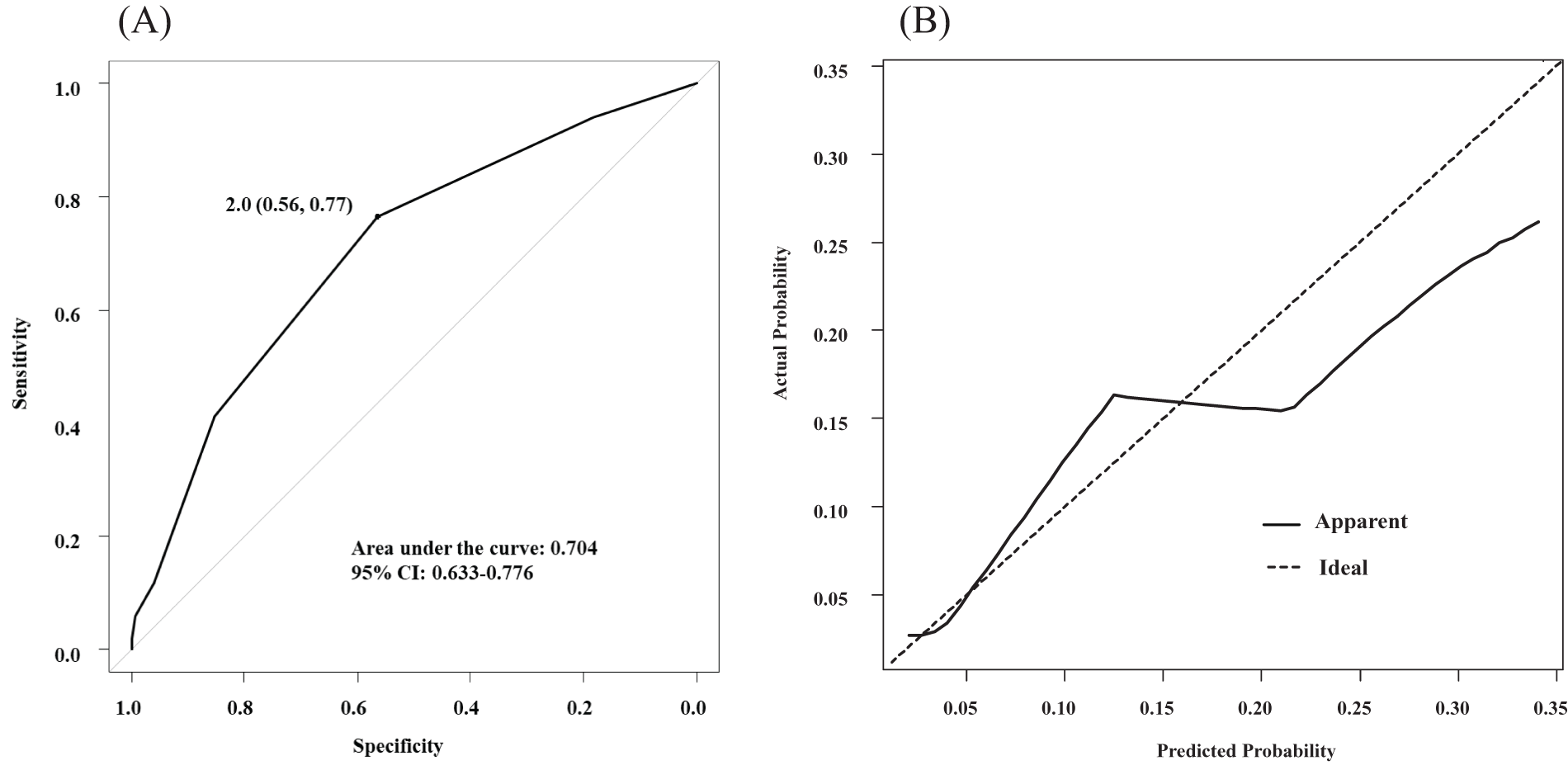
The individual risk of hospitalization due to medication non-adherence was calculated for each patient by summing the points assigned to the identified predictors. The risk score demonstrated acceptable discriminatory performance, with a c-statistic of 0.704 (95% CI: 0.633–0.776) and a bootstrap optimism-corrected c-statistic of 0.703. The optimism-adjusted calibration slope was 1.032 (Figs. 2A, 2B). Sensitivity, specificity, positive likelihood ratio, and positive predictive value of the medication non-adherence score, as applied to the YOSACOI cohort, are presented in Table 4.
Table 4. Sensitivity, Specificity, and Positive Predictive Values
| Score |
Non-adherence,
No. of cases |
Adherence,
No. of cases |
Sensitivity |
Specificity |
PPV (%) |
NPV (%) |
PLR |
NLR |
| n (%) |
n (%) |
| ≥1 |
48 (7) |
611 (93) |
94.1 |
17.9 |
7.3 |
92.7 |
1.15 |
0.33 |
| ≥2 |
39 (11) |
327 (89) |
76.5 |
56.1 |
10.7 |
89.3 |
1.74 |
0.42 |
| ≥3 |
21 (16) |
112 (84) |
41.2 |
85.0 |
15.8 |
84.2 |
2.74 |
0.69 |
| ≥4 |
6 (15) |
33 (85) |
11.8 |
95.6 |
15.4 |
84.6 |
2.65 |
0.92 |
| ≥5 |
3 (27) |
8 (73) |
5.9 |
98.9 |
27.3 |
72.7 |
5.47 |
0.95 |
NLR: negative likelihood ratio; NPV: negative predictive value; PLR: positive likelihood ratio; PPV: positive predictive value.
Patients were categorized into three groups based on their medication non-adherence score: low-risk (0–2 points), medium-risk (3 points), and high-risk (4–6 points). The cut-off values for these categories were determined using both statistical and clinical considerations. First, an ROC curve using hospitalization due to medication non-adherence as the outcome indicated that the optimal cut-off was 2 points; therefore, scores ≤2 were classified as low risk. For the remaining categories, the score distribution, clinical interpretability, and gradient of risk were evaluated. Because the number of patients with a score of 5 was extremely small and a clear difference in risk patterns was observed between scores of 3 and 4–5, a score of 3 was classified as medium risk, and scores of 4–5 as high risk. Baseline characteristics stratified by risk group are provided in Supplemental Materials S2 and S3.
Among baseline variables not included in the scoring system, significant intergroup differences were observed for clinical scenario (CS) 5 status at admission and alcohol use. No other baseline factor differed significantly across risk groups.
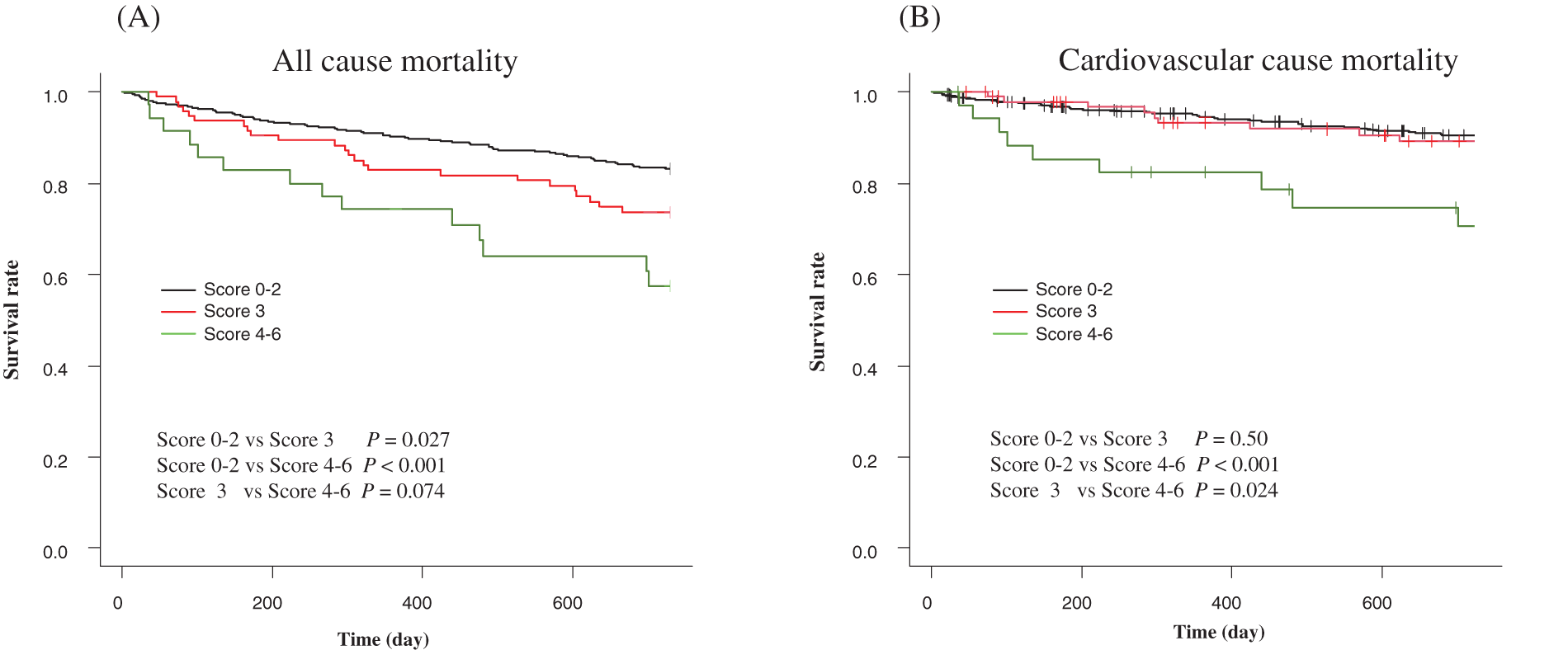
Kaplan–Meier analysis of 2-year all-cause mortality revealed survival rates of 84% in the low-risk group (0–2 points), 72% in the medium-risk group, and 37% in the high-risk group (Fig. 3A). Survival was significantly lower in the medium- and high-risk groups (log-rank test: Score 0–2 vs. Score 3, p = 0.027; Score 0–2 vs. Score 4–6, p < 0.001).
For cardiovascular mortality, survival rates were 90% in the low-risk group, 86% in the medium-risk group, and 71% in the high-risk group (Fig. 3B). Cardiovascular survival was significantly lower in the high-risk group (log-rank: Score 0–2 vs. Score 4–6, p < 0.001; Score 3 vs. Score 4–6, p = 0.024).
DISCUSSION
In this study, we identified five factors independently associated with hospitalization due to medication non-adherence in patients with HF: male sex, dementia, smoking, non-assisted living, and prior HF hospitalization. Based on these predictors, we developed a medication non-adherence risk score and demonstrated its association with both adherence behavior and long-term mortality.
HF affects millions of people globally,1) requiring intensive medical management to maintain adequate circulatory and respiratory function, particularly as the disease progresses. Recurrent acute exacerbations may ultimately lead to resting symptoms and progressive deterioration, increasing mortality risk.11,12) Preventing recurrent hospitalizations is critical, as acute decompensation episodes are often avoidable with consistent adherence to evidence-based therapies, including renin-angiotensin-aldosterone system inhibitors, sodium-glucose cotransporter 2 inhibitors, mineralocorticoid receptor antagonists, and β-blockers.13–16) Medication non-adherence is a modifiable risk factor strongly linked to adverse outcomes, including hospitalization and death.4,17) Conversely, prior studies—including those conducted by our team—have demonstrated that medication adherence improves when adequate social support is provided.5) Therefore, implementing targeted social support interventions for patients showing early signs of non-adherence may improve long-term survival.
Several studies have reported that adherence can be enhanced through multifaceted approaches, including structured medication management support, motivational interviewing, adherence-enhancing packages (e.g., calendar packaging, pillboxes, and electronic reminders), and patient education.18,19) Applying such multifaceted interventions to patients with early signs of non-adherence may therefore be effective.
Multivariate analysis identified five independent predictors of hospitalization due to medication non-adherence. Dementia, a well-established risk factor for non-adherence,20,21) likely impairs memory and executive function necessary for medication management. Male sex was associated with higher non-adherence risk, potentially reflecting lower levels of health-seeking behavior and social engagement.22,23) Current smoking, often linked to resistance to behavioral change, has also been associated with poor medication adherence.24,25) The absence of family members or other supporters in daily life makes adherence more difficult because both practical and emotional support are limited.5) Furthermore, prior HF hospitalizations may reflect underlying behavioral patterns or disease severity, suggesting a cycle of non-adherence and clinical deterioration.
The medication non-adherence score developed in this study exhibited acceptable discriminatory capacity, with an AUC of 0.704 (95% CI: 0.633–0.776). Patients were stratified into low-, medium-, and high-risk categories using a cut-off value of 2 points. During the 2-year follow-up, all-cause and cardiovascular mortality rates were significantly higher in the high-risk group than in the low-risk group. These findings suggest that the score may reflect mortality risk, potentially due to a greater likelihood of medication discontinuation among patients with higher scores. Moreover, the incorporated risk variables may independently contribute to the progression of HF. For example, smoking is a well-established aggravating factor in the clinical course of HF.26) Similarly, dementia and social isolation have been associated with worse HF outcomes, although definitive causality has not been established.27,28) Therefore, the predictive score may help identify patients at increased risk of medication non-adherence and may also serve as a surrogate marker of adverse prognosis.
However, the discriminatory ability of this predictive score was moderate (AUC = 0.704), indicating that it may not reliably distinguish between patients who will experience medication non-adherence leading to hospitalization and those who will not. Furthermore, the positive predictive value in the high-risk group (score ≥4) was relatively low at 15.4%, suggesting that many patients classified as “high risk” did not experience the outcome. This implies that the score alone may not be suitable for guiding the allocation of intensive intervention resources, particularly in resource-limited settings. Despite these limitations, a key strength of the proposed risk score is its simplicity and accessibility—it requires no laboratory data or advanced diagnostics, making it practical for bedside or outpatient use. Accordingly, the score should serve as a “trigger” to prompt further assessment or individualized support, rather than as a definitive criterion for clinical decision-making.
Despite prior reports, this study did not find polypharmacy or frequent dosing to be associated with medication non-adherence.29) As shown in Table 2, the number of medications (p = 0.75) and daily doses (p = 0.26) were not significantly associated with non-adherence in the univariate analysis and did not meet the p < 0.10 criterion for inclusion in the multivariate logistic regression model. A plausible explanation is the widespread use of adherence-enhancing strategies, including once-daily dosing regimens, which have demonstrated improved adherence in patients with HF.30) Clinicians may have proactively adjusted regimens to accommodate patient needs.
This study has some limitations. First, the Kochi YOSACOI Study population consisted primarily of older adults (median age: 81 years [IQR: 71–86]), limiting the generalizability of the findings to younger individuals with HF. Second, reliance on admission-based questionnaires may introduce selection or reporting bias.31) Third, all participants were of Japanese ethnicity and treated within a single national healthcare system; cultural, systemic, and social differences may affect the score’s external validity.32) Fourth, although the HDS-R is a standard cognitive screening tool in Japan, the MMSE is more commonly used in international research settings.33) Therefore, using the HDS-R may limit direct comparability with studies utilizing the MMSE or other internationally standardized cognitive assessments.
Despite these limitations, this study is the first to develop a predictive model for medication non-adherence among older adults with HF in a Japanese community-based setting. Further research should focus on external validation in diverse populations and healthcare systems.
CONCLUSION
We developed a medication non-adherence risk score for HF using five independent predictors identified from the Kochi YOSACOI Study cohort. The score demonstrated acceptable predictive accuracy for hospitalization due to medication non-adherence (c-statistic = 0.704; 95% CI: 0.633–0.776). All components of the score can be obtained through routine clinical assessment, making it a practical and accessible tool for identifying at-risk patients. Early identification of high-risk individuals may facilitate targeted interventions and improve long-term clinical outcomes. This risk score offers a simple, evidence-based approach for identifying patients with HF at high risk for medication non-adherence using only information available at hospital admission. Integrating the tool into routine clinical workflows could support timely implementation of adherence-promoting strategies, including social support services, medication counseling, or home-based care. The score may be particularly valuable in aging populations and resource-limited settings, where early identification of at-risk patients can help prevent avoidable readmissions and improve survival.
Acknowledgments
Saho Tsumura and Takayuki Maeda (Kochi Medical School, Kochi University); Takako Fujita and Hideyuki Matsuda (Chikamori Hospital); Naoto Osawa (Kochi Prefectural Hatakenmin Hospital); Masanori Kuwabara (Kochi Prefectural Aki General Hospital); Mana Kusunose (Susaki Kuroshio Hospital); and Yasumasa Kawada (Japanese Red Cross Kochi Hospital) were participating investigators from the study hospitals. The authors thank all the physicians for their contribution to this study.
DECLARATIONS
Funding
This work was supported by the Kochi Prefecture Sponsorship Project, Bayer Yakuhin, Ltd., Daiichi Sankyo Company Limited, Mitsubishi Tanabe Pharma Corporation, Otsuka Pharmaceutical Co., Ltd., and Takeda Pharmaceutical Company Limited.
Conflict of Interest
The authors declare no conflict of interest.
Supplementary Materials
This article contains supplementary materials.
REFERENCES
- 1) Savarese G, Becher PM, Lund LH, Seferovic P, Rosano GMC, Coats AJS. Global burden of heart failure: a comprehensive and updated review of epidemiology. Cardiovasc. Res., 118, 3272–3287 (2023).
- 2) Pallangyo P, Millinga J, Bhalia S, Mkojera Z, Misidai N, Swai HJ, Hemed NR, Kaijage A, Janabi M. Medication adherence and survival among hospitalized heart failure patients in a tertiary hospital in Tanzania: a prospective cohort study. BMC Res. Notes, 13, 89 (2020).
- 3) Silavanich V, Nathisuwan S, Phrommintikul A, Permsuwan U. Relationship of medication adherence and quality of life among heart failure patients. Heart Lung, 48, 105–110 (2019).
- 4) Fitzgerald AA, Powers JD, Ho PM, Maddox TM, Peterson PN, Allen LA, Masoudi FA, Magid DJ, Havranek EP. Impact of medication nonadherence on hospitalizations and mortality in heart failure. J. Card. Fail., 17, 664–669 (2011).
- 5) Kawada K, Kubo T, Ishida T, Jobu K, Morisawa S, Hamada T, Baba Y, Kawai K, Nakaoka Y, Yabe T, Furuno T, Yamada E, Fukuda H, Ohta T, Hayashi T, Kitaoka H, Miyamura M. Assisted living and medication adherence in super-aged patients with heart failure in the Japanese Population1. J. Cardiovasc. Pharmacol., 79, 467–471 (2022).
- 6) Wu JR, Frazier SK, Rayens MK, Lennie TA, Chung ML, Moser DK. Medication adherence, social support, and event-free survival in patients with heart failure. Health Psychol., 32, 637–646 (2013).
- 7) Hamada T, Kubo T, Kawai K, Nakaoka Y, Yabe T, Furuno T, Yamada E, Kitaoka H. Frailty in patients with acute decompensated heart failure in a super-aged regional Japanese cohort. ESC Heart Fail., 8, 2876–2888 (2021).
- 8) Ishida T, Kawada K, Jobu K, Hamada T, Kubo T, Okazaki M, Kawai K, Nakaoka Y, Yabe T, Furuno T, Yamada E, Kitaoka H, Hamada Y. Impact of comorbid constipation on the survival of patients with heart failure: a multicenter, prospective cohort study conducted in Japan. Front. Cardiovasc. Med., 11, 1470216 (2024).
- 9) Imai Y, Hasegawa K. The revised Hasegawa’s dementia scale (HDS-R): evaluation of its usefulness as a screening test for dementia. J Hong Kong Coll Psychiatr, 2, 20–24 (1994).
- 10) Rosli R, Tan MP, Gray WK, Subramanian P, Chin AV. Cognitive assessment tools in Asia: a systematic review. Int. Psychogeriatr., 28, 189–210 (2016).
- 11) Greene SJ, Bauersachs J, Brugts JJ, Ezekowitz JA, Lam CSP, Lund LH, Ponikowski P, Voors AA, Zannad F, Zieroth S, Butler J. Worsening Heart Failure: Nomenclature, Epidemiology, and Future Directions: JACC Review Topic of the Week. J. Am. Coll. Cardiol., 81, 413–424 (2023).
- 12) McDonagh TA, Metra M, Adamo M, et al. Corrigendum to: 2021 ESC Guidelines for the diagnosis and treatment of acute and chronic heart failure: developed by the Task Force for the diagnosis and treatment of acute and chronic heart failure of the European Society of Cardiology (ESC) with the special contribution of the Heart Failure Association (HFA) of the ESC. Eur. Heart J., 42, 4901 (2021).
- 13) Kawada K, Ishida T, Fukuda H, Hyohdoh Y, Kubo T, Hamada T, Baba Y, Hayashi T, Aizawa F, Yagi K, Izawa-Ishizawa Y, Niimura T, Abe S, Goda M, Kitaoka H, Ishizawa K. Effects of renin-angiotensin system inhibitor and beta-blocker use on mortality in older patients with heart failure with reduced ejection fraction in Japan. Front. Cardiovasc. Med., 11, 1377228 (2024).
- 14) McMurray JJV, Solomon SD, Inzucchi SE, et al. Dapagliflozin in patients with heart failure and reduced ejection fraction. N. Engl. J. Med., 381, 1995–2008 (2019).
- 15) McMurray JJ, Packer M, Desai AS, et al. Angiotensin-neprilysin inhibition versus enalapril in heart failure. N. Engl. J. Med., 371, 993–1004 (2014).
- 16) Heidenreich PA, Bozkurt B, Aguilar D, et al. 2022 AHA/ACC/HFSA guideline for the management of heart failure: executive summary: a report of the American College of Cardiology/American Heart Association Joint Committee on clinical practice guidelines. J. Am. Coll. Cardiol., 79, 1757–1780 (2022).
- 17) Ho PM, Bryson CL, Rumsfeld JS. Medication adherence: its importance in cardiovascular outcomes. Circulation, 119, 3028–3035 (2009).
- 18) Al-Arkee S, Al-Ani O. Community pharmacist-led interventions to improve medication adherence in patients with cardiovascular disease: a systematic review of randomised controlled trials. Int. J. Pharm. Pract., 31, 269–275 (2023).
- 19) Farhana L, Rahayu FP, Sholihah S, Sweileh W, Abdulah R, Alfian SD. Effectiveness of pharmacist-led intervention on medication adherence in chronic diseases: a systematic review of randomized controlled trials. Patient Prefer. Adherence, 19, 2161–2178 (2025).
- 20) Thaler NS, Sayegh P, Arentoft A, Thames AD, Castellon SA, Hinkin CH. Increased neurocognitive intra-individual variability is associated with declines in medication adherence in HIV-infected adults. Neuropsychology, 29, 919–925 (2015).
- 21) Arlt S, Lindner R, Rösler A, von Renteln-Kruse W. Adherence to medication in patients with dementia: predictors and strategies for improvement. Drugs Aging, 25, 1033–1047 (2008).
- 22) Kremenchugsky S, Wick JY. Medication safety, adherence, and deprescribing in patients with dementia. Sr. Care Pharm., 34, 351–362 (2019).
- 23) Dunlay SM, Eveleth JM, Shah ND, McNallan SM, Roger VL. Medication adherence among community-dwelling patients with heart failure. Mayo Clin. Proc., 86, 273–281 (2011).
- 24) El-Saifi N, Moyle W, Jones C, Tuffaha H. Medication adherence in older patients with dementia: a systematic literature review. J. Pharm. Pract., 31, 322–334 (2018).
- 25) Aune D, Schlesinger S, Norat T, Riboli E. Tobacco smoking and the risk of heart failure: a systematic review and meta-analysis of prospective studies. Eur. J. Prev. Cardiol., 26, 279–288 (2019).
- 26) Kamimura D, Cain LR, Mentz RJ, White WB, Blaha MJ, DeFilippis AP, Fox ER, Rodriguez CJ, Keith RJ, Benjamin EJ, Butler J, Bhatnagar A, Robertson RM, Winniford MD, Correa A, Hall ME. Cigarette smoking and incident heart failure: insights from the Jackson Heart Study. Circulation, 137, 2572–2582 (2018).
- 27) Cannon JA, Moffitt P, Perez-Moreno AC, Walters MR, Broomfield NM, McMurray JJV, Quinn TJ. Cognitive impairment and heart failure: systematic review and meta-analysis. J. Card. Fail., 23, 464–475 (2017).
- 28) Chen H, Liu F, Luo J, Tu Y, Huang S, Zhu W. Association of living alone with clinical outcomes in patients with heart failure: a systematic review and meta-analysis. Clin. Cardiol., 47, e24153 (2024).
- 29) Stolfo D, Iacoviello M, Chioncel O, et al. How to handle polypharmacy in heart failure. A clinical consensus statement of the Heart Failure Association of the ESC. Eur. J. Heart Fail., 27, 747–759 (2025).
- 30) Schroeder K, Fahey T, Ebrahim S. How can we improve adherence to blood pressure-lowering medication in ambulatory care? Systematic review of randomized controlled trials. Arch. Intern. Med., 164, 722–732 (2004).
- 31) Oosterom-Calo R, van Ballegooijen AJ, Terwee CB, te Velde SJ, Brouwer IA, Jaarsma T, Brug J. Determinants of adherence to heart failure medication: a systematic literature review. Heart Fail. Rev., 18, 409–427 (2013).
- 32) El-Zein RS, Mohammed M, Nguyen DD, Hill CL Jr, Thomas L, Nassif M, DeVore AD, Albert NM, Butler J, Patterson JH, Williams FB, Hernandez A, Fonarow GC, Spertus JA. Association of medication adherence and health status in heart failure with reduced ejection fraction: insights from the CHAMP-HF registry. Circ. Cardiovasc. Qual. Outcomes, 17, e010211 (2024).
- 33) Chun CT, Seward K, Patterson A, Melton A, MacDonald-Wicks L. Evaluation of available cognitive tools used to measure mild cognitive decline: a scoping review. Nutrients, 13, 3974 (2021).