Experimental
ChemistryTLC was performed using aluminum plates pre-coated with silica gel 60 or 60 F254 (Merck, Germany) and visualized by iodine or UV light (254 nm). Melting points were determined on a Böetius PHMK (Veb Analytik Dresden, Germany) apparatus. The NMR spectra were recorded on a Varian Gemini 300 and Bruker DRX 400 spectrometer at 25°C, unless otherwise stated. 1H-NMR and 13C-NMR signals were referenced to tetramethylsilane and the solvent shift ((CD3)2SO δ H 2.50 and δC 39.5). Coupling constants are given in Hz and without sign. The IR-spectra were recorded (KBr) on a Jasco FT/IR-410 instrument. Mass spectrometry was carried out on a Varian FINNIGAN MAT 212 instrument and the elemental analysis on the PerkinElmer, Inc. 240 instrument. The Anti-cancer evaluation was performed at National Research Center (NRC), Dokki, Cairo, Egypt.
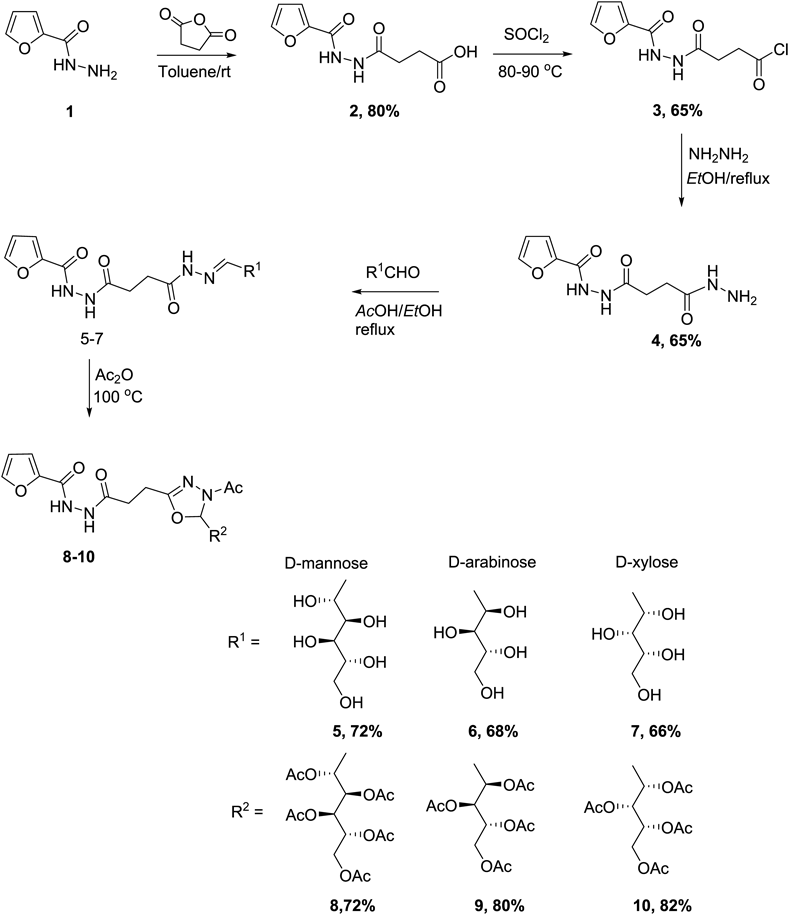
4-(2-(Furan-2-carbonyl)hydrazinyl)-4-oxobutanoic Acid (2)A solution of furan-2-carbohydrazide (1.29 g, 10 mmol) and succinic anhydride (1.02 g, 10 mmol) in toluene (20 mL) was stirred at room temperature for 24 h. The solvent was evaporated under reduced pressure at 50°C to give a residue, which was triturated with diethyl ether (25 mL) to afford a solid which was filtered, dried and crystallized from ethanol to afford compound 2 as a yellowish solid. Yield: 1.85 g, 80%; mp 148–149°C; 1H-NMR (DMSO-d6) δ/ppm: 3.04 (t, 2H, J = 6.2 Hz, CH2), 3.15 (t, 2H, J = 6.2 Hz, CH2), 6.70 (m, 1H, furanH-4), 7.58 (d, 1H, J = 7.4 Hz, furan H-3), 8.12 (d, 1H, J = 7.6 Hz, furanH-5), 9.24 (br s, 1H, NH exchangeable), 9.50 (br s, 1H, NH exchangeable), 11.84 (s, 1H, OH); 13C-NMR (DMSO-d6) δ: 30.5, 31.8 (2CH2), 111.5, 115.3, 143.0, 146.5 (furyl-C), 158.2, 168.1, 175 (3C = O); IR (KBr) cm−1, ν: 3344 (OH), 3335, 3243 (NH), 2925 (CH), 1740, 1686 (C=O); MS m/z: 226 (M+, 12%). Anal. Calcd for C9H10N2O5 (226.19): C, 47.79; H, 4.46; N, 12.39; Found: C, 48.0; H, 4.48; N, 12.50.
4-(2-(Furan-2-carbonyl)hydrazinyl)-4-oxobutanoyl Chloride (3)A solution of the carboxylic acid derivative 2 (1.98 g, 10 mmol) and a catalytic amount of N,N-dimethylformamide (DMF) in thionyl chloride (5 mL) was stirred at 80–90°C for 5 h. After removal of half of the solvent under reduced pressure, the formed precipitate was filtered, washed with cold ethanol, dried and recrystallized from methanol to give the acid chloride 3 as a brownish solid. Yield: 1.586 g, 65%; mp 178–179°C; 1H-NMR (DMSO-d6) δ/ppm: 3.05 (t, 2H, J = 6.2 Hz, CH2), 3.16 (t, 2H, J = 6.2 Hz, CH2), 6.62 (m, 1H, furanH-4), 7.57 (d, 1H, J = 7.4 Hz, furan H-3), 8.09 (d, 1H, J = 7.6 Hz, furan H-5), 9.25 (br s, 1H, NH exchangeable), 9.50 (br s, 1H, NH exchangeable). 13C-NMR (DMSO-d6) δ: 30.5, 42.8 (2CH2), 111.5, 115.3, 143.0, 146.5 (furyl-C), 158.2, 168.1, 176.0 (3C = O): IR (KBr) cm−1, ν: 3330, 3133 (NH), 2924 (CH), 1726 (C=O), 1650 (C=O); MS m/z: 244 (M+, 14); Anal. Calcd for C9H9ClN2O4 (244.63): C, 44.19; H, 3.71; N, 11.45; Found: C, 44.12; H, 3.82; N, 11.71.
N′-(Furan-2-carbonyl)succinohydrazide (4)Hydrazine hydrate (2 mL) was added blow (5°C) using ice bath to a solution of acid chloride derivative 3 (2.16 g, 10 mmol) in ethanol (50 mL) then stirred for 15 min at room temperature and then refluxed for 5 h.The reaction mixture was allowed to cool and stand at room temperature for about 5 h and the precipitated product was filtered and dried to give acid hydrazide 4 as yellowish solid. Yield: 1.56 g, 65%; mp 188–189°C; 1H-NMR (DMSO-d6) δ/ppm: 3.26 (t, 2H, J = 6.6 Hz, CH2), 3.53 (t, 2H, J = 6.6 Hz, CH2), 5.22 (br s, 2H, NH2 exchangeable), 6.71 (m, 1H, furanH-4), 7.55 (m, 1H, furanH-3), 8.14 (d, 1H, J = 7.6 Hz, furanH-5), 9.14 (br s, 1H, NH exchangeable), 9.50 (br s, 1H, NH exchangeable), 10.12 (br s, 1H, NH exchangeable); 13C-NMR (DMSO-d6) δ: 33.5, 34.0 (2CH2), 111.5, 115.3, 143.0, 146.5 (furyl-C), 158.2, 168.1, 176.0 (3C = O); IR (KBr) cm−1, ν: 3431, 3330 (NH, NH2), 2926 (CH), 1640 (C=O), 1655 (C=O); MS m/z: 240 (M+, 88%). Anal. Calcd for C9H12N4O4 (240.22): C, 45.00; H, 5.04; N, 23.32; Found: C, 44.88; H, 5.09; N, 23.28.
Sugar N′-(3-Hydrazinyl-3-oxopropyl)furan-2-carbohydrazones (5–7)General Procedure: The monosaccharide namely; D-mannose, D-arabinose or D-xylose (6 mmol) dissolved in water (1 mL) was added to a solution of the hydrazide 4 (5 mmol) in ethanol (20 mL) containing glacial acetic acid (0.3 mL). The reaction mixture was heated at reflux temperature for 4 h then concentrated till removal of half of the amount of solvent and left to cool at room temperature. The formed precipitate was filtered off, washed with water and cold ethanol, then dried and recrystallized from ethanol to give compounds 5–7, respectively.
D-Mannose N′-(3-Hydrazinyl-3-oxopropyl)furan-2-succinohydrazide (5)Yield: 2.89 g, 72%; mp 289–290°C; 1H-NMR (DMSO-d6) δ/ppm: 3.23 (t, 2H, J = 6.6 Hz, CH2), 3.37–3.42 (m, 2H, H-6′, H-6″), 3.52 (t, 2H, J = 6.6 Hz, CH2), 3.62–3.65 (m, 1H, H-5′), 4.18–4.25 (m, 2H, H-4′, H-3′), 4.41–4.52 (m, 3H, H-2′, 2OH), 4.85–4.91 (m, 2H, 2OH), 5.39 (m, 1H, OH), 6.76 (m, 1H, furan H-4), 7.55 (m, 2H, furan H-3, H-1′), 8.15 (d, 1H, J = 7.6 Hz, furan H-5), 10.06 (br s, 1H, NH exchangeable), 10.25 (br s, 1H, NH exchangeable), 10.50 (br s, 1H, NH exchangeable); 13C-NMR (DMSO-d6) δ: 35.8, 46.9 (2CH2), 63.7 (C-6) 66.4 (C-5), 69.8 (C-4), 71.3 (C-3), 73.4 (C-2), 111.5, 115.3, 143.0, 146.5, 154.3 (furyl-C, C-1), 163.2, 168.1, 175 (3C = O); IR (KBr) cm−1, ν: 3433–3405 (OH), 3250 (NH), 2923 (CH), 1652 (C=O), 1633 (C=O), 1618 (C=N); Anal. Calcd for C15H22N4O9 (402.36): C, 44.78; H, 5.51; N, 13.92. Found: C, 44.97; H, 5.88; N, 13.80.
D-Arabinose N′-(3-Hydrazinyl-3-oxopropyl)furan-2-succinohydrazide (6)Yield: 2.52 g, 68%; mp 280–281°C; 1H-NMR (DMSO-d6) δ/ppm: 3.23 (t, 2H, J = 6.6 Hz, CH2), 3.52 (t, 2H, J = 6.6 Hz, CH2), 3.62–3.67 (m, 2H, H-5′, H5″), 3.75–3.78 (m, 1H, H-4′), 4.31–4.34 (m, 1H, H-3′), 4.41 (dd, 1H, J = 6.8, J = 7.6 Hz, H-2′), 4.91–4.94 (m, 1H, OH), 4.99 (m, 1H, OH), 5.19–5.23 (m, 2H, 2OH), 6.78 (m, 1H, furan H-4), 8.30–8.35 (m, 3H, furan H-3, H-1′, H-5), 9.50 (br s, 1H, NH exchangeable), 10.06 (br s, 1H, NH exchangeable), 11.75 (s, 1H, NH exchangeable). 13C-NMR (DMSO-d6) δ: 35.4, 46.8 (2CH2), 64.1 (C-5) 67.1 (C-4), 69.7 (C-3), 73.4 (C-2), 111.5, 115.3, 143.0, 146.5, 153.6 (furyl-C, C-1), 159.8, 167.8, 175 (3C = O); IR (KBr) cm−1, ν: 3427–3404 (OH), 3333 (NH), 2924 (CH), 1657 (C=O), 1642 (C=O), 1618 (C=N); Anal. Calcd for C14H20N4O8 (372.33): C, 45.16; H, 5.41; N, 15.05; Found: C, 45.02; H, 5.50; N, 15.37.
D-Xylose N′-(3-Hydrazinyl-3-oxopropyl)furan-2-succinohydrazide (7)Yield: 2.45 g, 66%; mp 283–284°C; 1H-NMR (DMSO-d6) δ/ppm: 3.25 (t, 2H, J = 6.6 Hz, CH2), 3.54 (t, 2H, J = 6.6 Hz, CH2), 3.62–3.67 (m, 2H, H-5′, H-5″), 3.75–3.78 (m, 1H, H-4′), 4.35–4.41 (m, 2H, H-3′, 2′), 4.91–4.99 (m, 2H, 2OH), 5.19–5.25 (m, 2H, 2OH), 6.90 (m, 1H, furan H-4), 7.58–7.61 (m, 2H, furan H-3, H-1′), 8.17 (d, 1H, J = 7.6 Hz, furan H-5), 9.50 (br s, 1H, NH exchangeable), 10.25 (br s, 1H, NH exchangeable), 11.06 (br s, 1H, NH exchangeable); 13C-NMR (DMSO-d6) δ: 35.4, 46.8 (2CH2), 64.1 (C-5) 67.1 (C-4), 69.7 (C-3), 73.4 (C-2), 111.5, 115.3, 143.0, 146.5, 153.6 (furyl-C, C-1), 159.8, 167.8, 175 (3C = O); IR (KBr) cm−1, ν: 3438–3398 (OH), 3246 (NH), 2923 (CH), 1638–1642 (C=O), 1618 (C=N); Anal. Calcd for C14H20N4O8 (372.33): C, 45.16; H, 5.41; N, 15.05; Found: C, 45.05; H, 5.48; N, 15.19.
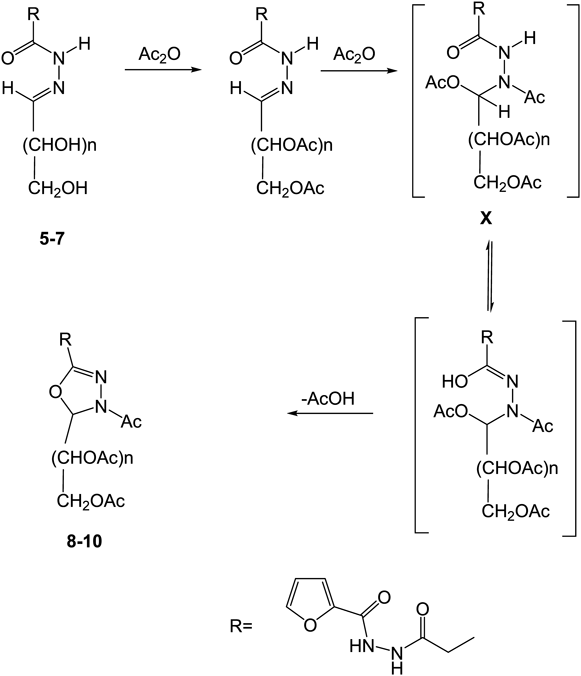
5-(O-Acetyl Sugar)-1-(3-acetyl-5-(2-(furan-2-carbonyl)hydrazinyl)ethyl)-2,3-dihydro-1,3,4-oxadiazole (8–10)General Procedure: A solution of the sugar hydrazones 5–7 (5 mmol) in acetic anhydride (10 mL) was heated at 100°C while connected with reflux condenser for 3 h. The resulting solution was cooled then ice-cold water (50 mL) was added with continuous shaking. The product was extracted with chloroform (40 mL) followed by addition of sodium hydrogen carbonate and the mixture was stirred for 45 min then filtered. The solvent was dried with calcium chloride and evaporated till dryness to afford the corresponding oxadiazoline substituted acetyl sugar derivatives 8–10.
N′-(2-(4-Acetyl-5-(penta-O-acetyl-D-mannopentitolyl)-4,5-dihydro-1,3,4-oxadiazol-2-yl)ethyl)furan-2-succinohydrazide (8)Yield: 4.70 g, 72%; brownish foam; mp 127–129°C;1 H-NMR (DMSO-d6) δ/ppm: 1.98, 1.99, 2.01, 2.02, 2.05, 2.18 (6s, 18H, 6CH3), 3.53 (t, 2H, J = 6.6 Hz, CH2), 3.64 (t, 2H, J = 6.6 Hz, CH2), 3.97–4.05 (m, 2H, H-5′, H-5″), 4.86 (m, 1H, H-4′), 4.94 (dd, 1H, J = 6.5, J = 7.4 Hz, H-3′), 5.25 (t, 1H, J = 7.4 Hz, H-2′), 5.41 (dd, 1H,J = 7.4, J = 8.8 Hz, H-1′), 5.78 (d, 1H, J = 8.8 Hz, oxadiazoline H-5), 6.61 (m, 1H, furan H-4), 7.18 (d, 1H, J = 7.8 Hz, furanH-3), 7.88 (d, 1H, J = 7.6 Hz, furan H-5), 9.25 (s, 1H, NH exchangeable), 9.5 (s, 1H, NH exchangeable). 13C-NMR (DMSO-d6) δ: 19.7, 20.1, 20.3, 20.7, 21.1, 23.4 (6CH3) 35.7, 44.3 (2CH2), 61.8 (C-5), 62.9 (C-4), 67.5 (C-3), 69.5 (C-2), 74.7 (C-1), 88.7 (oxadiazoline C-2), 111.5, 115.3, 143.0, 146.5, 156.2 (furyl-C, oxadiazoline C-5), 159.1, 165.5, 169.1, 169.4, 169.7, 169.9, 170.3, 175 (8C = O); IR (KBr) cm−1, ν: 3259 (NH), 2923 (CH), 1740 (C=O), 1637 (C=O), 1617 (CN); Anal. Calcd for C27H34N4O15 (654.58): C, 49.54; H, 5.24; N, 8.56; Found: C, 49.21; H, 5.03; N, 8.39.
N′-(2-(4-Acetyl-5-(tetra-O-acetyl-D-arabinotetritolyl)-4,5-dihydro-1,3,4-oxadiazol-2-yl)ethyl)furan-2-succinohydrazide (9)Yield: 4.656 g, 80%; 153–154°C;1H-NMR (DMSO-d6) δ/ppm: 1.99, 2.00, 2.01, 2.02, 2.05 (5s, 15H, 5CH3), 3.67 (t, 2H, J = 6.6 Hz, CH2), 3.77–4.03 (m, 4H, CH2, H-4′, H-4″), 4.88–4.94 (m, 2H, H-3′, H-2′), 5.25 (t, 1H, J = 7.4 Hz, H-1′), 5.80 (d, 1H, J = 8.8 Hz, oxadiazoline H-5), 6.69 (m, 1H, furan H-4), 7.22 (d, 1H, J = 7.8 Hz, furanH-3), 8.68 (d, 1H, J = 7.6 Hz, furan H-5), 9.50 (s, 1H, NH exchangeable), 10.07 (s, 1H, NH exchangeable); 13C-NMR (DMSO-d6): δ 20.1, 20.4, 20.7, 21.2, 23.5 (5CH3), 35.7, 44.5 (2CH2), 62.9 (C-4), 63.7 (C-3), 72.3 (C-2), 76.7 (C-1), 88.2 (oxadiazoline C-2), 111.5, 115.3, 143.0, 146.5, 156.8 (furyl-C, oxadiazoline C-5), 159.2, 165.5, 169.3, 169.6, 169.0, 170.2, 175 (7 C=O); IR (KBr) cm−1, ν: 3278 (NH), 2923 (CH), 1742 (C=O), 1644 (C=O), 1615 (C=N); Anal. Calcd for C24H30N4O13 (582.52): C, 49.49; H, 5.19; N, 9.62; Found: C, 49.24; H, 5.14; N, 9.76.
N′-(2-(4-Acetyl-5-(tetra-O-acetyl-D-xylotetritolyl)-4,5-dihydro-1,3,4-oxadiazol-2-yl)ethyl)-furan-2-succinohydrazide (10)Yield: 4.77 g, 82%; mp 136–137°C; 1H-NMR (DMSO-d6) δ/ppm: 1.98, 1.99, 2.01, 2.04, 2.19 (5s, 15H, 5CH3), 3.63 (t, 2H, J = 6.6 Hz, CH2), 3.75–4.03 (m, 4H, CH2, H-4′, H-4″), 4.86–4.93 (m, 2H, H-3′, H-2′), 5.25 (dd, 1H, J = 7.4, 5.6 Hz, H-1′), 5.80 (d, 1H, J = 8.8 Hz, oxadiazoline H-5), 6.63 (m, 1H, furanH-4), 7.19 (d, 1H, J = 7.8 Hz, furanH-3), 7.89 (d, 1H, J = 7.6 Hz, H-5 furan), 7.91 (s, 1H, NH exchangeable), 9.50 (s, 1H, NH exchangeable); 13C-NMR (DMSO-d6) δ: 20.1, 20.4, 20.7, 21.2, 23.5 (5CH3), 35.7, 44.5 (2CH2), 62.9 (C-4), 63.7 (C-3), 72.3 (C-2), 76.7 (C-1), 88.2 (oxadiazoline C-2), 111.5, 115.3, 143.0, 146.5, 156.8 (furyl-C, oxadiazoline C-5), 159.2, 165.5, 169.3, 169.6, 169.0, 170.2, 177 (7C = O); IR (KBr) cm−1, ν: 3278 (NH), 2924 (CH), 1741 (C=O), 1633 (C=O), 1564 (C=N); Anal. Calcd for C24H30N4O13 (582.52): C, 49.49; H, 5.19; N, 9.62; Found: C, 49.21; H, 5.11; N, 9.80.
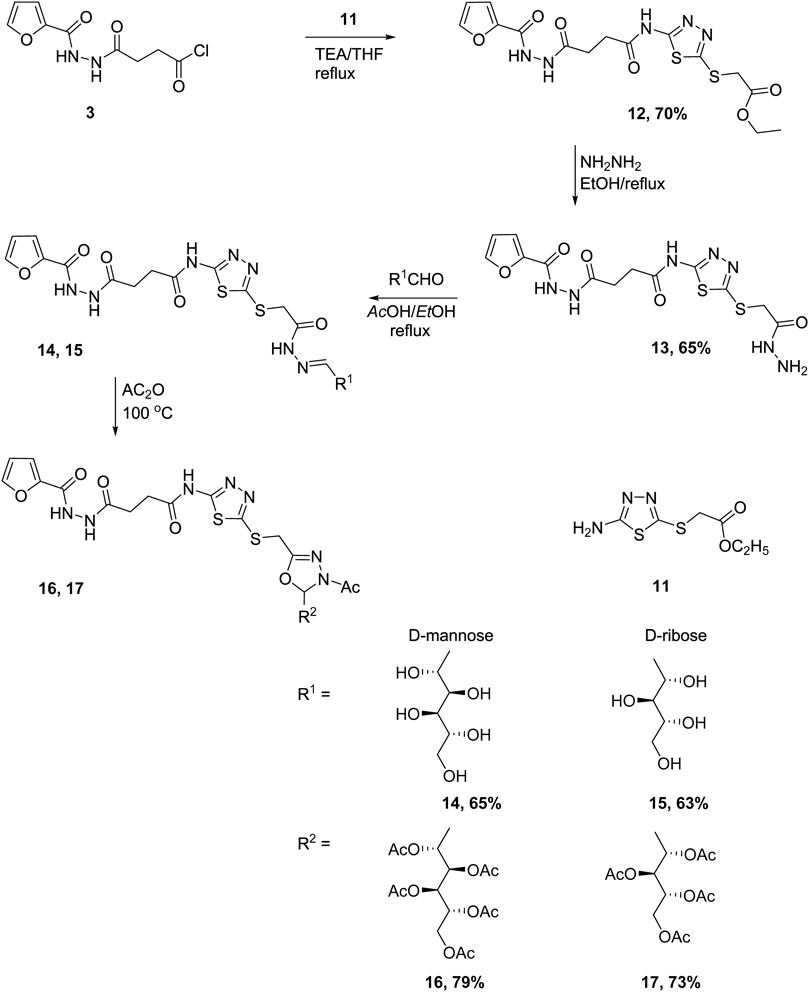
Ethyl 2-((5-(4-(2-(Furan-2-carbonyl)hydrazinyl)-4-oxobutanamido)-1,3,4-thiadiazol-2-yl)-thio)acetate (12)Triethyl amine (0.35 mL) was added to a well stirred solution of the acid chloride 3 (2.16 g, 10 mmol) and ethyl 2-((5-amino-1,3,4-thiadiazol-2-yl)thio)acetate 11 (2.19 g, 10 mmol) in tetrahydrofuran (THF) (30 mL), then the mixture was heated under reflux for 5 h at which TLC indicated full consumption of the starting compounds. Crushed ice was added and the precipitated product was filtered off and recrystallized from acetic acid to give yellow crystals of compound 12.
Yield: 2.989 g, 70%; mp 175–176°C; 1H-NMR (DMSO-d6) δ/ppm: 1.17 (t, 3H, J = 6.2 Hz, CH3), 3.64 (t, 2H, J = 6.6 Hz, CH2), 3.96 (t, 2H, J = 6.6 Hz, CH2), 4.13–4.20 (m, 4H, 2CH2), 6.65–6.74 (m, 2H, NH, furanH-4), 7.03 (d, 1H, J = 7.6 Hz, furanH-3), 7.29 (d, 1H, J = 7.8 Hz, furanH-5), 9.50 (s, 1H, NH exchangeable), 11.65 (s, 1H, NH exchangeable); 13C-NMR (DMSO-d6) δ: 14.2 (CH3), 31.9, 32.4, 33.5, 60.1 (4 CH2), 111.5, 115.3, 143.0, 146.5 (furyl-C), 152, 164 (thiadiazole-C), 157, 167, 173, 177 (4CO); IR (KBr) cm−1, ν 3278 (NH), 2922 (CH), 1735 (C=O), 1630 (C=O), 1618 (CN); MS m/z: 426 (M+ - 1, 15%). Anal. Calcd for C15H17N5O6S2 (427.45): C, 42.15; H, 4.01; N, 16.38; Found: C, 42.25; H, 4.21; N, 16.29.
4-(2-(Furan-2-carbonyl)hydrazinyl)-N-(5-((2-hydrazinyl-2-oxoethyl)thio)-1,3,4-thiadiazol-2-yl)-4-oxobutanamide (13)A solution of the thiadiazolyl ester 12 (3.83 g, 10 mmol) and hydrazine hydrate (98%) (2 mL) in absolute ethanol (30 mL) was heated under reflux for 6 h. The resulting mixture was cooled and left to stand at room temperature for 6 h. The formed precipitate was filtered, dried then recrystallized from ethanol–acetic acid mixture (1 : 1) to give compound the hydrazide product 13 as a yellow solid. Yield: 2.684 g, 65%; mp 250–251°C; 1H-NMR (DMSO-d6) δ/ppm: 3.27 (t, 2H, J = 6.6 Hz, CH2), 3.51 (t, 2H, J = 6.6 Hz, CH2), 4.12 (s, 2H, CH2), 5.29 (m, 2H, NH2 exchangeable), 6.61 (m, 1H, furanH-4), 7.56 (m, 1H, furanH-3), 8.10 (d, 1H, J = 7.6 Hz, furanH-5), 9.17–9.25 (br s, 2H, 2NH exchangeable), 9.50 (br s, 1H, NH exchangeable), 10.18 (br s, 1H, NH); 13C-NMR (DMSO-d6) δ: 31.9, 32.4, 33.5 (3CH2), 111.5, 115.3, 143.0, 146.5 (furyl-C), 152, 164 (thiadiazole-C), 157, 170, 173, 177 (4CO); IR (KBr) cm−1, ν 3430, 3305 (NH, NH2), 2920 (CH), 1658 (C=O), 1615 (CN); MS m/z: 413 (M+, 44%). Anal. Calcd for C13H15N7O5S2 (413.43): C, 37.77; H, 3.66; N, 23.72; Found: C, 37.79; H, 3.67; N, 23.59.
General Procedure for the Synthesis of Sugar Hydrazone Derivatives (14, 15)To a solution of the acid hydrazide 13 (10 mmol) in ethanol (20 mL) 3–5 drops of glacial acetic acid have been added. D-Mannose or D-arabinose (10 mmol) suspended in water (1 mL) was added and the mixture was refluxed for 6 h at which TLC indicated full consumption of the starting compounds. The resulting solution was concentrated and left to stand at room temperature overnight. The formed precipitate was filtered off, washed with water and cold ethanol, then dried and recrystallized from ethanol to give the sugar hydrazones 14 or 15, respectively.
3-(2-(Furan-2-carbonyl)hydrazinyl)-N-5-((2-oxo-2-(2-(D-mannopentitolylidenehydrazin-yl)-ethyl)thio)-1,3,4-thiadiazol-2-yl)butanamide (14)Yield: 3.737 g, 65%; mp 294–295°C; 1H-NMR (DMSO-d6) δ/ppm: 2.72 (t, 2H, J = 6.6 Hz, CH2), 2.88 (t, 2H, J = 6.6 Hz, CH2), 3.37–3.41 (m, 2H, H-6′, H-6″), 3.58–3.61 (m, 1H, H-5′), 4.16–4.23 (m, 4H, CH2, H-4′, H-3′), 4.43–4.55 (m, 3H, H-2′, 2OH), 4.84–4.92 (m, 2H, 2OH), 5.38 (m, 1H, OH), 6.65–7.93 (m, 3H, furan H-3,4,5), 7.98 (d, J = 8.4, 1H, H-1′), 9.50 (s, 1H, NH exchangeable), 10.06–10.25 (brs, 2H, 2NH), 11.75 (s, 1H, NH exchangeable); 13C-NMR (DMSO-d6) δ: 35.6, 43.4, 46.7 (3CH2), 64.7 (C-6), 66.6 (C-5), 69.9 (C-4), 72.3 (C-3), 73.4 (C-2), 111.5, 115.3, 143.0, 146.5, 154.2, 155.6 (furyl-C, thiadiazole C-2, C-1), 157.3 (C-5 thiadiazole), 159.2, 164.5, 165.6, 173 (4C = O); IR (KBr) cm−1, ν: 3425–3381 (OH), 3245 (NH), 2924 (CH), 1655 (C=O), 1637 (C=O), 1617 (C=N); Anal. Calcd. For C19H25N7O10S2 (575.57): C, 39.65; H, 4.38; N, 17.04; Found: C, 39.55; H, 4.29; N, 17.17.
3-(2-(Furan-2-carbonyl)hydrazinyl)-N-5-((2-oxo-2-(2-(D-arabinotetritolylidenehydrazin-yl)-ethyl)thio)-1,3,4-thiadiazol-2-yl)butanamide (15)Yield: 3.433 g, 63%; mp 290–291°C; 1H-NMR (DMSO-d6) δ/ppm: 2.73 (t, 2H, J = 6.6 Hz, CH2), 2.89 (t, 2H, J = 6.6 Hz, CH2), 3.31–3.38 (m, 2H, H-5′, H-5″), 4.05–4.20 (m, 4H, CH2, H-4′, H-3′), 4.43–4.52 (m, 2H, H-2′, OH), 4.84–4.92 (m, 2H, 2OH), 5.35–5.38 (m, 1H, OH), 6.67–7.93 (m, 3H, H-3,4,5), 7.97 (d, J = 8.4, 1H, H-1′), 9.50 (s, 1H, NH exchangeable) 10.05–10.25 (br s, 2H, 2NH exchangeable), 11.71 (s, 1H, NH exchangeable); 13C-NMR (DMSO-d6) δ: 35.6, 43.4, 46.7 (3CH2), 66.6 (C-5), 69.9 (C-4), 72.3 (C-3), 73.4 (C-2), 111.5, 115.3, 143.0, 146.5, 153.2, 155.6 (furyl-C, thiadiazole C-2, C-1), 157.3 (C-5 thiadiazole), 159.2, 164.5, 165.6, 173 (4C = O); IR (KBr) cm−1, ν: 3438–3400 (OH), 3243 (NH), 2924 (CH), 1654 (C=O), 1617 (C=N); Anal. Calcd for C18H23N7O9S2 (545.54): C, 39.63; H, 4.25; N, 17.97; Found: C, 39.47; H, 4.45; N, 17.68.
N-(5-(((4-Acetyl-5-(per-O-acetylsugar)-4,5-dihydro-1,3,4-oxadiazol-2-yl)methyl)thio)-1,3,4-thiadiazol-2-yl)-3-(2-(furan-2-carbonyl)hydrazinyl)propanamide (16, 17)A well stirred solution of the sugar hydrazones14 or 15 (10 mmol) in acetic anhydride (10 mL) was heated at 100°C 4 h at which TLC (methanol/chloroform; 0.4/9.6) showed completion of the reaction. The resulting solution was poured onto ice-cold water, and then extracted with chloroform (40 mL). Sodium hydrogen carbonate was added to the organic layer and mixture was stirred for 45 min and filtered. The chloroform layer was washed with water, dried with calcium chloride and evaporated till dryness to afford the corresponding acetyl sugar derivatives.
N-(5-(((4-Acetyl-5-(penta-O-acetyl-D-mannopentitolyl)-4,5-dihydro-1,3,4-oxadiazol-2-yl)methyl)thio)-1,3,4-thiadiazol-2-yl)-3-(2-(furan-2-carbonyl)hydrazinyl) butanamide (16)Yield: 6.54 g, 79%; yellowish foam; 1H-NMR (DMSO-d6) δ/ppm: 1.83, 1.89, 1.93, 1.97, 2,01, 2.21 (6s, 18H, 6CH3), 2.68 (t, 2H, J = 6.6 Hz, CH2), 2.79–3.97 (m, 3H, CH2, H-5′), 4.03–4.15 (m, 3H, CH2, H-5″), 4.87–4.94 (m, 2H, H-4′, H-3′), 5.05–5.11 (dd, 1H, J = 7.4, J = 8.8 Hz, H-2′), 5.26 (t, 1H, J = 7.4 Hz, H-1′), 5.90 (d, 1H, J = 8.8 Hz, oxadiazoline H-5), 6.43 (m, 1H, furan H-4), 7.21 (d, 1H, J = 7.8 Hz, furan H-3), 7.89 (d, 1H, J = 7.6 Hz, furan H-5), 7.99–8.12 (br s, 2H, 2NH exchangeable), 9.50 (br s, 1H, NH exchangeable); 13C-NMR (DMSO-d6) δ: 20.0, 20.3, 20.5, 21.8, 22.0, 23.2 (6CH3), 33.9, 34.3, 45.2 (3CH2), 61.5 (C-5), 62.9 (C-4), 64.9 (C-3), 67.8 (C-2), 76.8 (C-1), 83.9 (oxadiazoline C-5), 114.6, 115.3, 143.0, 146.5, 153.2, 153.1 (furyl-C, thiadiazole C-2, oxadiazole C-2), 157.1 (thiadiazole C-5), 158.3, 159.1, 169.5, 169.7, 170.0, 172.2, 174.2, 175, 177 (9 C=O); IR (KBr) cm−1, ν: 3238 (NH), 2911 (CH), 1740 (C=O), 1660 (C=O), 1615 (C=N); Anal. Calcd. for C31H37N7O16S2 (827.79): C, 44.98; H, 4.51; N, 11.84; Found: C, 44.76; H, 4.61; N, 12.02.
N-(5-(((4-Acetyl-5-(tetra-O-acetyl-D-arabinotetritolyl)-4,5-dihydro-1,3,4-oxadiazol-2-yl)methyl)thio)-1,3,4-thiadiazol-2-yl)-3-(2-(furan-2-carbonyl)hydrazinyl)propanamide (17)Yield: 5.517 g, 73%; yellowish foam; 1H-NMR (DMSO-d6) δ/ppm: 1.87, 1.89, 1.92, 1.96, 2.10 (5s, 15H, 5 CH3), 2.73 (t, 2H, J = 6.6 Hz, CH2), 2.83–3.98 (m, 3H, CH2, H-4′), 4.06–4.17 (m, 3H, CH2, H-4″), 4.89–4.93 (m, 1H, H-3′), 5.05–5.09 (dd, 1H, J = 7.2, J = 8.5 Hz, H-2′), 5.25 (t, 1H, J = 7.4 Hz, H-1′), 5.88 (d, 1H, J = 8.8 Hz, oxadiazoline H-5), 6.63 (m, 1H, furan H-4), 7.19 (d, 1H, J = 7.8 Hz, furan H-3), 7.89 (d, 1H, J = 7.6 Hz, furan H-5), 7.91–8.01 (br s, 2H, 2NH exchangeable), 9.5 (br s, 1H, NH exchangeable); 13C-NMR (DMSO-d6) δ: 20.0, 20.3, 20.5, 21.8, 23.2 (5CH3), 33.9, 34.3, 45.2 (3CH2), 62.9 (C-4), 64.9 (C-3), 67.8 (C-2), 76.8 (C-1), 83.9 (oxadiazoline C-5), 114.6, 115.3, 143.0, 146.5, 153.2, 153.1 (furyl-C, thiadiazole C-2, oxadiazole C-2), 157.1 (thiadiazole C-5), 158.3, 159.1, 169.5, 169.7, 170.0, 172.2, 175, 177 (8C = O); IR (KBr) cm−1, ν: 3243 (NH), 2926 (CH), 1738 (C=O), 1661 (C=O), 1617 (C=N); Anal. Calcd for C28H33N7O14S2 (755.73): C, 44.50; H, 4.40; N, 12.97; Found: C, 44.29; H, 4.62; N, 13.09.
In Vitro Anticancer ActivityDulbecco’s modified Eagle’s medium (DMEM) and fetal bovine serum (FBS) were purchased from Gibco, UK. Dimethyl sulfoxide (DMSO) was of HPLC grade and all other reagents and chemicals were of analytical reagent grade.
Cell CultureHepG-2 (Human liver carcinoma) and RPE-1 (human normal Retina pigmented epithelium) cell lines were purchased from the American Type Culture Collection (Rockville, MD, U.S.A.) and maintained in DMEM medium which was supplemented with 10% heat-inactivated FBS, 100 U/mL penicillin and 100 U/mL streptomycin. The cells were grown at 37°C in a humidified atmosphere of 5% CO2. All experiments were conducted thrice in triplicate (n = 3). All the values were represented as means ± standard deviation (S.D.)
Lactate Dehydrogenase (LDH) AssayTo determine the effect of each synthesized compounds on membrane permeability in both HepG2 and RPE-1 cell lines, a LDH release assay was used.39) The cells were seeded in 24-well culture plates at a density of 2 × 10⁵ cells/well in 500 µL volume and allowed to grow for 18h before treatment. After treatment with a series of different concentrations of each compound or Doxorubicin® (positive control), the plates were incubated for 48 h. Then, the supernatant (40 µL) was transferred to a new 96 well to determine LDH release and 6% triton X-100 (40 µL) was added to the original plate for determination of total LDH. An aliquot of 0.1 M potassium phosphate buffer (100 µL, pH 7.5) containing 4.6 mM pyruvic acid was mixed to the supernatant using repeated pipetting. Then, 0.1 M potassium phosphate buffer (100 µL, pH 7.5) containing 0.4 mg/mL reduced β-reduced nicotinamide adenine dinucleotide (NADH) was added to the wells. The kinetic changes were read for 1 min using enzyme-linked immunosorbent assay (ELISA) microplate reader in absorbance at wavelength 340 nm. This procedure was repeated with 40 µL of the total cell lysate to determine total LDH. The percentage of LDH release was determined by dividing the LDH released into the media by the total LDH following cell lysis in the same well.40) All experiments were conducted in triplicate (n = 3). All the values were represented as mean ± S.D. Significant differences between the means of parameters as well as IC50s were determined by probit analysis using SPSS software program (SPSS Inc., Chicago, IL, U.S.A.).