Abstract
Lung cancer is one of the most common malignant cancers in the world. Epidermal growth factor receptor tyrosine kinase inhibitors (EGFR-TKIs) is a second- or third-line therapy for mutated non-small cell lung cancer (NSCLC). It usually becomes drug resistance after a period of treatment. Triptolide (TPL) is an epoxy diterpenoid lactone compound extracted from Tripterygium wilfordii HOOK. F. and many studies demonstrated that TPL has a synergistic effect when combined with chemotherapy drugs. In this research, we plan to evaluate the combined effect of TPL and EGFR-TKIs (Gefitinib, Erlotinib, and Icotinib) and investigate the possible mechanisms. 3-(4,5-Dimethylthiazol-2-yl)-2,5-diphenyltetrazolium bromide (MTT) assay was conducted to detect the cell viabilities, combined effect was evaluated by Combination Index. Molecular docking study was used to predict the binding ability of TPL. The expression of proteins was detected by Western blot. MTT results showed TPL had synergistic effect with three EGFR-TKIs at different concentrations on H1975 cells but not on H1299 cells. Molecular docking study demonstrated that TPL with T790M/L858R EGFR can form a more stable compound than that with wild type EGFR. Western blot results showed TPL inhibited the EGFR/Akt pathway and increased the expression of Bax and the ratio of Bax and Bcl-2 in H1975 cells. In conclusion, TPL had synergistic effect with three EGFR-TKIs on H1975 cells but not on H1299 cells, which may be due to the binding ability of TPL and different-type EGFR. The synergistic effect of TPL on H1975 cells may be partly related to the inhibition of the EGFR/Akt pathway.
Introduction
Lung cancer is one of the most common malignant cancers in the world.1) Non-small cell lung cancer (NSCLC) accounts for about 80% in all lung cancers, and about 75% of patients have been found in the middle or advanced stage. Epidermal growth factor receptor (EGFR) has tyrosine kinase activity which can promote cell division and proliferation, usually activated abnormally or overexpressed in NSCLC. The discovery of mutations in the tyrosine kinase domain of EGFR gene in NSCLC2) leaded to the research of molecular-targeted therapy by EGFR-tyrosine kinase inhibitors (TKIs), such as Gefitinib (GE) and Erlotinib (EL).
GE and EL, a second- or third-line therapy for mutated non-small cell lung cancer, are targeting therapies for EGFR 858 site mutation and often used to ease the disease progression of patients with advanced cancer in clinical practice. Icotinib (IC), an EGFR-TKI drug discovered in China, targeting the same sites as GE and EL, has been gradually used widely for NSCLC.3) However, drug resistance still occurs nine to ten months after treatment with EGFR-TKIs, and some of them developed to T790M/L858R resistance mutation, resulting in the poor treatment outcomes.4) How to increase the sensitivity of drug-resistant NSCLC to EGFR-TKI is a worthy study.
Triptolide (TPL) is an epoxy diterpenoid lactone compound with strong cytotoxic effect which is extracted from the flower, leaf, and fruit of Tripterygium wilfordii HOOK. F.5) Tripterygium wilfordii is a traditional Chinese medicine, used for the treatment of rheumatoid arthritis, nephritis, lupus erythematosus, thrombocytopenic purpura and so on.6) Different from the total exacts of Tripterygium wilfordii, TPL is more usually used for anti-cancer research because of its strong cytotoxicity. A large number studies have reported that TPL has strong anti-tumor activity against a variety of cancers such as leukemia, breast cancer, pancreatic cancer, and lung cancer.7–10) Some studies have shown that TPL also have effect on improving the anti-tumor effect of chemotherapy drugs such as 5-fluorouracil, cisplatin or doxorubicin11–13) and so on, reduced the dosage and side effects of chemotherapy drugs and improved the efficacy of drugs.
Zhang et al.14) has researched the combined effects under different subsequences of TPL and Gefitinib on H1975. Based on this, we plan to investigate the combined effects of TPL and three kinds of EGFR-TKIs from another experimental viewpoint, observe their combined effects, analyze the combined effect, and explore the underlying mechanisms from EGFR/Akt signaling pathway.
Experimental
Chemicals and ReagentsTriptolide (TPL, purity >98%) was obtained from Huateng pharmaceuticals-company (Hunan, China). Gefitinib (GF, purity >99%), Erlotinib (EL, purity >98%) and Icotinib (IC, purity >98%) were obtained from Bailingwei technology Co., Ltd. (Beijing, China). RPMI-1640 medium, phosphate-buffered saline (PBS) was obtained from Thermo Fisher Scientific, Inc. (Waltham, U.S.A.). Fetal bovine serum (FBS) was obtained from Biological Industries (Cromwell, U.S.A.). Dimethyl sulfoxide (DMSO) and 3-(4, 5-dimethylthiazol-2-yl)-2,5-diphenyltetrazolium bromide (MTT) was obtained from Sigma-Aldrich (St. Louis, MO, U.S.A.). Trypsin, penicillin, and streptomycin were obtained from Hyclone (Logan, U.S.A.).
Cell Lines and Cell GrowthHuman non-small cell lung cancer cell line H1975 and H1299 were obtained from CAS cell bank (Shanghai, China) and maintained in RPMI-1640 medium with 10% FBS, 100 U/mL penicillin and 100 mg/mL streptomycin in the 37°C incubator with 5% carbon dioxide.
Cell ViabilityEffects of TPL, GF, EL, and IC on cell viability of H1975 and H1299 cells were determined by MTT assay. H1975 and H1299 cells were seeded at a density of 1 × 10⁴ cells /well and plated onto a 96-well plate, with 200 µL media per each well. Cells were exposed to different concentrations of TPL (0, 1, 5, 10, 15, 20, 25, 30 nM), GF (0, 1, 2, 4, 8, 12, 16, 20 µM), EL (0, 1, 2, 4, 8, 12, 16, 20 µM) or IC (0, 1, 2, 4, 8, 12, 16, 20 µM) for 24, 48, and 72 h. Subsequently, 20 µL 5 mg/mL MTT solution with PBS was added to each well (so each well has a concentration of 0.5 mg/mL of MTT) and incubated for 4 h at 37°C with 5% carbon dioxide. Removed MTT and replaced with 200 µL DMSO per each well, shaken for 10 min at room temperature. The optical density of each well was measured at 540 nm by using a Multiskan MS Plate Reader (LabSystems, Inc.; Thermo Fisher Scientific, Inc., U.S.A.).
Combined Effect AnalysisTo study the combined effect of the combination treatment of the formulation, Combination Index (CI) analysis was undertaken.15) The results of cytotoxicity were evaluated via the CI. The CI of a combination of drugs less than 1 indicates the synergistic effect, CI equal to 1 means additive effect, and CI greater than 1 means an antagonistic effect. To evaluate the CI value, both individual drugs and drug combinations treatment in a range of concentrations were performed on the cell lines as described above. Briefly, for each level of Fa (the fraction of affected cells), the CI values were calculated by the following equation:
(D)A and (D)B represent the CIX value of compound alone, respectively. (DX)A and (DX)B represent the concentration of compounds in the combination system at the CIX value. The CIX values curves were drawn according to Fa. Fa values between 0.2 and 0.8 are considered validate.
Molecular Docking StudyThe crystal structure of T790M/L858R EGFR and wild type EGFR were loaded from the Protein Data Bank (PDB ID: 4LL0 and 4ZAU) in docking study. The molecular structure of TPL was optimized using MMFF94s force filed, and then T790M/L858R EGFR or wild type EGFR was protonated based on amber 99 force filed after removing water molecules. MOE-docking (MOE 2014.09 (Chemical Computing Group, Inc. Montreal, Canada)) was applied to identify the binding poses of TPL and EGFR. All docked poses of TPL were ranked based on the binding docking energies. The lowest energy conformation was chosen for binding modes analyses.
Western BlottingH1975 cells, treated with different concentrations of TPL in advance, were collected and prepared in cell lysis buffer for 30 min on ice and then centrifuged at 14000 × g for 30 min at 4°C. The protein concentrations of the samples were determined by the Pierce BCA protein assay kit (Servicebio, G2026, Wuhan, China) according to the manufacturer’s instructions. Protein was loaded and fractionated by 12% sodium dodecyl sulfate-polyacrylamide gel electrophoresis (SDS-PAGE) gel (Servicebio, G2003, Wuhan, China) at 80 V for 15 min, and transferred to nitrocellulose membranes (Millipore, ISEQ00010, U.S.A.). Membranes were incubated with primary antibodies of EGFR (Abcam, ab52894), p-EGFR (Abcam, ab40815), Akt (Abcam, ab8805), p-Akt (Affinity, AF0908), Bcl-2(Abcam, ab692), Bax (Abcam, ab32503), and β-actin (Servicebio, GB12001, Wuhan, China) overnight at 4°C. Then incubated with the appropriate conjugated to a bovine-anti-mouse immunoglobulin and G-horseradish peroxidase-conjugated secondary antibodies (cat no., sc-2371; dilution, 1 : 2000; Santa Cruz Biotechnology). Membranes were detected using electrochemiluminescence detection system (Bio-Rad Laboratories, Inc., Hercules, CA, U.S.A.) and observed using a luminescent image analyzer (Image Quant LAS4000 mini, GE Healthcare, Sweden).
Statistical AnalysisData are presented as the mean ± standard deviation and analyzed using GraphPad Prism 6. CDI value was calculated by Office Excel. Two-tailed Student’s t-test was used for comparison between two groups, and p < 0.05 was considered to indicate a statistically significant difference.
Results
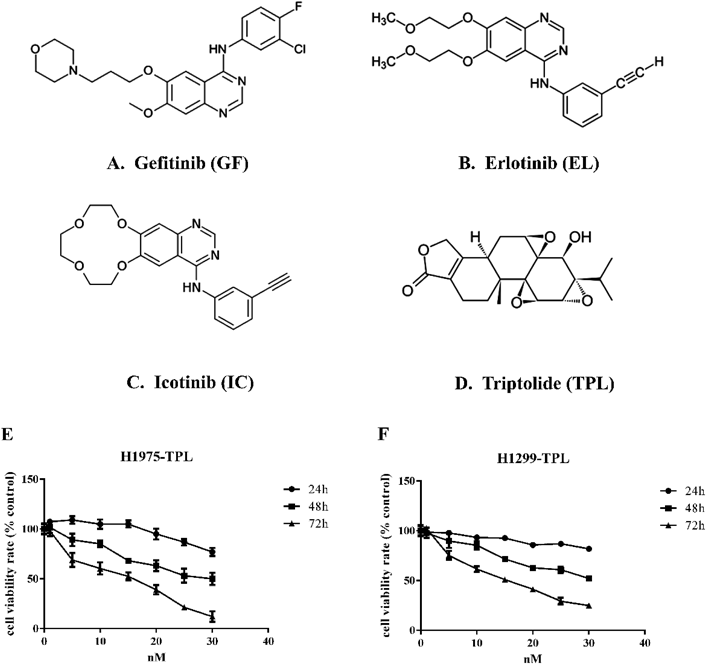
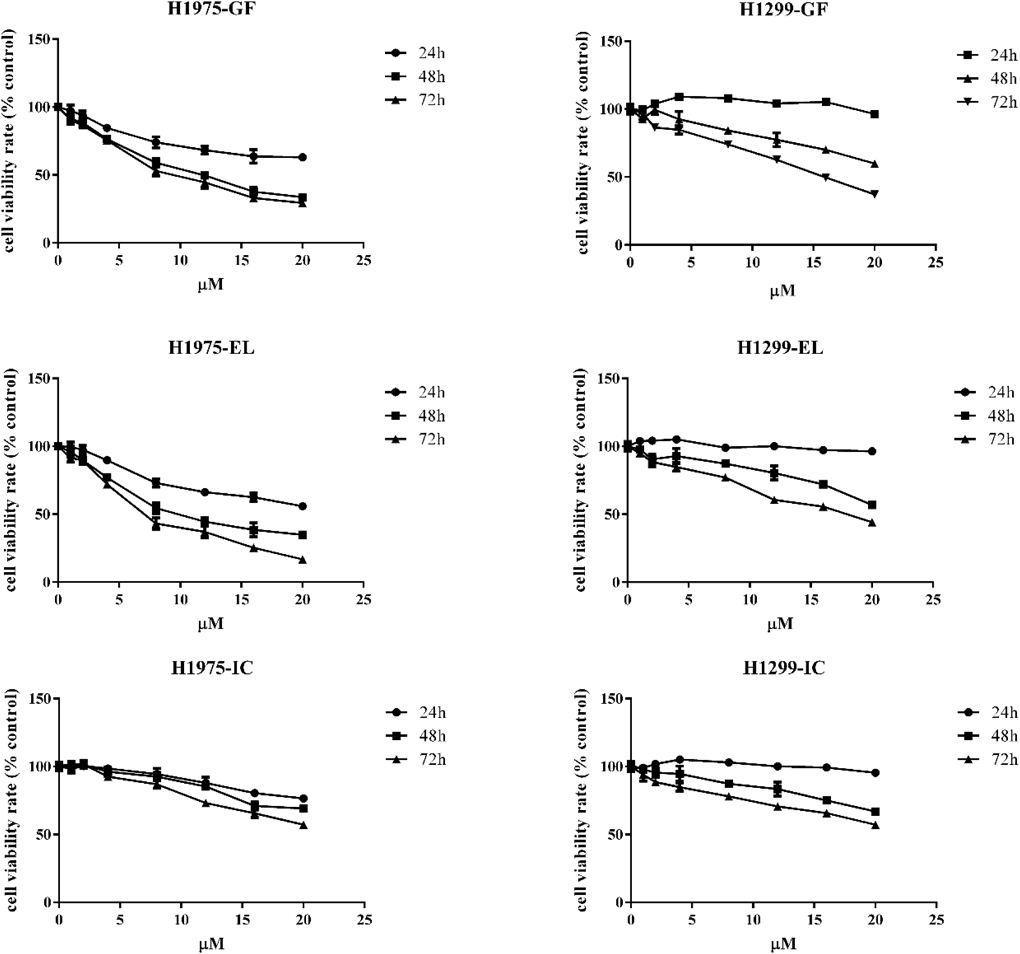
TPL Showed Stronger Cellular Inhibition than GF, EL, and IC on H1975 and H1299 Cell LinesIn the first step of the experiment, to determine the concentration of drugs in subsequent experiments, the inhibition effect of four drugs on H1975 and H1299 cells were detected. The structural formula of EGFR-TKIs and TPL were shown in below (Figs. 1A–D). MTT results showed that TPL had the strongest inhibitory effect on H1975 and H1299 cells among four compounds, which can achieve a strong inhibitory effect of cell viability at a very small dose (Figs. 1E, 1F and 2).
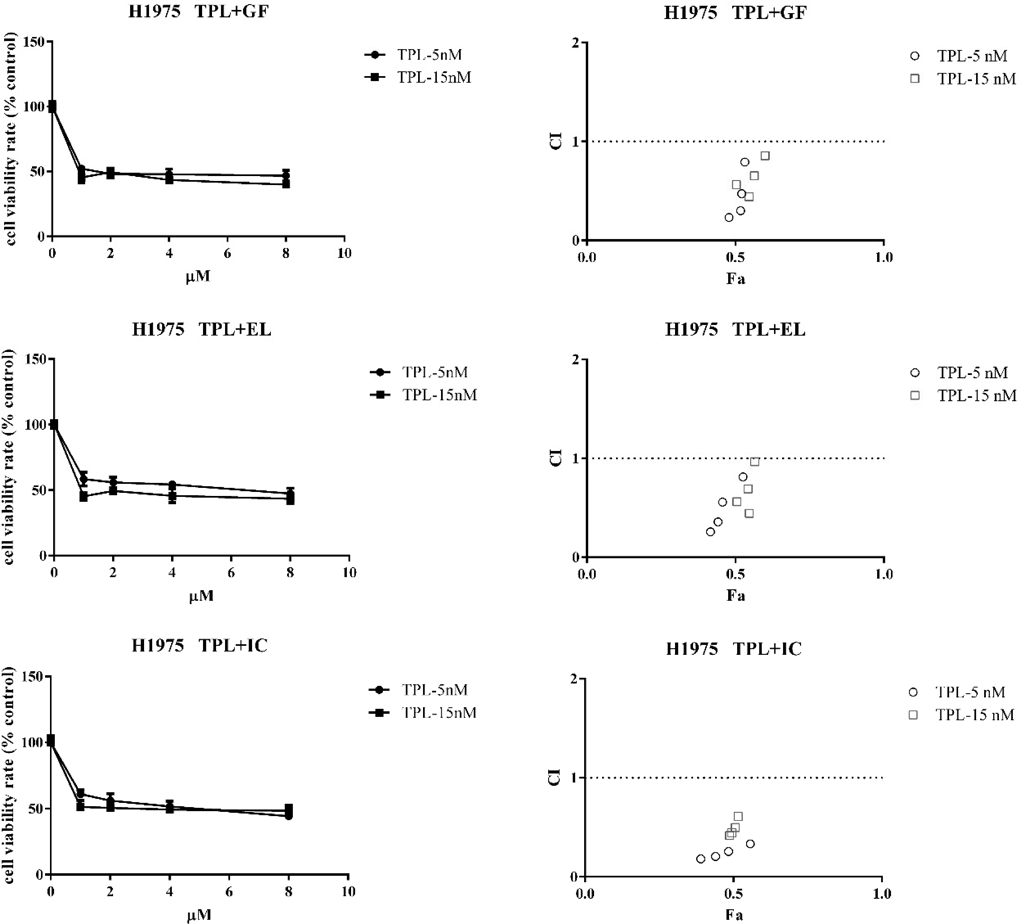
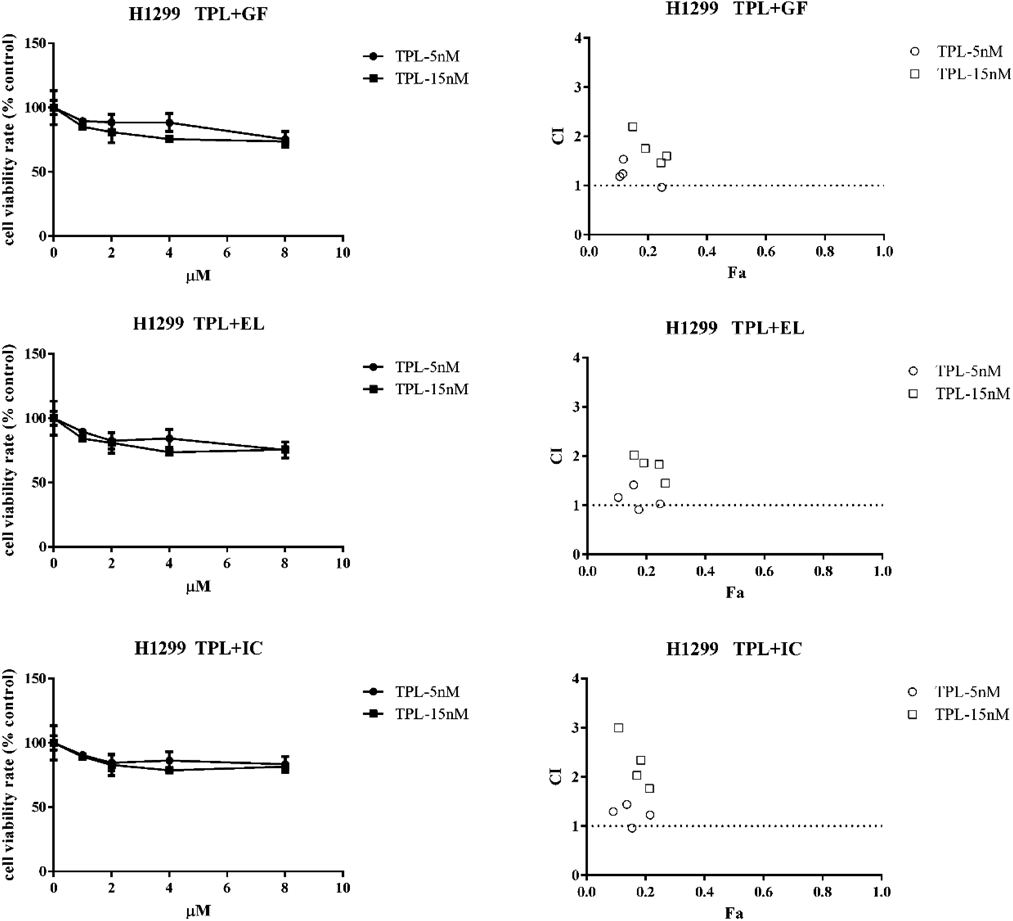
TPL Showed Synergistic Effect with GF, EL, and IC on H1975 Cell Line but Not on H1299 Cell LineCombined effects of TPL (5 or 15 nM) and GF or EL or IC (0, 1, 2, 4, 8 µM) on H1975 cells were also determined by MTT assay. H1975 cells and H1299 cells were exposed to different concentration of TPL and GF or EL or IC for 48 h. Then taken MTT assay. The results showed that at the concentration we detected, TPL had synergistic effects with GF or EL or IC (CI <1) in H1975 cells, and most of their Fa values were clustered around 0.5 (Fig. 3). But for H1299 cells, there was no synergistic effects after the drug combination (Fig. 4). It should be noted that increasing the concentration of TPL or TKIs can only slightly increase the inhibitory effect on H1975 cells. The cell viability of H1975 cells and H1299 cells treated only with TPL (5 or 15 nM) showed in Table 1.
Table 1. Cell Viability (% of Control) of H1975 Cells and H1299 Cells When the Concentratios of TPL are 5 and 15 nM
| Cells | H1975 | H1299 |
|---|
| Con. | | |
| TPL-5 nM | 89.00% ± 6.1873 | 89.73% ± 7.1031 |
| TPL-15 nM | 68.24% ± 2.351 | 71.62% ± 0.3724 |
We also investigated the combined effect of lower drug concentrations. Gefitinib was selected as TKIs representative drug for the combined study on H1975 cells. Our results showed that when choosing lower concentrations of Triptolide (1 nM) and Gefitinib (0.5, 1 nM), CI values did not get lower (1.38537, 1.56795), showing an antagonistic effect, and the cell inhibition rates were too low which do not have practical significance (Table 2).
Table 2. CI Values and Fa Values of TPL (1 nM) and GF at Lower Concentrations in H1975 Cells
| Con. (TPL-1 nM) | GF-0.5 µM | GF-1 µM |
|---|
| CI | 1.38537 | 1.56795 |
| Inhibition rate (% of control) | 11.56% | 14.15% |
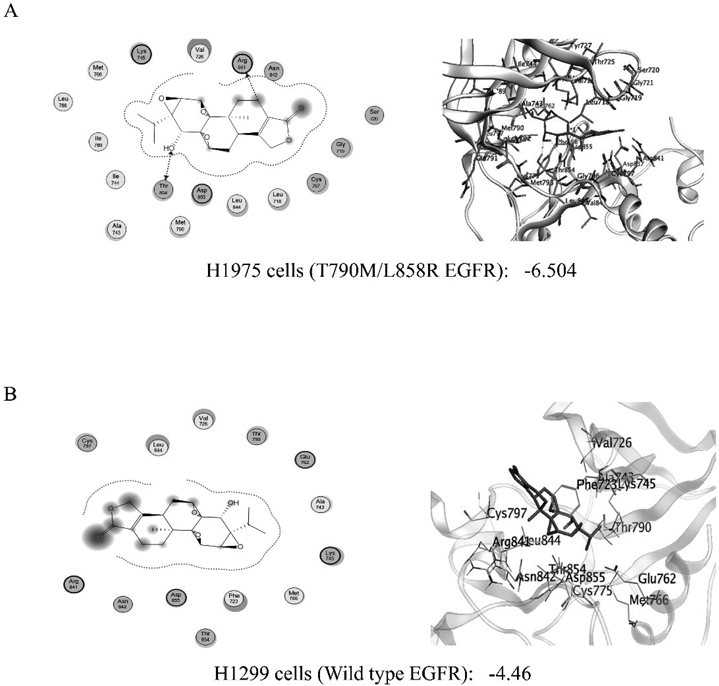
The binding mode of TPL to T790M/L858R EGFR and wild type EGFR were shown in Fig. 5. The hydroxyl groups of TPL can form the hydrogen bond with the residue Thr854 of T790M/L858R EGFR in the complex. The interaction can provide the binding energy to stabilize the complex which means the TPL-T790M/L858R EGFR complex is a relatively stable composition. The docking score of them is −6.504. While for wild type EGFR, there is no hydrogen bond between TPL and protein crystal structure, and the docking score is −4.46, lower than TPL-T790M/L858R EGFR complex.
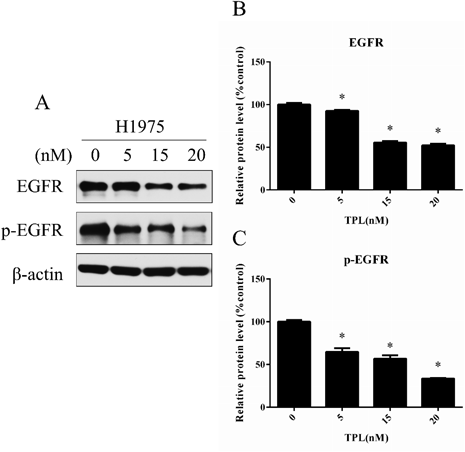
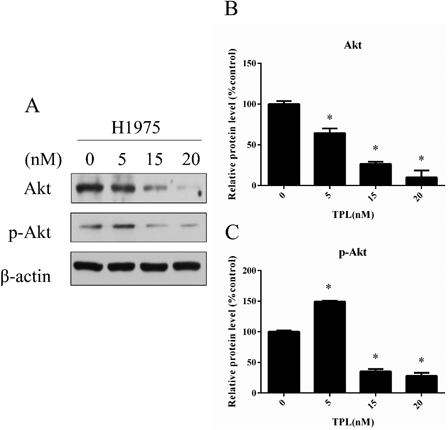
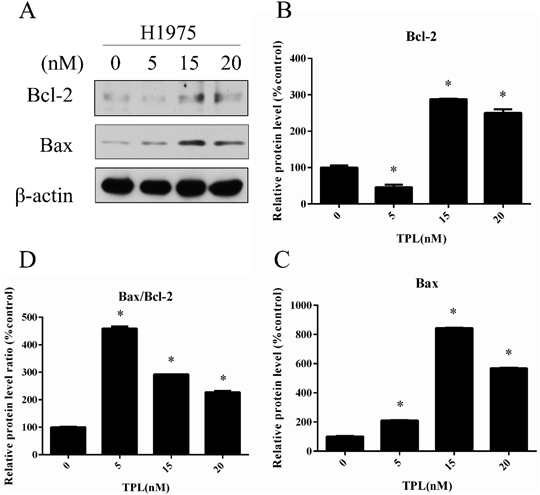
TPL Suppressed the EGFR/Akt Signaling Pathway and Induced ApoptosisH1975 cells were exposed to a series of continuous concentration of TPL (0, 5, 15, 20 nM) for 24 h, then Western blot assays were taken. The results showed that TPL down-regulated the expression of EGFR, p-EGFR, Akt and p-Akt (Figs. 6 and 7), and upregulated the ratio of Bax and Bcl-2 especially at low concentrations (Fig. 8), which mean TPL have the potential capacity to induce cell apoptosis and suppress EGFR/Akt signaling pathway.
Discussion
Tyrosine kinase inhibitors (TKI) is a kind of drugs that inhibit tyrosine kinase activity. GF, EL and IC are EGFR-TKIs for the treatment of NSCLC, which can compete with ATP and thus inhibit the activation of EGFR. TPL, because of its high content and strong physiological activity in Tripterygium wilfordii HOOK. F, has been widely studied in anti-tumor, immunomodulation, anti-inflammatory,16,17) and other aspects. Interestingly, in the early literature, TPL was the target of attenuation and enhancement in the combined effects research.18) In recent researches, TPL was used to combine with chemotherapeutic drugs to improve the therapeutic effect of chemotherapeutic drugs or increase the sensitivity of chemotherapeutic drug-resistant cells. As target-drugs almost act on a specific site, in this study, we shift the focus from chemotherapy drugs to target-drugs, to explore the synergies effect between TPL and EGFR-TKIs and the possible mechanisms.
We used the MTT assay and Combination Index (CI) analysis to evaluate the combined effects of EGFR-TKIs and TPL at different concentrations. The results showed that TPL had synergistic effect with GF, EL, and IC at different concentrations on H1975 but not H1299 cell line. Interestingly, increasing the concentration of TP or TKI did not have a great impact on the inhibitory effect of H1975 cells, but reduced their combined index. Since the effects by these concentrations of the compound in here seem to be saturated, we also investigated the combined effect at lower drug concentrations of TPL and GF on H1975 cells but the results showed an antagonistic effect, and the cell inhibition rates were too low which do not have practical significance. Therefore, according to our experimental results, relatively lower concentrations of TPL and TKI is a better choice for combination therapy on H1975 cells.
We tested the affinity and the stability of the ligand of TPL to T790M/L858R EGFR and wild type EGFR by using computer simulated molecular docking technology. According to the molecular docking results in this study, we found the binding model of TPL-T790M/L858R EGFR is more stable than that of TPL–wild type EGFR. Combined with the data of the drug combination, it raises a possibility that there is a connection between the binding ability of TPL and EGFR and the combined effect. That is, the formation of a more stable complex of EGFR and TPL could contribute to the synergistic effect, otherwise, will be antagonism. While the possibility is still a conjecture triggered by the results of this experiment, it is indeed worth studying to find the relationship between synergism and EGFR phenotype, and more kinds of phenotypes of EGFR should be considered.
Another interesting finding is that Leuenroth and Crews19) have used isotope tracer method to study the intracellular binding of TPL, and the results showed TPL is membrane localized, reversible and saturable. Although a more specific binding condition has not been mentioned in this literature, our experimental results could provide enlightenment that TPL may bind to the EGFR in cell membrane to exert its cytotoxic effect.
About the structural requirement of the compound when binding with EGFR, we could use for reference of the literature. Zhao et al.20) have screened more than two thousand kinds of plant-source compounds by molecular docking and found three compounds which have high combining ability with L858R EGFR, respectively is Matrine, Triptolide (docking score is −5.69), and Hydroxyjolkinolide B. There are many differences in the structure and combination way of those three compounds,20) but we still can find some similar characteristics, which are also similar with TKIs. For example, they all have three to four six-member rings structure, the oxygen containing functional groups, and unsaturated bond. Therefore, we guess these characteristics may be related to their affinity for EGFR.
EGFR/Akt signaling pathway is a classic signaling pathway in NSCLC and can regulate cell growth activity. To investigate the mechanism of TPL on drug-resistant NSCLC cell lines, we examined EGFR and EGFR downstream pathway, which regulate the important activity like survival, proliferation, autophagy, and apoptosis in cells, to investigate the influence of TPL on it. The results of Western blot showed that TPL suppressed the EGFR/Akt signaling pathway and increased the expression of pro-apoptotic factor Bax and the ratio of Bax and Bcl-2. This suggests that TPL caused degradation of EGFR and its downstream proteins, and promotes cell apoptosis. As a compensative mechanism for EGFR-TKIs, which can partially explain its synergistic effects with GF, EL and IC.
Conclusion
From our experimental results, we found that TPL had synergistic effect with three EGFR-TKIs (GF, EL, and IC) on H1975 cells but not on H1299 cells, which may due to the binding ability of TPL and different-type EGFR. The synergistic effect of TPL on H1975 cells may be partly related to the inhibition of the EGFR/Akt pathway by TPL.
Acknowledgments
This work was supported by the National Natural Science Foundation of China (No. 81573686), the Natural Science Foundation of Hunan Province, China (No. 2016JJ4098) and the Fundamental Research Funds for the Central Universities of Central South University (No. 2018zzts926).
Conflict of Interest
The authors declare no conflict of interest.
References
- 1) Ferlay J., Colombet M., Soerjomataram I., Mathers C., Parkin D. M., Piñeros M., Znaor A., Bray F., Int. J. Cancer, 144, 1941–1953 (2019).
- 2) Smouse J. H., Cibas E. S., Jänne P. A., Joshi V. A., Zou K. H., Lindeman N. I., Cancer, 117, 67–72 (2009).
- 3) Shi Y., Sun Y., Ding C., Wang Z., Wang C., Wang Z., Bai C., Bai C., Feng J., Liu X., Li F., Yang Y., Shu Y., Wu M., He J., Zhang Y., Zhang S., Chen G., Luo H., Luo R., Zhou C., Zhou Y., Pang Q., Zhao H., Zhao Q., Gu A., Ling Y., Huang C., Han B., Jiao S., Jiao H., J. Thorac. Dis., 7, E468–E472 (2015).
- 4) Yamamoto H., Toyooka S., Mitsudomi T., Lung Cancer, 63, 315–321 (2009).
- 5) Kupchan S. M., Court W. A., Dailey R. G. Jr., Gilmore C. J., Bryan R. F., J. Am. Chem. Soc., 94, 7194–7195 (1972).
- 6) Luo D., Zuo Z., Zhao H., Tan Y., Xiao C., Fr. Medecine, 2019, in press.
- 7) Liu L., Li G., Li Q., Jin Z., Zhang L., Zhou J., Hu X., Zhou T., Chen J., Gao N., Cell Death Dis., 4, e941 (2013).
- 8) Li H., Pan G. F., Jiang Z. Z., Yang J., Sun L. X., Zhang L. Y., Acta Pharmacol. Sin., 36, 606–613 (2015).
- 9) Kim S. T., Kim S. Y., Lee J., Kim K., Park S. H., Park Y. S., Lim H. Y., Kang W. K., Park J. O., BMC Cancer, 18, 1103 (2018).
- 10) Reno T. A., Tong S. W., Wu J., Fidler J. M., Nelson R., Kim J. Y., Raz D. J., BMC Cancer, 16, 439 (2016).
- 11) Xu B., Guo X., Mathew S., Armesilla A. L., Cassidy J., Darling J. L., Wang W., Cancer Lett., 291, 200–208 (2010).
- 12) Wang X., Zhang J. J., Sun Y. M., Zhang J., Wang L. R., Li J. C., Liu H., Folia Biol, 61, 195–202 (2015).
- 13) Deng Y., Li F., He P., Yang Y., Yang J., Zhang Y., Liu J., Tong Y., Li Q., Mei X., Shu Z., Zhao Q., Mol. Carcinog., 57, 807–814 (2018).
- 14) Zhang X., Liu G., Liu H., Ma T., Zhongguo Fei Ai Za Zhi., 18, 599–609 (2015).
- 15) Chou T. C., Talalay P., Adv. Enzyme Regul., 22, 27–55 (1984).
- 16) Gao J. P., Sun S., Li W. W., Chen Y. P., Cai D. F., Neurosci. Bull., 24, 133–142 (2008).
- 17) Huang G., Yuan K., Zhu Q., Zhang S., Lu Q., Zhu M., Sheng H., Yu R., Luo G., Xu A., Mol. Immunol., 101, 210–220 (2018).
- 18) Wei Y. S., Ye Q. L., Jing J. J., He P., Long R. B., Cao Z. R., J Fujian Medical University, 2, 22–25 (1999).
- 19) Leuenroth S. J., Crews C. M., Chem. Biol., 12, 1259–1268 (2005).
- 20) Zhao G. F., Huang Z. A., Du X. K., Yang M. L., Huang D. D., Zhang S., Mol. Med. Rep., 14, 1132–1138 (2016).