Experimental
All commercially available reagents were used as received. Dry THF was obtained by passing commercially available predried, oxygen-free formulations through an activated alumina column. Column chromatography was carried out with silica gel 60N (Kanto Chemical Co., 100–210 µm). All reactions were monitored by TLC carried out on 0.2-mm E. Merck silica gel plates (60F-254) with UV light. 1H-NMR spectra (400 MHz) and 13C-NMR spectra (100 MHz) were recorded on a JEOL JNM-AL400 spectrometer. Chemical shifts (δ) are given from TMS (0 ppm) as an internal standard for 1H-NMR and 13CDCl3 (77.0 ppm) for 13C-NMR. The following abbreviations are used: s (singlet); d (doublet); t (triplet); q (quartet); quin (quintet); m (multiplet); and dd (double doublet). Mass spectra and high-resolution mass spectra (HRMS) were measured on JEOL JMS-700 and MS-AX500 instruments, respectively. IR spectra were recorded on a JASCO FT/IR-4100. Only the strongest and/or structurally important absorption is reported as the IR data given in cm−1. Melting points were determined with Yazawa Micro Melting Point BY-2 and are not corrected.
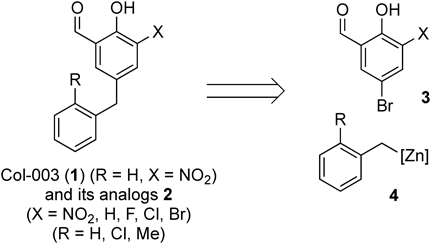
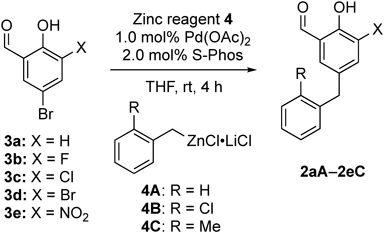
General Procedure: Synthesis of Col-003 Analogues by Negishi Cross-CouplingTo the solution of 5-bromosalicylaldehyde derivative 3 (1.0 equiv), Pd(OAc)2 (0.01 equiv) and S-Phos (0.02 equiv) in THF (1.0 mL/mmol) was added dropwise the benzylzinc reagent 415) (1.3 equiv) in THF (0.70 mL/mmol) at room temperature under an argon atmosphere. After being stirred at the same temperature for 4 h, the reaction mixture was quenched with saturated aqueous NH4Cl. The organic layer was separated, and the water layer was extracted twice with Et2O. The organic layer was washed with brine and dried over MgSO4. The filtrate was concentrated in vacuo, and the resulting residue was purified by column chromatography on silica gel (eluted with hexane/EtOAc = 50 : 1) to afford Col-003 analogues 2.
5-Benzylsalicylaldehyde (2aA)Colorless oil; 64% yield (682 mg, 3.2 mmol); 1H-NMR (400 MHz, CDCl3) δ: 10.9 (1H, s), 9.82 (1H, s), 7.37 (1H, dd, J = 8.0, 2.4 Hz), 7.31 (3H, t, J = 8.0 Hz), 7.24–7.20 (1H, m), 7.17 (2H, d, J = 7.2 Hz), 6.92 (1H, d, J = 8.8 Hz), 3.96 (2H, s); 13C-NMR (100 MHz, CDCl3) δ: 196.5, 160.1, 140.4, 137.8, 133.3, 132.7, 128.8, 128.6, 126.4, 120.4, 117.7, 40.6; IR (neat) 3164, 3027, 2845, 1624, 1483, 1279, 1146, 735, 700 cm−1; HR electron ionspray (EI)MS m/z: 212.0852 ([M]+ calcd for C14H12O2: 212.0837).
5-(2-Chlorobenzyl)salicylaldehyde (2aB)White solid; 57% yield (140 mg, 0.57 mmol); mp 39.5–40.6°C; 1H-NMR (400 MHz, CDCl3) δ: 10.9 (1H, s), 9.83 (1H, s, a), 7.40–7.36 (2H, m), 7.33 (1H, d, J = 2.4 Hz), 7.22–7.16 (3H, m), 6.93 (1H, d, J = 8.8 Hz), 4.08 (2H, s); 13C-NMR (100 MHz, CDCl3) δ: 196.5, 160.2, 138.0, 137.7, 134.2, 133.4, 131.0, 130.9, 129.8, 128.1, 127.0, 120.5, 117.8, 38.1; IR (neat) 3194, 3064, 2848, 1658, 1483, 1281, 1146, 770, 752 cm−1; HREIMS m/z: 246.0449 ([M]+ calcd for C14H11ClO2: 246.0448).
5-(2-Methylbenzyl)salicylaldehyde (2aC)Colorless oil; 97% yield (1.5 g, 6.6 mmol); 1H-NMR (400 MHz, CDCl3) δ: 10.9 (1H, s), 9.76 (1H, s), 7.29 (1H, dd, J = 8.0, 2.0 Hz), 7.22 (1H, d, J = 0.8 Hz), 7.17–7.15 (3H, m), 7.10–7.06 (1H, m), 6.89 (1H, m), 3.94 (2H, s), 2.22 (3H, s); 13C-NMR (100 MHz, CDCl3) δ: 196.5, 159.8, 138.1, 137.5, 136.4, 132.9, 131.8, 130.4, 129.7, 126.7, 126.1, 120.3, 117.5, 38.1, 19.5; IR (neat) 3103, 3018, 2850, 1653, 1483, 1279, 1144, 770, 743 cm−1; HREIMS m/z: 226.0994 ([M]+ calcd for C15H14O2: 226.0994).
5-Benzyl-3-fluorosalicylaldehyde (2bA)White solid; 95% yield (436 mg, 1.9 mmol); mp 64.9–66.2°C; 1H-NMR (400 MHz, CDCl3) δ: 10.8 (1H, s), 9.85 (1H, d, J = 1.6 Hz), 7.32 (2H, t, J = 8.0 Hz), 7.26–7.22 (1H, m), 7.19–7.16 (4H, m), 3.95 (2H, s); 13C-NMR (100 MHz, CDCl3) δ: 196.2 (d, J = 2.5 Hz), 152.0, 148.1 (d, J = 12 Hz), 139.6, 133.1 (d, J = 4.9 Hz), 128.8 (d, J = 3.3 Hz), 128.0 (d, J = 3.3 Hz), 126.7, 123.5, 123.3, 122.0 (d, J = 4.2 Hz), 40.6; IR (neat) 3165, 3028, 2853, 1663, 1480, 1388, 1276, 718, 701 cm−1; HREIMS m/z: 230.0757 ([M]+ calcd for C14H11FO2: 230.0743).
5-(2-Chlorobenzyl)-3-fluorosalicylaldehyde (2bB)White solid; 70% yield (183 mg, 0.69 mmol); mp 93.5–95.3°C; 1H-NMR (400 MHz, CDCl3) δ: 10.8 (1H, s), 9.85 (1H, m), 3.90 (1H, dd, J = 12.0, 2.4 Hz), 7.24–7.16 (5H, m), 4.07 (2H, s); 13C-NMR (100 MHz, CDCl3) δ: 196.2 (d, J = 2.5 Hz), 152.0, 148.2 (d, J = 13 Hz), 137.3, 131.5, 131.4 (d, J = 4.9 Hz), 130.9, 129.9, 128.4, 128.1 (d, J = 3.3 Hz), 127.2, 123.4, 123.2, 122.1 (d, J = 3.3 Hz), 38.1; IR (neat) 3420, 2940, 2865, 1665, 1476, 1266, 1142, 739, 716 cm−1; HREIMS m/z: 264.0341 ([M]+ calcd for C14H10ClFO2: 264.0353).
3-Fluoro-5-(2-methylbenzyl)salicylaldehyde (2bC)Yellow solid; 64% yield (157 mg, 0.64 mmol); mp 79.0–80.4°C; 1H-NMR (400 MHz, CDCl3) δ: 10.8 (1H, s), 9.82 (1H, s), 7.19–7.07 (6H, m), 3.95 (2H, s), 2.22 (3H, s); 13C-NMR (100 MHz, CDCl3) δ: 196.3 (d, J = 3.3 Hz), 147.9 (d, J = 3.4 Hz), 137.4, 136.5, 132.4 (d, J = 5.4 Hz), 130.6, 129.8, 127.8 (d, J = 2.4 Hz), 127.1, 126.3, 123.3, 123.1, 122.0 (d, J = 3.3 Hz), 38.2 (d, J = 1.6 Hz), 19.5; IR (neat) 3052, 3015, 2849, 1662, 1477, 1384, 1276, 725, 713 cm−1; HREIMS m/z: 244.0900 ([M]+ calcd for C15H13FO2: 244.0900).
5-Benzyl-3-chlorosalicylaldehyde (2cA)Yellow solid; 93% yield (459 mg, 1.86 mmol); mp 94.0–95.0°C; 1H-NMR (400 MHz, CDCl3) δ: 11.3 (1H, s), 9.83 (1H, s), 7.46 (1H, d, J = 2.0 Hz), 7.32 (2H, t, J = 7.2 Hz), 7.28–7.25 (2H, m), 7.17 (2H, d, J = 7.2 Hz), 3.95 (2H, s); 13C-NMR (100 MHz, CDCl3) δ: 196.0, 155.5, 139.6, 137.4, 134.1, 133.5, 131.8, 128.8, 126.7, 122.1, 121.2, 40.5; IR (neat) 3257, 3033, 2892, 1647, 1453, 1436, 1222, 1140, 752, 701 cm−1; HREIMS m/z: 246.0443 ([M]+ calcd for C14H11ClO2: 246.0448).
3-Chloro-5-(2-chlorobenzyl)salicylaldehyde (2cB)Yellow solid; 90% yield (254 mg, 0.90 mmol); mp 111.0–112.0°C; 1H-NMR (400 MHz, CDCl3) δ: 11.3 (1H, s), 9.83 (1H, s), 7.47 (1H, d, J = 2.0 Hz), 7.41–7.39 (1H, m), 7.28 (1H, d, J = 2.0 Hz), 7.25–7.22 (2H, m), 7.20–7.18 (1H, m), 4.07 (2H, s); 13C-NMR (100 MHz, CDCl3) δ: 196.0, 155.6, 137.24, 137.21, 134.2, 131.9, 131.8, 130.9, 129.9, 128.3, 127.2, 122.1, 121.1, 37.9; IR (neat) 3060, 2924, 2868, 1652, 1445, 1220, 1140, 759, 704 cm−1; HREIMS m/z: 280.0049 ([M]+ calcd for C14H10Cl2O2: 280.0058).
3-Chloro-5-(2-methylbenzyl)salicylaldehyde (2cC)Yellow solid; 43% yield (112 mg, 0.43 mmol); mp 96.8–98.0°C; 1H-NMR (400 MHz, CDCl3) δ: 11.3 (1H, s), 9.79 (1H, s), 7.41 (1H, d, J = 2.0 Hz), 7.20–7.17 (4H, m), 7.10–7.08 (1H, m), 3.95 (2H, s), 2.23 (3H, s); 13C-NMR (100 MHz, CDCl3) δ: 196.1, 155.4, 137.4, 137.1, 136.4, 132.8, 131.5, 130.6, 129.8, 127.1, 126.3, 122.0, 121.1, 38.0, 19.6; IR (neat) 3071, 3021, 2921, 1652, 1458, 1217, 1140, 746, 700 cm−1; HREIMS m/z: 260.0604 ([M]+ calcd for C15H13ClO2: 260.0604).
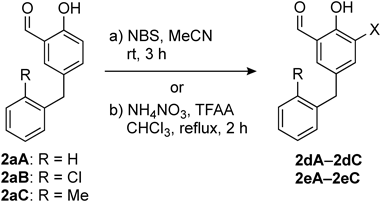
General Procedure: Synthesis of Col-003 Analogues 2d by ortho-BrominationTo a solution of 2a (1.0 equiv) in MeCN (10 mL/mmol) was added N-bromosuccinimide (NBS) (1.3 equiv) at room temperature under an argon atmosphere. After being stirred at the same temperature for 3 h, the reaction mixture was quenched with saturated aqueous Na2S2O3. The organic layer was separated, and the water layer was extracted once with Et2O and twice with EtOAc. The organic layer was washed with brine and dried over MgSO4. The filtrate was concentrated in vacuo, and the resulting residue was purified by column chromatography on silica gel (eluted with hexane/EtOAc = 60 : 1) to afford the 3-bromosalicylaldehyde derivative 2d.
5-Benzyl-3-bromosalicylaldehyde (2dA)Yellow solid; 75% yield (108 mg, 0.37 mmol); mp 109.0–110.3°C; 1H-NMR (400 MHz, CDCl3) δ: 11.4 (1H, s), 9.78 (1H, s), 7.63 (1H, d, J = 2.0 Hz), 7.34–7.32 (3H, m), 7.26–7.23 (1H, m), 7.17 (2H, d, J = 7.2 Hz), 3.95 (2H, s); 13C-NMR (100 MHz, CDCl3) δ: 196.0, 156.5, 140.4, 139.6, 138.1, 134.1, 132.7, 128.8, 126.7, 121.0, 111.2, 40.4; IR (neat) 3173, 3027, 2851, 1657, 1453, 1239, 1136, 737, 698 cm−1; HREIMS m/z: 289.9934 ([M]+ calcd for C14H11BrO2: 289.9942).
5-(2-Chlorobenzyl)-3-bromosalicylaldehyde (2 dB)White solid; 90% yield (108 mg, 0.37 mmol); mp 122.3–123.6°C; 1H-NMR (400 MHz, CDCl3) δ: 11.5 (1H, s), 9.79 (1H, s), 7.64 (1H, d, J = 2.4 Hz), 7.41–7.39 (1H, m), 7.32 (1H, d, J = 2.4 Hz), 7.24–7.22 (2H, m), 7.20–7.18 (1H, m), 4.09 (2H, s); 13C-NMR (100 MHz, CDCl3) δ: 195.9, 170.2, 156.6, 140.3, 137.3, 134.2, 133.6, 132.7, 130.9, 129.9, 128.4, 127.2, 111.2, 37.9; IR (neat) 3422, 3067, 2851, 1654, 1444, 1277, 1136, 752, 696 cm−1; HREIMS m/z: 323.9549 ([M]+ calcd for C14H10BrClO2: 323.9553).
3-Bromo-5-(2-methylbenzyl)salicylaldehyde (2dC)White solid; 33% yield (101 mg, 0.33 mmol); mp 99.2–100.9°C; 1H-NMR (400 MHz, CDCl3) δ: 11.4 (1H, s), 9.75 (1H, s), 7.58 (1H, d, J = 2.0 Hz), 7.22–7.17 (4H, m), 7.10 (1H, m), 3.95 (2H, s), 2.23 (3H, m); 13C-NMR (100 MHz, CDCl3) δ: 196.0, 156.4, 140.2, 137.4, 136.5, 133.4, 132.4, 130.7, 129.8, 127.1, 126.3, 121.0, 111.2, 38.0, 19.6; IR (neat) 3063, 3025, 2965, 1652, 1455, 1217, 1140, 745, 691 cm−1; HREIMS m/z: 304.0086 ([M]+ calcd for C15H13BrO2: 304.0099).
General Procedure: Synthesis of Col-003 Analogues 2e by ortho-NitrationTo a suspension of 2a (1.0 equiv) and NH4NO3 (2.0 equiv) in chloroform (7 mL/mmol) was added trifluoroacetic anhydride (TFAA) (8.0 equiv) at 0°C under an argon atmosphere. After being stirred in reflux for 2 h, the reaction mixture was cooled to room temperature and diluted with H2O. The organic layer was separated, and the water layer was extracted three times with chloroform. The combined organic layers were washed with brine and dried over MgSO4. The filtrate was concentrated in vacuo, and the resulting residue was purified by column chromatography on silica gel (eluted with hexane/EtOAc = 8 : 1) to afford the 3-nitrosalicylaldehyde derivative 2e.
5-Benzyl-3-nitrosalicylaldehyde (2eA) (Col-003 (1))Orange solid; 70% yield (715 mg, 2.8 mmol); mp 101.8–103.5°C; 1H-NMR (400 MHz, CDCl3) δ: 11.3 (1H, s), 10.4 (1H, s), 8.15 (1H, d, J = 2.4 Hz), 7.93 (1H, d, J = 2.4 Hz), 7.32 (2H, t, J = 8.0 Hz), 7.27–7.23 (1H, m), 7.17 (2H, d, J = 7.2 Hz), 4.00 (2H, s); 13C-NMR (100 MHz, CDCl3) δ: 189.3, 155.0, 138.8, 137.3, 133.5, 131.0, 128.9, 128.7, 126.9, 125.3, 116.8, 40.4; IR (neat) 3173, 3027, 2851, 1657, 1453, 1239, 1136, 737, 698 cm−1; HREIMS m/z: 257.0675 ([M]+ calcd for C14H11NO4: 257.0688).
5-(2-Chlorobenzyl)-3-nitrosalicylaldehyde (2eB)Orange solid; 12% yield (29 mg, 0.10 mmol); mp 86.5–88.0°C; 1H-NMR (400 MHz, CDCl3) δ: 11.3 (1H, s), 10.4 (1H, s), 8.15 (1H, d, J = 2.4 Hz), 7.93 (1H, d, J = 2.4 Hz), 7.41–7.39 (1H, m), 7.26–7.22 (3H, m), 4.11 (2H, s); 13C-NMR (100 MHz, CDCl3) δ: 189.2, 155.1, 137.2, 136.4, 135.1, 134.2, 131.9, 131.03, 130.99, 130.1, 128.8, 127.4, 125.3, 38.1; IR (neat) 3224, 3072, 2854, 1665, 1530, 1260, 1094, 1038, 799 cm−1; HREIMS m/z: 291.0287 ([M]+ calcd for C14H10ClNO4: 291.0298).
3-Nitro-5-(2-methylbenzyl)salicylaldehyde (2eC)Orange solid; 41% yield (121 mg, 0.45 mmol, 41%); mp 93.3–94.9°C; 1H-NMR (400 MHz, CDCl3) δ: 10.9 (1H, s), 9.83 (1H, d, J = 2.0 Hz), 8.06–7.97 (2H, m), 7.36–7.23 (3H, m), 6.96 (1H, d, J = 8.4 Hz), 4.05 (2H, s), 2.35 (3H, s); 13C-NMR (100 MHz, CDCl3) δ: 196.4, 160.3, 133.8, 131.3, 130.3, 130.0, 126.5, 125.2, 124.4, 122.5, 121.9, 121.3, 120.5, 38.1, 19.9; IR (neat) 3161, 3068, 2853, 1657, 1520, 1345, 1280, 771, 740 cm−1; HREIMS m/z: 271.0745 ([M]+ calcd for C15H13NO4: 271.0845).
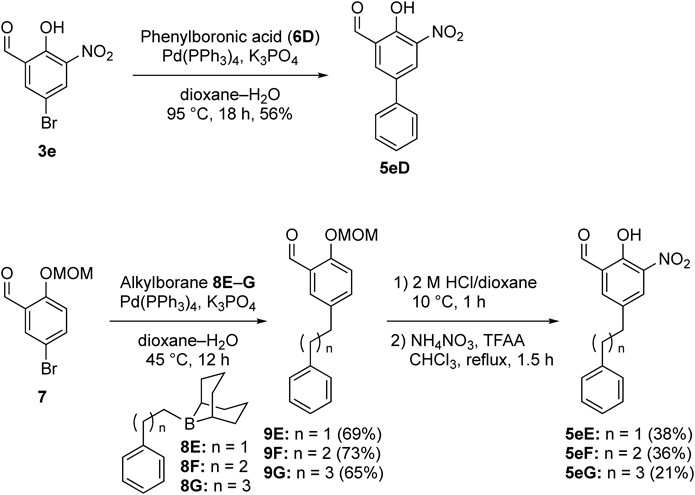
Synthesis of 3-Nitro-5-phenylsalicylaldehyde (5eD)To a solution of 3-nitro-5-bromosalicylaldehyde (3e) (48 mg, 0.196 mmol, 1.0 equiv) in 1,4-dioxane (1.6 mL, 8.3 mL/mmol) and H2O (1.6 mL, 0.83 mL/mmol) was added phenyl boronic acid (6D) (48 mg, 0.392 mmol, 2.0 equiv), K3PO4 (83 mg, 0.392 mmol, 2.0 equiv) and Pd(PPh3)4 (23 mg, 0.0196 mmol, 0.1 equiv) at room temperature under an argon atmosphere. After being stirred at 95°C for 18 h, the reaction mixture was cooled to room temperature and diluted with H2O. The organic layer was separated, and the water layer was extracted three times with EtOAc. The organic layer was washed with brine and dried over MgSO4. The filtrate was concentrated in vacuo, and the resulting residue was purified by column chromatography on silica gel (eluted with hexane/EtOAc = 40 : 1) to afford 3-nitro-5-phenylsalicylaldehyde (5eD) (27 mg, 0.11 mmol, 56%) as an orange solid; mp 115.3–116.4°C; 1H-NMR (400 MHz, CDCl3) δ: 11.4 (1H, s), 10.5 (1H, s), 8.57 (1H, d, J = 2.4 Hz), 8.35 (1H, d, J = 2.4 Hz), 7.60–7.58 (2H, m), 7.51–7.48 (2H, m), 7.45–7.41 (1H, m); 13C-NMR (100 MHz, CDCl3) δ: 189.1, 155.6, 137.0, 135.4, 135.2, 133.6, 129.3, 129.0, 128.6, 126.7, 125.7; IR (neat) 3237, 3067, 2926, 1693, 1462, 1261, 1139, 761, 696 cm−1; HREIMS m/z: 243.0529 ([M]+ calcd for C13H9NO4: 243.0532).
General Procedure: Synthesis of Compounds 9 by Suzuki–Miyaura Cross-CouplingTo a solution of alkylborane 822) (1.5 equiv) in 1,4-dioxane (9.0 mL/mmol) was added 5-bromo-2-(methoxymethoxy)benzaldehyde 723) (1.0 equiv), K3PO4 (2.0 equiv), and Pd(PPh3)4 (0.01 equiv) at room temperature. After being stirred at 45°C for 12 h, the reaction mixture was diluted with H2O. The organic layer was separated, and the water layer was extracted three times with EtOAc. The organic layer was washed with brine and dried over MgSO4. The filtrate was concentrated in vacuo, and the resulting residue was purified by column chromatography on silica gel (eluted with hexane/EtOAc = 30 : 1) to afford coupling products 9.
2-(Methoxymethoxy)-5-phenethylbenzaldehyde (9E)Brown oil; 69% yield (230 mg, 0.85 mmol); 1H-NMR (400 MHz, CDCl3) δ: 10.5 (1H, s), 7.69 (1H, d, J = 2.4 Hz), 7.32–7.10 (7H, m), 5.28 (2H, s), 3.52 (3H, s), 2.89 (4H, s); 13C-NMR (100 MHz, CDCl3) δ: 190.1, 158.1, 141.2, 136.1, 128.44, 128.39, 128.36, 128.3, 127.8, 126.0, 115.1, 94.7, 56.4, 37.7, 36.8; IR (neat) 2929, 2853, 1683, 1495, 1151, 987, 700 cm−1; HREIMS m/z: 270.1234 ([M]+ calcd for C17H18O3: 270.1256).
2-(Methoxymethoxy)-5-(3-phenylpropyl)benzaldehyde (9F)Orange oil; 73% yield (255 mg, 0.89 mmol); 1H-NMR (400 MHz, CDCl3) δ: 10.5 (1H, s), 7.66 (1H, d, J = 2.4 Hz), 7.34 (1H, dd, J = 8.6, 2.4 Hz), 7.28 (2H, t, J = 7.6 Hz), 7.20–7.12 (4H, m), 5.27 (2H, s), 3.51 (3H, s), 2.63 (4H, q, J = 6.8 Hz), 1.97–1.89 (2H, quin); 13C-NMR (100 MHz, CDCl3) δ: 189.9, 158.0, 141.9, 136.0, 135.8, 128.4, 128.3, 127.7, 125.8, 125.2, 115.1, 94.7, 56.4, 35.3, 34.3, 32.8; IR (neat) 2935, 2858, 1684, 1582, 1149, 988 cm−1; HREIMS m/z: 284.1411 ([M]+ calcd for C18H20O3: 284.1412).
2-(Methoxymethoxy)-5-(4-phenylbutyl)benzaldehyde (9G)Brown oil; 65% yield (238 mg, 0.80 mmol); 1H-NMR (400 MHz, CDCl3) δ: 10.5 (1H, s), 7.64 (d, J = 2.4 Hz), 7.32 (1H, dd, J = 8.6, 2.4 Hz), 7.28–7.25 (2H, m), 7.18–7.11 (4H, m), 5.23 (2H, s), 3.51 (3H, s), 2.64–2.59 (4H, m), 1.66–1.62 (4H, m); 13C-NMR (100 MHz, CDCl3) δ: 189.9, 157.9, 142.3, 136.1, 135.9, 128.33, 128.27, 128.2, 127.6, 125.7, 125.2, 115.0, 94.7, 56.4, 35.7, 34.7, 30.9; IR (neat) 2933, 2857, 1685, 1495, 1149, 988, 700 cm−1; HREIMS m/z: 298.1550 ([M]+ calcd for C19H22O3: 298.1569).
General Procedure: Synthesis of Col-003 Analogues 5eE–5eG by Regioselective NitrationTo a solution of MOM ether 9 (1.0 equiv) in 1,4-dioxane (70 mL/mmol) was added 4 M HCl in 1,4-dioxane (70 mL/mmol) slowly at 10°C under an argon atmosphere. After being stirred at the same temperature for 1 h, the reaction mixture was concentrated in vacuo, and the resulting residue was used for the next reaction without further purification.
To a suspension of crude product and NH4NO3 (2.0 equiv) in chloroform (7 mL/mmol) was added TFAA (8.0 equiv) at 0°C under an argon atmosphere. After being stirred in reflux for 1.5 h, the reaction mixture was cooled to room temperature and diluted with H2O. The organic layer was separated, and the water layer was extracted three times with chloroform. The organic layer was washed with brine and dried over MgSO4. The filtrate was concentrated in vacuo, and the resulting residue was purified by column chromatography on silica gel (eluted with hexane/EtOAc = 25 : 1) to afford nitrated analogues 5eE–5eG.
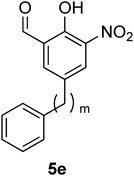
3-Nitro-5-(2-phenethyl)salicylaldehyde (5eE)Orange solid; 38% yield (64 mg, 0.24 mmol); mp 107.1–108.2°C; 1H-NMR (400 MHz, CDCl3) δ: 11.3 (1H, s), 10.4 (1H, s), 8.08 (1H, d, J = 2.4 Hz), 7.87 (1H, d, J = 2.4 Hz), 7.31–7.20 (3H, m), 7.13 (2H, d, J = 6.8 Hz), 3.01–2.91 (4H, m); 13C-NMR (100 MHz, CDCl3) δ: 189.2, 154.9, 139.9, 137.1, 134.9, 133.6, 130.8, 128.6, 128.4, 126.5, 125.2, 37.1, 36.3; IR (neat) 3055, 2921, 2861, 1691, 1532, 1305, 768, 700 cm−1; HREIMS m/z: 271.0835 ([M]+ calcd for C15H13NO4: 271.0845).
3-Nitro-5-(3-phenylpropyl)benzaldehyde (5eF)Orange oil; 36% yield (65 mg, 0.23 mmol); 1H-NMR (400 MHz, CDCl3) δ: 11.2 (1H, s), 10.4 (1H, s), 8.14 (1H, d, J = 2.0 Hz), 7.92 (1H, d, J = 2.4 Hz), 7.30 (2H, t, J = 7.6 Hz), 7.22–7.16 (3H, m), 2.70–2.65 (4H, m), 1.98 (2H, quin, J = 7.6 Hz); 13C-NMR (100 MHz, CDCl3) δ: 189.2, 154.9, 141.2, 136.9, 134.9, 134.4, 130.6, 128.5, 128.4, 126.1, 125.3, 35.1, 33.9, 32.3; IR (neat) 3219, 2934, 2860, 1694, 1538, 1463, 1308, 751, 700 cm−1; HREIMS m/z: 285.0987 ([M]+ calcd for C16H15NO4: 285.1001).
3-Nitro-5-(4-phenylbutyl)salicylaldehyde (5eG)Orange solid; 21% yield (40 mg, 0.13 mmol); mp 52.4–53.1°C; 1H-NMR (400 MHz, CDCl3) δ: 11.2 (1H, s), 10.4 (1H, s), 8.12 (1H, d, J = 2.0 Hz), 7.90 (1H, d, J = 2.0 Hz), 7.28 (2H, t, J = 6.8 Hz), 7.20–7.15 (3H, m), 2.69–2.63 (4H, m), 1.67 (4H, quin, J = 4.0 Hz); 13C-NMR (100 MHz, CDCl3) δ: 189.2, 154.8, 141.9, 136.9, 134.9, 134.6, 130.6, 128.4, 128.3, 125.9, 125.2, 35.6, 34.3, 30.7, 30.4; IR (neat) 3218, 2934, 2858, 1693, 1537, 1309, 749, 701 cm−1; HREIMS m/z: 299.1146 ([M]+ calcd for C17H17NO4 299.1158).