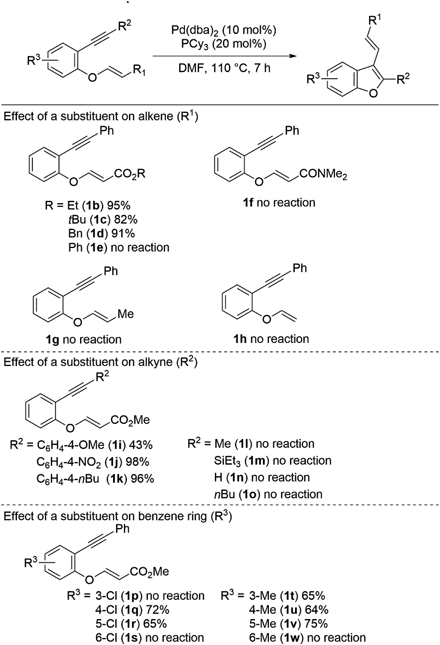
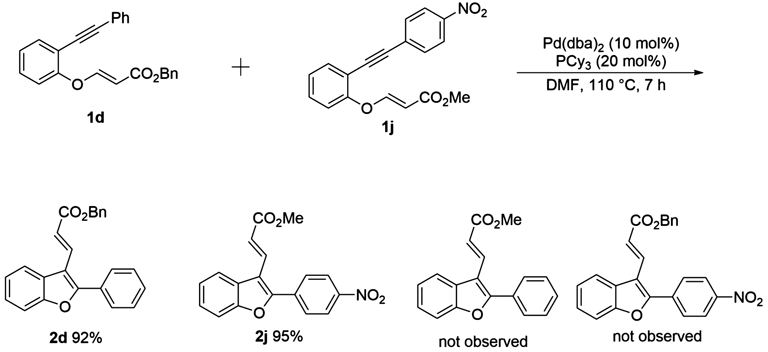
Experimental
General MethodsMelting points were measured by BÜCHI B-545 and all melting points were uncorrected. 1H- and 13C-NMR spectra were measured by JEOL JNM-ECS 400, JEOL ECS 300 or JEOL JNM-LA 500 spectrometers. 1H-NMR spectra are reported as follows: chemical shift in ppm relative to the chemical shift of CDCl3 at 7.26 ppm, integration, multiplicities (s = singlet, d = doublet, t = triplet, q = quartet, m = multiplet), and coupling constants (Hz). 13C-NMR spectra reported in ppm relative to the central line of triplet for CDCl3 at 77 ppm as an internal standard. High resolution mass spectra and elemental analysis were performed by the Elemental Analysis Section of Osaka University. Column chromatography was performed with SiO2 (Merck Silica Gel 60, 230–400 mesh or Kanto Chemical Silicagel 60, spherical neutral, 63–210 µm) unless otherwise stated. Commercially available organic and inorganic compounds were used without further purification.
Procedure and Experimental Data for Derivatives(E)-1-(Phenylethynyl)-2-(prop-1-en-1-yloxy)benzene (1g)1g was prepared according to the literature.23) 2-Iodophenol (550 mg, 2.5 mmol) was converted to 1g (260 mg, 47%). Colorless oil. 1H-NMR (300 MHz, CDCl3) δ: 7.57–7.50 (m, 3H), 7.38–7.27 (m, 4H), 7.05–6.97 (m, 2H), 6.47 (qd, J = 3.1, 1.7 Hz, 1H), 4.94 (qd, J = 6.9, 6.9 Hz, 1H), 1.80 (dd, J = 6.9, 1.7 Hz, 3H); 13C-NMR (125 MHz, CDCl3) δ: 157.8, 140.8, 133.4, 131.6, 129.6, 128.3, 128.2, 123.5, 122.2, 114.8, 113.6, 107.8, 93.8, 85.2, 9.5.
1-(Phenylethynyl)-2-(vinyloxy)benzene (1h)1h was prepared according to the literature.24) 2-Iodophenol (550 mg, 2.50 mmol) was converted to 1h (240 mg, 41%). Colorless oil. 1H-NMR (400 MHz, CDCl3) δ: 7.58–7.51 (m, 3H), 7.38–7.27 (m, 4H), 7.09 (ddd, J = 7.5, 7.5, 1.0 Hz, 1H), 7.04 (dd, J = 8.3, 1.0 Hz, 1H), 6.70 (dd, J = 13.8, 6.2 Hz, 1H), 4.80 (dd, J = 13.8, 2.1 Hz, 1H), 4.48 (dd, J = 6.2, 1.7 Hz, 1H); 13C-NMR (100 MHz, CDCl3) δ: 157.0, 148.6, 133.5, 131.6, 129.6, 128.5, 128.3, 123.3, 117.2, 114.6, 95.0, 94.1, 84.9.
Typical Procedure A for Preparation of Compounds 1a–1f, 1i–1o, 1q, 1u–1wTo a round-bottom flask containing 2-iodophenol (1.0 equivalent (equiv.)) and mono-substituted acetylene (1.1 equiv.) and triethylamine (15 equiv.) in THF (0.4 M) under nitrogen were added copper iodide (2 mol%) and bis(triphenylphosphine) palladium(II) dichloride (1 mol%). The mixture was stirred at ambient temperature for 4 h. The mixture was diluted with AcOEt and filtered by celite pad. The filtrate was concentrated, and the residue was purified by short column chromatography (n-hexane/AcOEt = 15 : 1) to give 2-substituted-ethynylphenol. To a stirred solution of the above obtained crude substituted 2-ethynylphenol in CH2Cl2 (0.2 M) was added DABCO (0.1 equiv.) and propiolic acid derivative (1.05 equiv.) at 0 °C. The mixture was stirred at ambient temperature for 2 h. After addition of water to the mixture, the organic layer was separated, and the aqueous layer was extracted with CH2Cl2. The combined organic layer was dried over Na2SO4, filtered, and concentrated. The residue was purified by flash column chromatography on silica gel to give compounds.
Methyl (E)-3-(2-(Phenylethynyl)phenoxy)acrylate (1a)25)Following the typical procedure A, 2-iodophenol (550 mg, 2.50 mmol) was converted to 1a (598 mg, 86%). Yellow oil. 1H-NMR (500 MHz, CDCl3) δ: 7.86 (d, J = 12.5 Hz, 1H), 7.57 (dd, J = 7.4, 1.7 Hz, 1H), 7.53–7.50 (m, 2H), 7.37–7.33 (m, 4H), 7.23–7.19 (m, 1H), 7.12–7.09 (m, 1H), 5.57 (d, J = 12.5 Hz, 1H), 3.72 (s, 3H); 13C-NMR (100 MHz, CDCl3) δ: 167.5, 159.8, 155.8, 133.5, 131.5, 129.7, 128.5, 128.3, 125.2, 122.7, 118.8, 115.4, 101.4, 95.0, 83.8, 51.2.
Ethyl (E)-3-(2-(Phenylethynyl)phenoxy)acrylate (1b)25)Following the typical procedure A, 2-Iodophenol (550 mg, 2.50 mmol) was converted to 1b (618 mg, 84%). Colorless oil. 1H-NMR (300 MHz, CDCl3) δ: 7.85 (d, J = 12.4 Hz, 1H), 7.59–7.49 (m, 3H), 7.38–7.31 (m, 4H), 7.20 (dd, J = 7.5, 7.5 Hz, 1H), 7.11 (d, J = 8.4 Hz, 1H), 5.56 (d, J = 12.0 Hz, 1H), 4.18 (q, J = 7.2 Hz, 2H), 1.26 (t, J = 7.2 Hz, 3H); 13C-NMR (100 MHz, CDCl3) δ: 167.2, 159.7, 155.9, 133.6, 131.6, 129.8, 128.6, 128.3, 125.2, 122.8, 119.0, 115.5, 101.9, 95.1, 83.9, 60.1, 14.3.
tert-Butyl (E)-3-(2-(Phenylethynyl)phenoxy)acrylate (1c)Following the typical procedure A, 2-iodophenol (550 mg, 2.50 mmol) was converted to 1c (640 mg, 80%). Colorless oil. 1H-NMR (300 MHz, CDCl3) δ: 7.77 (d, J = 12.0 Hz, 1H), 7.58–7.50 (m, 3H), 7.38–7.32 (m, 4H), 7.19 (ddd, J = 7.6, 7.6, 1.0 Hz, 1H), 7.10 (dd, J = 8.3, 1.0 Hz, 1H), 5.50 (d, J = 12.0 Hz, 1H), 1.47 (s, 9H); 13C-NMR (100 MHz, CDCl3) δ: 166.5, 159.0, 156.1, 133.6, 131.6, 129.8, 128.6, 128.3, 125.0, 122.8, 118.9, 115.4, 103.5, 95.0, 84.0, 80.1, 28.2 high resolution (HR)MS (matrix-assisted laser desorption/ionization-time of flight (MALDI-TOF)) Calcd for C21H20O3Na [M + Na]+: 343.1305, Found 343.1285.
Benzyl (E)-3-(2-(Phenylethynyl)phenoxy)acrylate (1d)Following the typical procedure A, 2-iodophenol (550 mg, 2.50 mmol) was converted to 1d (710 mg, 80%). Colorless oil. 1H-NMR (500 MHz, CDCl3) δ: 7.89 (d, J = 12.5 Hz, 1H), 7.56 (dd, J = 7.8, 1.3 Hz, 1H), 7.51–7.49 (m, 2H), 7.37–7.31 (m, 9H), 7.22–7.18 (m, 1H), 7.12–7.08 (m, 1H), 5.59 (d, J = 12.0 Hz, 1H), 5.17 (s, 2H); 13C-NMR (75 MHz, CDCl3) δ: 167.0, 160.2, 155.8, 136.1, 133.6, 131.6, 129.8, 128.6, 128.5, 128.3, 128.1, 125.3, 122.8, 119.0, 115.5, 101.5, 95.1, 83.8, 65.9; HRMS (MALDI-TOF) Calcd for C24H18O3Na [M + Na]+: 377.1148, Found 377.1169.
Phenyl (E)-3-(2-(Phenylethynyl)phenoxy)acrylate (1e)Following the typical procedure A, 2-iodophenol (550 mg, 2.50 mmol) was converted to 1e (710 mg, 84%). Colorless oil. 1H-NMR (400 MHz, CDCl3) δ: 8.06 (d, J = 12.4 Hz, 1H), 7.61–7.55 (m, 3H), 7.41–7.35 (m, 6H), 7.24–7.16 (m, 3H), 7.09–7.06 (m, 2H), 5.75 (d, J = 11.9 Hz, 1H); 13C-NMR (100 MHz, CDCl3) δ: 165.6, 161.5, 155.8, 150.6, 133.7, 131.6, 129.9, 129.3, 128.7, 128.4, 125.6, 125.5, 122.7, 121.7, 119.2, 115.5, 100.9, 95.3, 83.8; HRMS (MALDI-TOF) Calcd for C23H16O3 [M]+: 363.0992, Found 363.0998.
(E)-N,N-Dimethyl-3-(2-(phenylethynyl)phenoxy)acrylamide (1f)Following the typical procedure A, 2-iodophenol (550 mg, 2.50 mmol) was converted to 1f (624 mg, 86%). Colorless oil. 1H-NMR (500 MHz, CDCl3) δ: 7.81 (d, J = 11.5 Hz, 1H), 7.56–7.51 (m, 3H), 7.35–7.31 (m, 4H), 7.17–7.11 (m, 1H), 7.11–7.08 (m, 1H), 6.10 (d, J = 11.5 Hz, 1H), 3.00 (s, 6H); 13C-NMR (100 MHz, CDCl3) δ: 166.5, 157.5, 156.3, 133.5, 131.6, 129.7, 128.4, 128.2, 124.5, 122.9, 117.8, 114.8, 101.6, 94.5, 84.2, 37.2, 35.5; HRMS (MALDI-TOF) Calcd for C19H18NO2Na [M + Na]+: 292.1332, Found 292.1327.
Methyl (E)-3-(2-((4-Methoxyphenyl)ethynyl)phenoxy)acrylate (1i)25)Following the typical procedure A, 2-iodophenol (550 mg, 2.50 mmol) was converted to 1i (458 mg, 59%). Colorless powder. M.p. 86–88 °C (CHCl3) 1H-NMR (300 MHz, CDCl3) δ: 7.85 (d, J = 12.4 Hz, 1H), 7.54 (dd, J = 7.6, 1.7 Hz, 1H), 7.45 (ddd, J = 9.4, 2.4, 2.4 Hz, 2H), 7.33 (ddd, J = 7.7, 7.7, 1.7 Hz, 1H), 7.19 (J = 7.6, 7.6, 1.4 Hz, 1H), 7.09 (dd, J = 7.9, 1.0 Hz, 1H), 6.87 (d, J = 8.9 Hz, 2H), 5.56 (d, J = 12.4 Hz, 1H), 3.83 (s, 3H), 3.71 (s, 3H); 13C-NMR (100 MHz, CDCl3) δ: 167.6, 160.0, 159.9, 155.7, 133.4, 133.1, 129.4, 125.2, 118.9, 115.8, 114.9, 114.0, 101.3, 95.2, 82.6, 55.3, 51.3.
Methyl (E)-3-(2-((4-Nitrophenyl)ethynyl)phenoxy)acrylate (1j)Following the typical procedure A, 2-iodophenol (550 mg, 2.50 mmol) was converted to 1j (458 mg, 59%). Yellow powder. M.p. 102–104 °C (CHCl3) 1H-NMR (500 MHz, CDCl3) δ: 8.21 (d, J = 8.6 Hz, 2H), 7.84 (d, J = 12.0 Hz, 1H), 7.64 (d, J = 8.6 Hz, 2H), 7.59 (dd, J = 7.4, 1.7 Hz, 1H), 7.42 (ddd, J = 7.9, 7.9, 1.5 Hz, 1H), 7.25–7.22 (m, 1H), 7.14 (d, J = 8.0 Hz, 1H), 5.59 (d, J = 12.6 Hz, 1H), 3.73 (s, 3H); 13C-NMR (100 MHz, CDCl3) δ: 167.4, 159.4, 156.1, 147.1, 133.8, 132.3, 130.9, 129.7, 125.3, 123.6, 118.8, 114.2, 102.0, 92.8, 89.1, 51.4; HRMS (MALDI-TOF) Calcd for C18H13NO5Na [M + Na]+: 323.0788, Found 323.0781.
Methyl (E)-3-(2-((4-Butylphenyl)ethynyl)phenoxy)acrylate (1k)Following the typical procedure A, 2-iodophenol (550 mg, 2.50 mmol) was converted to 1k (458 mg, 59%). Colorless needle. M.p. 42–44 °C (n-hexane) 1H-NMR (300 MHz, CDCl3) δ: 7.86 (d, J = 12.0 Hz, 1H), 7.55 (dd, J = 7.6, 1.7 Hz, 1H), 7.42 (d, J = 8.3 Hz, 2H), 7.33 (dd, J = 8.1, 1.5 Hz, 1H), 7.22–7.08 (m, 4H), 5.56 (d, J = 12.0 Hz, 1H), 3.72 (s, 3H), 2.62 (t, J = 7.7 Hz, 2H), 1.62–1.57 (m, 2H), 1.35 (q, J = 7.3 Hz, 2H), 0.93 (t, J = 7.2 Hz, 3H); 13C-NMR (100 MHz, CDCl3) δ: 167.6, 160.0, 155.8, 143.8, 133.6, 131.5, 129.6, 128.5, 125.2, 119.9, 118.9, 115.7, 101.4, 95.4, 83.2, 51.3, 35.6, 33.4, 22.3, 13.9; HRMS (MALDI-TOF) Calcd for C22H23O3Na [M + Na]+: 335.1642, Found 335.1639.
Methyl (E)-3-(2-(Prop-1-yn-1-yl)phenoxy)acrylate (1l)26)Following the typical procedure A, 2-iodophenol (550 mg, 2.50 mmol) was converted to 1l (450 mg, 83%). Colorless oil. 1H-NMR (500 MHz, CDCl3) δ: 7.77 (d, J = 12.4 Hz, 1H), 7.42 (dd, J = 7.6, 1.6 Hz, 1H), 7.28 (ddd, J = 7.8, 7.8, 1.8 Hz, 1H), 7.13 (ddd, J = 7.6, 7.6, 1.2 Hz, 1H), 7.03 (dd, J = 8.2, 0.9 Hz, 1H), 5.49 (d, J = 12.4 Hz, 1H), 3.72 (s, 3H); 13C-NMR (100 MHz, CDCl3) δ: 167.6, 160.0, 155.8, 133.8, 129.0, 125.1, 118.8, 116.1, 101.2, 92.0, 74.2, 51.3, 4.6.
Methyl (E)-3-(2-((Triethylsilyl)ethynyl)phenoxy)acrylate (1m)21)Following the typical procedure A, 2-iodophenol (550 mg, 2.50 mmol) was converted to 1m (684 mg, 87%). Yellow oil. 1H-NMR (300 MHz, CDCl3) δ: 7.77 (d, J = 12.0 Hz, 1H), 7.49 (dd, J = 7.9, 1.7 Hz, 1H), 7.32 (ddd, J = 7.7, 7.7, 1.7 Hz, 1H), 7.14 (ddd, J = 7.6, 7.6, 1.0 Hz, 1H), 7.05 (dd, J = 8.3, 1.0 Hz, 1H), 5.48 (d, J = 12.0 Hz, 1H), 3.71 (s, 3H), 1.02 (t, J = 7.7 Hz, 9H), 0.69–0.61 (m, 6H); 13C-NMR (100 MHz, CDCl3) δ: 167.5, 159.8, 156.4, 134.1, 129.9, 125.1, 118.8, 115.6, 101.3, 100.2, 98.5, 51.2, 7.4, 4.2.
Methyl (E)-3-(2-Ethynylphenoxy)acrylate (1n)21)Following the typical procedure A, 2-iodophenol (550 mg, 2.50 mmol) was converted to 1n (341 mg, 67%). Colorless oil. 1H-NMR (300 MHz, CDCl3) δ: 7.77 (d, J = 12.5 Hz, 1H), 7.52 (dd, J = 7.5, 1.5 Hz, 1H), 7.37 (ddd, J = 7.8, 7.8, 1.5 Hz, 1H), 7.17 (ddd, J = 7.6, 7.6, 1.4 Hz, 1H), 7.06 (dd, J = 8.3, 1.0 Hz, 1H), 5.52 (d, J = 12.5 Hz, 1H), 3.72 (s, 3H), 3.29 (s, 1H); 13C-NMR (75 MHz, CDCl3) δ: 167.5, 159.3, 156.4, 134.3, 130.4, 125.1, 118.6, 114.2, 101.9, 82.8, 78.1, 51.4.
Methyl (E)-3-(2-(Hex-1-yn-1-yl)phenoxy)acrylate (1o)25)Following the typical procedure A, 2-iodophenol (550 mg, 2.50 mmol) was converted to 1o (525 mg, 81%). Yellow oil. 1H-NMR (300 MHz, CDCl3) δ: 7.77 (d, J = 12.0 Hz, 1H), 7.42 (dd, J = 7.6, 1.7 Hz, 1H), 7.30–7.23 (m, 1H), 7.12 (ddd, J = 7.5, 7.5, 1.1 Hz, 1H), 7.03 (dd, J = 8.1, 1.2 Hz, 1H), 5.47 (d, J = 12.0 Hz, 1H), 3.71 (s, 3H), 2.41 (t, J = 6.9 Hz, 2H), 1.60–1.41 (m, 4H), 0.92 (t, J = 7.2 Hz, 3H); 13C-NMR (75 MHz, CDCl3) δ: 167.7, 160.2, 155.9, 133.7, 128.9, 125.2, 118.9, 116.2, 101.0, 96.6, 75.0, 51.2, 30.5, 21.9, 19.2, 13.6.
Methyl (E)-3-(4-Chloro-2-(phenylethynyl)phenoxy)acrylate (1q)25)Following the typical procedure A, 4-chloro-2-iodophenol (255 mg, 1.00 mmol) was converted to 1q (244 mg, 78%). Colorless oil. 1H-NMR (500 MHz, CDCl3) δ: 7.80 (d, J = 12.5 Hz, 1H), 7.54 (d, J = 2.0 Hz, 1H), 7.51–7.49 (m, 2H), 7.37–7.35 (m, 3H), 7.31 (dd, J = 9.0, 2.5 Hz, 1H), 7.04 (d, J = 9.0 Hz, 1H), 5.57 (d, J = 12.5 Hz, 1H), 3.72 (s, 3H); 13C-NMR (75 MHz, CDCl3) δ: 167.0, 159.1, 154.2, 132.8, 131.5, 130.2, 129.5, 128.8, 128.2, 122.1, 119.8, 116.8, 101.8, 96.1, 82.6, 51.1.
Methyl (E)-3-(4-Methyl-2-(phenylethynyl)phenoxy)acrylate (1u)Following the typical procedure A, 4-methyl-2-iodophenol (234 mg, 1.00 mmol) was converted to 1u (203 mg, 69%). Colorless oil. 1H-NMR (500 MHz, CDCl3) δ: 7.83 (d, J = 12.0 Hz, 1H), 7.51–7.49 (m, 1H), 7.39–7.32 (m, 3H), 7.14 (dd, J = 8.3, 1.8 Hz, 2H), 6.99 (d, J = 8.6 Hz, 2H), 5.52 (d, J = 12.0 Hz, 1H), 3.71 (s, 3H), 2.34 (s, 3H); 13C-NMR (100 MHz, CDCl3) δ: 167.6, 160.3, 153.7, 135.0, 133.8, 131.5, 130.4, 128.5, 128.3, 122.8, 118.8, 115.0, 100.9, 94.6, 84.0, 51.2, 20.5; HRMS (MALDI-TOF) Calcd for C19H17O3Na [M + Na]+: 293.1172, Found 293.1176.
Methyl (E)-3-(5-Methyl-2-(phenylethynyl)phenoxy)acrylate (1v)Following the typical procedure A, 5-methyl-2-iodophenol (234 mg, 1.00 mmol) was converted to 1v (185 mg, 63%). Colorless oil. 1H-NMR (500 MHz, CDCl3) δ: 7.85 (d, J = 12.0 Hz, 1H), 7.51–7.49 (m, 2H), 7.44 (d, J = 8.0 Hz, 1H), 7.36–7.32 (m, 3H), 7.01 (d, J = 8.0 Hz, 1H), 6.92 (s, 1H), 5.57 (d, J = 12.0 Hz, 1H), 3.72 (s, 3H), 2.38 (s, 3H); 13C-NMR (100 MHz, CDCl3) δ: 167.6, 160.0, 155.7, 140.7, 133.3, 131.5, 128.4, 128.3, 126.1, 123.0, 119.5, 112.3, 101.3, 94.3, 84.0, 51.3, 21.4; HRMS (MALDI-TOF) Calcd for C19H17O3Na [M + Na]+: 293.1172, Found 293.1171.
Methyl (E)-3-(2-Methyl-6-(phenylethynyl)phenoxy)acrylate (1w)Following the typical procedure A, 6-methyl-2-iodophenol (234 mg, 1.00 mmol) was converted to 1w (458 mg, 59%). Colorless oil. 1H-NMR (500 MHz, CDCl3) δ: 7.77 (d, J = 13.0 Hz, 1H), 7.53–7.51 (m, 2H), 7.42–7.32 (m, 5H), 6.96 (d, J = 8.5 Hz, 1H), 5.46 (d, J = 12.0 Hz, 1H), 3.73 (s, 3H), 2.24 (s, 3H); 13C-NMR (100 MHz, CDCl3) δ: 167.5, 159.2, 153.6, 134.7, 131.5, 130.7, 129.0, 128.3, 128.3, 123.1, 120.2, 118.0, 101.5, 89.3, 88.5, 51.3, 15.7; HRMS (MALDI-TOF) Calcd for C19H16O3Na [M + Na]+: 292.1094, Found 292.1101.
Typical Procedure B for Preparation of Compounds 1p, 1sChloromethyl methyl ether (1.5 equiv.) was added to a solution of substituted iodophenol (1.0 equiv.) and diisopropylethylamine (2.0 equiv.) in dichloromethane (0.4 M) at 0 °C under nitrogen, and the mixture was stirred 1 h at ambient temperature. The resulting solution was quenched with water and extracted with CH2Cl2. The combined organic layers were dried over Na2SO4, filtered, and concentrated under reduced pressure. The residue was purified by short column chromatography (n-hexane/AcOEt = 20 : 1) to give a MOM ether. To a round-bottom flask containing the above obtained MOM ether (1.0 equiv.) and phenylacetylene (1.1 equiv.) and triethylamine (15 equiv.) in THF (0.4 M) under nitrogen were added copper iodide (2 mol%) and bis(triphenylphosphine) palladium(II) dichloride (1 mol%). The mixture was stirred at ambient temperature for 4 h. The mixture was diluted with AcOEt and filtered by celite pad. The filtrate was concentrated, and the residue was purified by short column chromatography (n-hexane/AcOEt = 15 : 1) to give 1-(methoxymethoxy)-2-(phenylethynyl)benzene derivative. 6 M HCl (6.0 equiv.) was added dropwise to a solution of 1-chloro-2-iodo-3-(methox-ymethoxy)benzene (1 equiv.) in methanol (0.2 M). After stirring for 12 h at ambient temperature, water was added followed by AcOEt. The layers were separated and the aqueous layer was extracted with AcOEt. The combined organic layers were dried over Na2SO4, filtered and concentrated. The crude residue was purified by column chromatography on silica gel (n-hexane/AcOEt = 10 : 1) to afford 2-(phenylethynyl)phenol derivative. To a stirred solution of the above obtained crude 2-substituted-ethynylohenol in CH2Cl2 (0.2 M) was added DABCO (0.1 equiv.) and methyl propiolate (1.05 equiv.) at 0 °C. The mixture was stirred at ambient temperature for 2 h. After addition of water to the mixture, the organic layer was separated, and the aqueous layer was extracted with CH2Cl2. The combined organic layer was dried over Na2SO4, filtered, and concentrated. The residue was purified by flash column chromatography on silica gel to give compounds.
Methyl (E)-3-(3-Chloro-2-(phenylethynyl)phenoxy)acrylate (1p)Following the typical procedure B, 3-chloro-2-iodophenol (255 mg, 1.00 mmol) was converted to 1p (188 mg, 60%). Colorless oil. 1H-NMR (500 MHz, CDCl3) δ: 7.83 (d, J = 12.0 Hz, 1H), 7.57 (dd, J = 6.6, 2.6 Hz, 2H), 7.38 (dd, J = 5.2, 1.7 Hz, 3H), 7.33–7.31 (m, 1H), 7.28 (d, J = 8.0 Hz, 1H), 7.05–7.03 (m, 1H), 5.62 (d, J = 12.6 Hz, 1H), 3.74 (s, 3H); 13C-NMR (125 MHz, CDCl3) δ: 167.3, 159.1, 156.7, 137.4, 131.7, 129.4, 129.0, 128.3, 126.1, 122.5, 116.9, 116.1, 102.2, 100.4, 80.9, 51.4; HRMS (MALDI-TOF) Calcd for C18H12O3ClNa [M + Na]+: 311.0469, Found 311.0462.
Methyl (E)-3-(2-Chloro-6-(phenylethynyl)phenoxy)acrylate (1s)Following the typical procedure B, 6-chloro-2-iodophenol (255 mg, 1.00 mmol) was converted to 1s (266 mg, 85%). Colorless oil. 1H-NMR (400 MHz, CDCl3) δ: 7.79 (d, J = 12.4 Hz, 1H), 7.50–7.46 (m, 3H), 7.42 (dd, J = 8.2, 1.4 Hz, 1H), 7.37–7.33 (m, 3H), 7.17 (t, J = 7.8 Hz, 1H), 5.37 (d, J = 11.9 Hz, 1H), 3.70 (s, 3H); 13C-NMR (100 MHz, CDCl3) δ: 167.3, 160.1, 151.2, 131.7, 131.6, 130.6, 129.0, 128.4, 127.1, 126.5, 122.3, 118.8, 100.6, 96.1, 83.0, 51.3; HRMS (MALDI-TOF) Calcd for C18H14O3ClNa [M + Na]+: 313.0626, Found 311.0623.
Typical Procedure C for Preparation of Compounds 1r, 1tTo a flame dried round-bottom flask containing triphenylphosphine (4.0 equiv.) and CH2Cl2 (0.3 M) at 0 °C was added carbon tetrabromide (4.0 equiv.) and triehylamine (8.0 equiv.). After stirring at 0 °C for 10 min, the salicylaldehyde (1.0 equiv.) in CH2Cl2 (2 M) was added to this solution. The mixture was stirred at 0 °C for 10 min, then warmed ambient temperature and stirred until TLC showed complete consumption of the starting material. The filtrate was concentrated, and the residue was purified by short column chromatography to give 2-(2,2-dibromovinyl)phenol. To a stirred solution of the above obtained 2-(2,2-dibromovinyl)phenol in anhydrous THF (0.2 M) under nitrogen at −78 °C was added n-butyllithium (3.0 equiv., 1.60 M in n-hexane). The mixture was stirred at −78 °C for 3 h, and allowed to warm to ambient temperature. The mixture was quenched with 1 M HClaq., and the organic layer was washed with brine, dried over Na2SO4, filtered, and concentrated. The residue was purified by short column chromatography to give 2-ethynylpheol. To a round-bottom flask containing 2-ethynylpheol derivative (1.0 equiv.) and iodobenzene (1.1 equiv.) and triethylamine (15 equiv.) in THF (0.4 M) under nitrogen were added copper iodide (2 mol%) and bis(triphenylphosphine) palladium(II) dichloride (1 mol%). The mixture was stirred at ambient temperature for 4 h. The mixture was diluted with AcOEt and filtered by celite pad. The filtrate was concentrated, and the residue was purified by short column chromatography (n-hexane/AcOEt = 15 : 1) to give 2-(phenylethynyl)phenol. To a stirred solution of the above obtained crude substituted 2-ethynylphenol in CH2Cl2 (0.2 M) was added DABCO (0.1 equiv.) and methyl propiolate (1.05 equiv.) at 0 °C. The mixture was stirred at ambient temperature for 2 h. After addition of water to the mixture, the organic layer was separated, and the aqueous layer was extracted with CH2Cl2. The combined organic layer was dried over Na2SO4, filtered, and concentrated. The residue was purified by flash column chromatography on silica gel to give compounds.
Methyl (E)-3-(5-Chloro-2-(phenylethynyl)phenoxy)acrylate (1r)Following the typical procedure C, 5-chloro-2-iodophenol (255 mg, 1.00 mmol) was converted to 1r (224 mg, 72%). Colorless oil. 1H-NMR (500 MHz, CDCl3) δ: 7.81 (d, J = 12.0 Hz, 1H), 7.51–7.47 (m, 3H), 7.36–7.34 (m, 3H), 7.19 (dd, J = 8.3, 2.3 Hz, 1H), 7.12 (d, J = 1.5 Hz, 1H), 5.62 (d, J = 12.0 Hz, 1H), 3.73 (s, 3H); 13C-NMR (100 MHz, CDCl3) δ: 167.2, 158.9, 156.1, 135.0, 134.2, 131.6, 128.8, 128.4, 125.5, 122.5, 119.3, 114.0, 102.5, 96.0, 82.9, 51.4; HRMS (MALDI-TOF) Calcd for C18H14O3ClNa [M + Na]+: 313.0626, Found 313.0619.
Methyl (E)-3-(3-Methyl-2-(phenylethynyl)phenoxy)acrylate (1t)Following the typical procedure C, 3-methyl-iodophenol (255 mg, 1.00 mmol) was converted to 1t (241 mg, 77%). Colorless oil. 1H-NMR (300 MHz, CDCl3) δ: 7.77 (d, J = 12.0 Hz, 1H), 7.46–7.42 (m, 2H), 7.30–7.24 (m, 3H), 7.15 (dd, J = 8.1, 8.1 Hz, 1H), 7.02 (d, J = 7.6 Hz, 1H), 6.86 (d, J = 7.9 Hz, 1H), 5.47 (d, J = 12.0 Hz, 1H), 3.64 (s, 3H), 2.46 (s, 3H); 13C-NMR (100 MHz, CDCl3) δ: 167.6, 160.1, 156.0, 142.7, 131.4, 128.9, 128.5, 128.3, 126.3, 123.0, 116.0, 115.4, 101.1, 99.2, 82.7, 51.2, 20.7; HRMS (MALDI-TOF) Calcd for C19H17O3Na [M + Na]+: 293.1172, Found 293.1169.
Typical Procedure D for Palladium Catalyzed Benzofuran Synthesis with Acrylicacid Ester Migration of Compound 2a–2d, 2i–2k, 2q, 2s, 2t–2vIn glove box, to a round-bottom flask containing compound 1 (1.0 equiv.) in DMF was added Pd(dba)2 (10 mol%) and PCy3 (20 mol%). The mixture was stirred for 7 h at 110 °C before it was quenched with water. The aqueous layer was extracted with AcOEt × 3 and the combined organic layer was washed sequentially with water and brine, dried over anhydrous Na2SO4. The solvent was evaporated and the residue was purified by flash column chromatography (n-hexane/EtOAc = 10/1) to give benzofuran.
Methyl (E)-3-(2-Phenylbenzofuran-3-yl)acrylate (2a)21)Following the typical procedure D, 1a (13.9 mg, 0.050 mmol) was converted to 2a (13.2 mg, 95%). Colorless oil. 1H-NMR (300 MHz, CDCl3) δ: 8.03 (d, J = 16.2 Hz, 1H), 7.90–7.86 (m, 1H), 7.85–7.80 (m, 2H), 7.59–7.46 (m, 4H), 7.42–7.32 (m, 2H), 6.69 (d, J = 15.8 Hz, 1H), 3.84 (s, 3H); 13C-NMR (100 MHz, CDCl3) δ: 167.8, 157.7, 154.5, 136.2, 129.8, 129.6, 128.9, 128.6, 126.7, 125.3, 123.8, 121.0, 118.7, 112.6, 111.6, 51.7.
Ethyl (E)-3-(2-Phenylbenzofuran-3-yl)acrylate (2b)21)Following the typical procedure D, 1b (14.6 mg, 0.050 mmol) was converted to 2b (13.9 mg, 95%). Colorless needle. M.p. 81–83 °C (CHCl3) 1H-NMR (500 MHz, CDCl3) δ: 8.04 (d, J = 16.0 Hz, 1H), 7.90 (d, J = 6.9 Hz, 1H), 7.78 (d, J = 7.4 Hz, 2H), 7.58–7.52 (m, 3H), 7.51–7.47 (m, 1H), 7.41–7.33 (m, 2H), 6.69 (d, J = 16.0 Hz, 1H), 4.30 (q, J = 7.0 Hz, 2H), 1.36 (t, J = 7.0 Hz, 3H); 13C-NMR (100 MHz, CDCl3) δ: 167.3, 157.6, 154.5, 135.9, 129.7, 129.7, 128.9, 128.6, 126.8, 125.3, 123.7, 121.0, 119.2, 112.6, 111.6, 60.5, 14.4.
tert-Butyl (E)-3-(2-Phenylbenzofuran-3-yl)acrylate (2c)27)Following the typical procedure D, 1c (16.0 mg, 0.050 mmol) was converted to 2c (13.1 mg, 82%). Colorless oil. 1H-NMR (500 MHz, CDCl3) δ: 7.97 (d, J = 16.0 Hz, 1H), 7.91 (d, J = 7.4 Hz, 1H), 7.79 (d, J = 7.4 Hz, 2H), 7.57–7.51 (m, 3H), 7.49–7.45 (m, 1H), 7.40–7.32 (m, 2H), 6.62 (d, J = 16.0 Hz, 1H), 1.56 (s, 9H); 13C-NMR (125 MHz, CDCl3) δ: 166.7, 157.3, 154.5, 134.9, 129.8, 129.6, 128.9, 128.5, 126.9, 125.2, 123.6, 121.1, 121.0, 112.7, 111.5, 80.5, 28.2.
Benzyl (E)-3-(2-Phenylbenzofuran-3-yl)acrylate (2d)Following the typical procedure D, 1d (17.8 mg, 0.050 mmol) was converted to 2d (16.2 mg, 91%). colorless needle. M.p. 50–52 °C (CHCl3) 1H-NMR (500 MHz, CDCl3) δ: 8.10 (dd, J = 16.0, 2.3 Hz, 1H), 7.88 (d, J = 8.0 Hz, 1H), 7.79–7.77 (m, 2H), 7.59–7.32 (m, 11H), 6.74 (dd, J = 16.0, 2.3 Hz, 1H), 5.29 (s, 2H); 13C-NMR (100 MHz, CDCl3) δ: 167.1, 157.8, 154.5, 136.5, 136.1, 129.8, 129.6, 128.9, 128.6, 128.4, 128.2, 126.7, 125.3, 123.8, 121.0, 118.7, 112.6, 111.6, 66.3; HRMS (MALDI-TOF) Calcd for C24H18O3Na [M + Na]+: 354.1250, Found 354.1260.
Methyl (E)-3-(2-(4-Methoxyphenyl)benzofuran-3-yl)acrylate (2i)21)Following the typical procedure D, 1i (15.4 mg, 0.050 mmol) was converted to 2i (6.6 mg, 43%). Yellow oil. 1H-NMR (500 MHz, CDCl3) δ: 7.84–7.87 (m, 1H), 7.54 (d, J = 7.7 Hz, 1H), 7.45 (d, J = 9.2 Hz, 2H), 7.33 (t, J = 7.7 Hz, 1H), 7.19 (t, J = 7.4 Hz, 1H), 7.09 (d, J = 8.0 Hz, 1H), 6.87 (d, J = 8.6 Hz, 2H), 5.56 (d, J = 12.6 Hz, 1H), 3.83 (s, 3H), 3.71 (s, 3H); 13C-NMR (125 MHz, CDCl3) δ: 167.6, 160.1, 159.9, 155.7, 133.5, 133.3, 133.1, 129.4, 125.2, 118.9, 115.8, 114.9, 114.0, 101.3, 95.2, 82.6, 55.3, 51.3.
Methyl (E)-3-(2-(4-Nitrophenyl)benzofuran-3-yl)acrylate (1j)Following the typical procedure D, 1j (16.2 mg, 0.050 mmol) was converted to 2j (15.9 mg, 98%). Yellow plate. M.p. 81–82 °C (CHCl3) 1H-NMR (500 MHz, CDCl3) δ: 8.39 (d, J = 8.6 Hz, 2H), 8.00–7.89 (m, 4H), 7.60 (d, J = 8.0 Hz, 1H), 7.46 (dd, J = 7.7, 7.7 Hz, 1H), 7.40 (dd, J = 7.7, 7.7 Hz, 1H), 6.75 (d, J = 16.0 Hz, 1H), 3.86 (s, 3H); 13C-NMR (100 MHz, CDCl3) δ: 167.2, 154.8, 153.8, 147.9, 135.6, 134.6, 128.8, 126.5, 126.5, 124.3, 124.2, 121.3, 121.3, 115.3, 111.9, 52.0; HRMS (MALDI-TOF) Calcd for C18H13NO5Na [M + Na]+: 323.0788, Found 323.0792.
Methyl (E)-3-(2-(4-Butylphenyl)benzofuran-3-yl)acrylate (2k)Following the typical procedure D, 1k (16.7 mg, 0.050 mmol) was converted to 2k (16.0 mg, 96%). Colorless oil. 1H-NMR (500 MHz, CDCl3) δ: 8.05 (d, J = 16.0 Hz, 1H), 7.87 (dd, J = 7.2, 2.0 Hz, 1H), 7.69 (d, J = 8.6 Hz, 2H), 7.55 (dd, J = 7.2, 2.0 Hz, 1H), 7.39–7.33 (m, 4H), 6.68 (d, J = 16.0 Hz, 1H), 3.84 (s, 3H), 2.70 (t, J = 8.0 Hz, 2H), 1.63–1.70 (m, 2H), 1.41 (q, J = 7.4 Hz, 2H), 0.97 (t, J = 7.4 Hz, 3H); 13C-NMR (125 MHz, CDCl3) δ: 167.8, 158.1, 154.4, 145.0, 136.4, 129.0, 128.5, 127.0, 126.8, 125.1, 123.7, 120.8, 118.3, 112.1, 111.5, 51.6, 35.5, 33.4, 22.3, 13.9; HRMS (MALDI-TOF) Calcd for C22H22O3Na [M + Na]+: 334.1563, Found 334.1567.
Methyl (E)-3-(5-Chloro-2-phenylbenzofuran-3-yl)acrylate (2q)Following the typical procedure D, 1q (15.6 mg, 0.050 mmol) was converted to 2q (11.2 mg, 72%). Pale yellow needle. M.p. 89–91 °C (CHCl3) 1H-NMR (300 MHz, CDCl3) δ: 7.98 (d, J = 16.2 Hz, 1H), 7.83 (d, J = 2.1 Hz, 1H), 7.75 (dd, J = 7.9, 1.7 Hz, 2H), 7.56–7.43 (m, 4H), 7.34 (dd, J = 8.8, 1.9 Hz, 1H), 6.61 (d, J = 16.2 Hz, 1H), 3.84 (s, 3H); 13C-NMR (75 MHz, CDCl3) δ: 167.5, 158.7, 152.8, 135.4, 130.1, 129.5, 129.2, 129.0, 128.5, 128.1, 125.5, 120.6, 119.2, 112.5, 112.1, 51.8; HRMS (MALDI-TOF) Calcd for C18H13O3ClNa [M + Na]+: 312.0548, Found 312.0540.
Methyl (E)-3-(6-Chloro-2-phenylbenzofuran-3-yl)acrylate (2r)Following the typical procedure D, 1r (15.6 mg, 0.050 mmol) was converted to 2s (10.1 mg, 65%). Pale yellow oil. 1H-NMR (300 MHz, CDCl3) δ: 7.98 (d, J = 16.0 Hz, 1H), 7.79–7.73 (m, 3H), 7.58–7.49 (m, 4H), 7.33 (dd, J = 8.4, 1.9 Hz, 1H), 6.63 (d, J = 16.0 Hz, 1H), 3.84 (s, 3H); 13C-NMR (125 MHz, CDCl3) δ: 167.5, 158.1, 154.6, 135.6, 131.1, 130.0, 129.2, 129.0, 128.5, 125.5, 124.5, 121.5, 119.3, 112.4, 112.2, 51.8; HRMS (MALDI-TOF) Calcd for C18H13O3ClNa [M + Na]+: 312.0548, Found 312.0542.
Methyl (E)-3-(4-Methyl-2-phenylbenzofuran-3-yl)acrylate (2t)Following the typical procedure D, 1t (15.6 mg, 0.050 mmol) was converted to 2t (10.1 mg, 65%). Colorless oil. 1H-NMR (500 MHz, CDCl3) δ: 8.12 (d, J = 16.0 Hz, 1H), 7.80–7.76 (m, 2H), 7.47 (t, J = 7.4 Hz, 2H), 7.44–7.41 (m, 1H), 7.37 (d, J = 8.0 Hz, 1H), 7.23 (dd, J = 7.7, 7.7 Hz, 1H), 7.05 (d, J = 7.4 Hz, 1H), 6.27 (d, J = 16.0 Hz, 1H), 3.81 (s, 3H), 2.66 (s, 3H); 13C-NMR (125 MHz, CDCl3) δ. 13C-NMR (100 MHz, CDCl3) δ: 167.0, 154.3, 153.6, 137.2, 131.8, 130.3, 129.2, 128.8, 128.0, 126.7, 125.2, 124.9, 123.1, 113.4, 109.1, 51.7, 20.8. HRMS (MALDI-TOF) Calcd for C19H16O3Na [M + Na]+: 292.1094, Found 292.1093.
Methyl (E)-3-(5-Methyl-2-phenylbenzofuran-3-yl)acrylate (2u)Following the typical procedure D, 1u (14.7 mg, 0.050 mmol) was converted to 2u (9.4 mg, 64%). Colorless needle. M.p. 95–97 °C (CHCl3) 1H-NMR (500 MHz, CDCl3) δ: 8.02 (d, J = 16.0 Hz, 1H), 7.76 (dd, J = 8.3, 1.4 Hz, 2H), 7.66 (s, 1H), 7.55–7.52 (m, 2H), 7.49–7.48 (m, 1H), 7.44 (d, J = 8.6 Hz, 1H), 7.19 (dd, J = 8.3, 1.4 Hz, 1H), 6.68 (d, J = 16.0 Hz, 1H), 3.84 (s, 3H), 2.51 (s, 3H); 13C-NMR (100 MHz, CDCl3) δ: 167.8, 157.9, 152.9, 136.4, 133.4, 129.8, 129.7, 128.9, 128.5, 126.8, 126.5, 120.9, 118.5, 112.4, 111.1, 51.7, 21.5; HRMS (MALDI-TOF) Calcd for C19H16O3Na [M + Na]+: 292.1094, Found 292.1080.
Methyl (E)-3-(6-Methyl-2-phenylbenzofuran-3-yl)acrylate (2v)Following the typical procedure D, 1v (14.7 mg, 0.050 mmol) was converted to 2v (11.0 mg, 75%). Colorless needle. M.p. 95–97 °C (CHCl3) 1H-NMR (400 MHz, CDCl3) δ: 8.02 (d, J = 16.0 Hz, 1H), 7.74 (dd, J = 7.1, 7.1 Hz, 3H), 7.56–7.45 (m, 3H), 7.36 (s, 1H), 7.17 (d, J = 8.2 Hz, 1H), 6.66 (d, J = 16.0 Hz, 1H), 3.83 (s, 3H), 2.51 (s, 3H); 13C-NMR (100 MHz, CDCl3) δ: 167.8, 157.2, 154.9, 136.3, 135.8, 129.8, 129.5, 128.9, 128.5, 125.1, 124.2, 120.5, 118.5, 112.6, 111.8, 51.7, 21.6; HRMS (MALDI-TOF) Calcd for C19H16O3Na [M + Na]+: 292.1094, Found 292.1092.