Abstract
This work aims to investigate the effects and mechanism of emodin in treating diabetic gastroenteropathy and colonic dysmotility in STZ + HS/HF diet induced diabetic gastroenteropathy rats. Diabetic colonic dysmotility model was established by high-fat/high-glucose (HS/HF) feeding combined with streptozotocin (STZ). Emodin was divided into high, medium and low dose groups. After eight weeks of intervention, fasting blood glucose (FBG) and body weight were measured. Gastrointestinal transmission time was evaluated. Serum vasoactive intestinal peptide (VIP) and substance P (SP) were detected. Colonic protein expression of selective autophagy adaptor proteins p62 and beclin1 were detected by immunohistochemistry. Colonic protein expression of beclin1, autophagy related gene 5 (Atg5), C-kit and p62 were detected by Western blot. After treating with emodin, gastrointestinal transmission rate was improved. The expression of serum SP was increased and serum VIP was decreased. Colonic c-kit and p62 were up-regulated. The expressions of beclin1 and Atg5 were down-regulated. Emodin can improve colonic dysmotility and promote the recovery of colonic motility and intestinal defecation in diabetic rats. Its mechanism may involved with up-regulating the expression of C-kit and P62, down-regulating the expression of Beclin1 and Atg5 in colon, which are associated with colon over-autophagy of Cajal interstitial cell (ICC).
Introduction
The global morbidity of diabetes is increasing. Diabetic gastroenteropathy is one of the common chronic complications of diabetes, which manifest nausea, vomiting, bloating and constipation.1) Recent research demonstrate the machanism of diabetic gastroenteropathy is mainly related to hyperglycemia associated intestinal autonomic neuropathy, nerve damage, colonic interstitial cells of Cajal (ICC) lesions and smooth muscle fibrosis.2) ICC serves as pacemaker that generates slow waves and plays an important role in colonic motility.3) Indeed, excess autophagy of ICC may be another critical mechanism of diabetic colonic dysmotility.4) Therefore, suppressing over-autophagy of ICC and inhibiting damage and death of ICC can be a therapeutic strategy for treating diabetes colon dysmotility. Emodin is a active component of Rheum palmatum L., a traditional Chinese herb medicine used to treat constipation and diabetic gastroparesis.5–7) Previous studies have demonstrated that emodin can significantly regulate the colonic motility.8) But the effects and mechanism of emodin in diabetic gastroenteropathy and diabetic colonic dysmotility is still need to be investigated.
In this study, streptozotocin (STZ) + HS/HF diet induced diabetic gastroenteropathy rats were performed to investigate the effects of emodin in gastrointestinal motility. The gastrointestinal transmission time experiment was performed to evaluate the effects of emodin in gastrointestinal dysmotility. Then, colonic motility associated neurotransmitters such as vasoactive intestinal peptide (VIP) and substance P (SP) were examined. Moreover, colonic autophagy associated protein p62, beclin1 and autophagy related gene 5 (Atg5) were detected. Finally, the ICC maker C-kit were explore to investigate the mechanism of emodin in treating diabetic gastroenteropathy.
Experimental
Reagent and DrugsSTZ was purchased from Calbiochem (Darmstadt, Germany). Emodin was purchased from Chengke Huibo Technology (Chengdu, China). Mosapride citrate tablets were purchased from Lunan Beite Pharmaceutical Co., Ltd. (Linyi, China).
Rats and NutrientsSprague-Dawley rats (male, 8-weeks old, 200 ± 20 g) were purchased from Dashuo experimental animal Co., Ltd. (Chengdu, China). The rats were housed under pathogen-free conditions in a temperature-controlled room illuminated for 12 h every day and received humane care in accordance with the study guidelines established by the Shanxi University of Chinese Medicine Laboratory Animal Holding Care (SZFYIEC-PJ-KY-2016). Following acclimation for 1 week, all rats (except 10 rats as normal control) intraperitoneally received 55 mg/kg STZ once. After 3 d, the hyperglycemic (FBG ≥16.7 mmol/L) rats were classified into four groups, namely, diabetic model (n = 10), mosapride (n = 10), 30 mg/kg emodin (n = 10), 60 mg/kg emodin (n = 10) and 90 mg/kg emodin (n = 10) groups. The normal control group (NC) rats were fed with normal chow and treated with saline solution (per os (p.o.)). The diabetic model, mosapride, 30 mg/kg emodin, 60 mg/kg emodin and 90 mg/kg emodin groups were fed with high fat/high glucose diet (HF/HS) and treated with saline solution, 2.5 mg/kg mosapride, 30 mg/kg emodin, 60 mg/kg emodin and 90 mg/kg emodin (p.o.), respectively. After 8 weeks, all rats were euthanized through cervical dislocation after anesthesia. Tissues were snap-frozen or fixed in formalin.
Biochemical AssaysBlood sample was collected from retinal or tail vein. Rats were anesthetized by isoflurane. Blood glucose was measured by Bayer blood glucose meter (Leverkusen, Germany). Plasma SP and VIP were determined by Fengxiang commercial enzyme-linked immunosorbent assay (ELISA) kits (Shanghai, China).
Gastrointestinal TransmissionAfter fasting with 24 h, rats were gavaged with active carbon suspension. The gastrointestinal transmission time was evaluated with first stained faeces discharge. Gastrointestinal transmission rate was evaluated according to the intestinal carbon advancing distance. Rats were anesthetized with sodium pentobarbital and euthanized after gavage with active carbon suspension 2 h. The abdominal cavity was opened, the intestinal carbon advancing distance was measured. Intestinal propulsion rate (% in 2 h) = propulsion distance of carbon ink/total length of intestine ×100.
Immunohistochemical StainingColon rings were fixed in formalin, paraffin-embedded and sectioned. After dewaxing, tissue sections were performed antigen retrieval through microwave in citrate buffer solution (0.01 M). Then, after endogenous peroxidase elimination and blocking. Sections were incubated with anti-p62 (ab91526) and anti-beclin1 (ab207612) (Abcam, U.S.A.) at 4 °C overnight, rinsed three times with TBST, and incubated with respective secondary antibodies for 0.5 h at room temperature. Immuno-staining was performed by dimethylaminoazobenzene (DAB). The optical density was captured by microscope and performed statistical analysis.
Western BlotTotal protein extracts were fractionated by sodium dodecyl sulfate polyacrylamide gel electrophoresis and transferred to polyvinylidene difluoride membranes. The membranes were blocked with 5% skimmed milk in Tris-buffered saline with Tween-20 for 2 h at room temperature and incubated with anti-glyceraldehyde-3-phosphate dehydrogenase (GAPDH) (ab125247), anti-C-kit (ab256345), anti-p62, anti-beclin1 (Abcam, U.S.A.) and anti-Atg5 (PM045) (MBL, China) at 4 °C overnight, rinsed three times with TBST, and incubated with respective secondary antibodies for 2 h at room temperature. Protein bands were visualized with electrochemiluminescence and captured using a Four Star Biotechnology SH-1000 imaging system (Shanghai, China).
Data AnalysisAll data were expressed as means ± standard deviation. Statistical software (version 19.0, SPSS Inc., Chicago, IL, U.S.A.) was used. Data from more than two groups were analyzed using one-way ANOVA followed by least significant difference (LSD) or Dunnett’s test for multiple comparisons. Student’s t test was performed to identify differences between the two groups. p < 0.05 was considered significant.
Results
Effects of Emodin in Diabetic RatsAfter inducing diabetes by STZ, rats were fed with HS/HF and treated with respective drugs for 8 weeks. Rats of diabetic model group display significant hyperglycemia and body weight loss (Figs. 1A, B). But the loss of body weight of diabetic rats were attenuated by treating with different dosages of emodin and mosapride (Figs. 1A, B). However, emodin had no obviously effects in hyperglycemia in diabetic rats. According to these data, we considered emodin had no effects in diabetes development in STZ induced diabetic rats. Meanwhile, the β-hydroxybutyrate was also enhanced in diabetic rats and emodin treatment had no significantly effects in β-hydroxybutyrate (Table 1).
Table 1. Concentration of β-Hydroxybutyrate
| Groups (n = 10) | β-Hydroxybutyrate (mmol/L) |
|---|
| Normal control | 0.12 ± 0.07 |
| Diabetic model | 0.25 ± 0.03## |
| Mosapride | 0.23 ± 0.03 |
| 30 mg/kg emodin | 0.22 ± 0.05 |
| 60 mg/kg emodin | 0.22 ± 0.04 |
| 90 mg/kg emodin | 0.20 ± 0.05 |
# p < 0.05, ## p < 0.01 versus normal group.
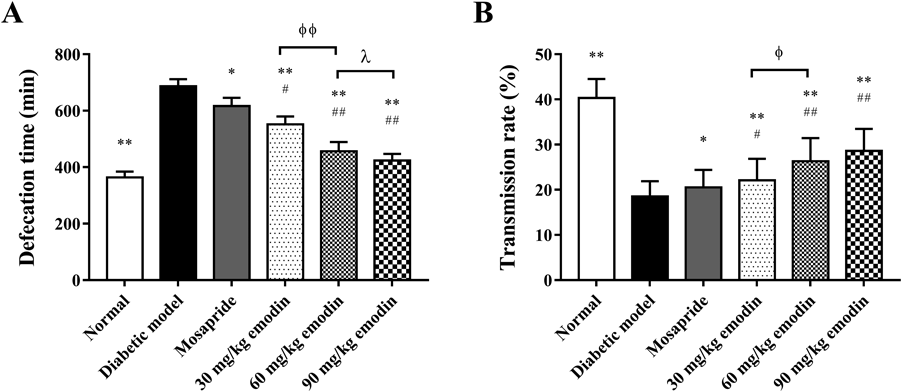
Compared with the control group, diabetic rats spent more time in defecation (Fig. 2A). Meanwhile, the gastrointestinal transmission rate was decreased in diabetic rats (Fig. 2B). These data indicated diabetic rats strongly developed into gastrointestinal dysmotility. But after treating with different dosages of emodin, faeces discharging time was significantly decreased (Fig. 2A). The gastrointestinal transmission rate also improved by different dosages of emodin treatment (Fig. 2B). Mosapride treatment also displayed similar effects with emodin in gastrointestinal transmission (Figs. 2A, B). So we considered emodin had potential effects in treating diabetic gastrointestinal dysmotility in diabetic rats.
Effects of Emodin in Intestinal NeurotransmittersAfter evaluating the effects of emodin in diabetic gastrointestinal dysmotility. We aimed to investigate the underlying mechanism. Several intestinal neurotransmitters (SP and VIP) associated intestinal motility were determined. As expected, serum SP was decreased in diabetic rats (Fig. 3A). On the contrary, serum VIP was enhanced in diabetic rats (Fig. 3B). But emodin treatment significantly increased the serum SP and suppressed the VIP concentration (Figs. 3A, B). These data suggested that effects emodin in diabetic gastrointestinal dysmotility may involved the neurotransmitters associated intestinal motility.
Effects of Emodin in ICC Associated ProteinsAccording to the effects of emodin and role of ICC in gastric motility, the ICC associated proteins were determined. The colonic proteins expression of c-kit and p62 were significantly reduced in diabetic rats (Figs. 4A, B). On the contrary, colonic proteins expression of beclin1 and Atg5 were enhanced in diabetic rats (Figs. 4A, B). These data indicated the colonic ICCs were impaired in the diabetic gastroenteropathy rats. On the other hand, we found emodin treatment reversed the expression of c-kit and p62 (Figs. 4A, B). Then, emodin also suppressed the expression of beclin1 and Atg5 (Figs. 4A, B). These effects were similar to the mosapride treatment (Figs. 4A, B). Moreover, IHC staining was also performed to validate our results. Similar results of p62 and beclin1 expression as WB were displayed (Fig. 5). Hence, we suggested emodin can ameliorate diabetic gastroenteropathy and promote the faeces discharge by protecting ICC.
Discussion
The incidence of diabetes is increasing globally. Diabetic gastroenteropathy and colonic dysmotility are common chronic complications. Diabetes colonic dysmotility is clinically characterized by nausea, vomiting, abdominal bloating and constipation without mechanical obstruction.1) The cardinal etiology of diabetic gastroenteropathy is manifested as delayed gastric emptying, decreased colonic contractility/relaxation and slower peristalsis, leading to severe poor glucose control.9) Chronic hyperglycemia is the critical pathogenesis of diabetic gastroenteropathy, which induces oxidative stress response and chronic inflammation, as well as leads to autonomic nerve damage and neuromuscular dysfunction.10) Current primary therapeutic strategies for treating diabetic gastroenteropathy are glycemia control and promoting gastrointestinal motility. But many drugs treatment can not fulfill these clinical demands completely.11) Rheum palmatum L. is a traditional Chinese herb for treating constipation.12,13) Previous research also indicated emodin has potential effects in colonic motility.8) However, the effects and mechanism of emodin in diabetic gastroenteropathy is still unclear.
In this study, emodin treatment could promote the gastrointestinal transmission and regulate intestinal neurotransmitters (SP and VIP) secretion. In previous researches, serum SP and VIP are important neurotransmitters for colonic motility. SP is the most powerful excitatory neurotransmitter in colon, which is widely distributed in colon tissues. SP can promote colonic smooth muscle contraction, peristalsis and propulsion.14) On the other hand, VIP is an inhibitory neurotransmitter in colonic nervous system, which inhibits the frequency of colonic contraction and peristalsis.15) Our results showed that emodin treatment increased serum SP and decreased serum VIP, indicating that emodin can improve colonic motility by modulating neurotransmitter secretion in diabetic gastroenteropathy rats. On the contrary, although previous study reported β-hydroxybutyrate regulate the gastrointestinal motility through cholecystokinin and insulin secretion.16) But according to the emodin had no effects in β-hydroxybutyrate. We considered emodin promote gastrointestinal motility independent of the β-hydroxybutyrate.
ICC serve as the mediator of neuromuscular transmission in the gastrointestinal tract and as pacemaker cells for gastrointestinal movements.17) Previous research demonstrated ICC damages have been found in the stomach, jejunum, and colon of patients with gastroenteropathy due either to type 1 or type 2 diabetes.18) Excessive autophagy was considered as a pathogenesis in ICC damage and dysfunction in diabetic gastroenteropathy and intestinal dysmotility in chronic hyperglycemia.19) C-kit, an ICC-specific marker, is widely used as an ICC indicator to determine ICC damage and dysfunction.3)
According to previous researches, autophagy associated proteins (Atg5, p62, Beclin1) constitute the initiator protein of autophagy. The levels of p62 usually inversely correlate with autophagic degradation, as the loss of Atg genes or factors required for the fusion of autophagosomes with lysosomes all result in a marked increase of p62-positive aggregates.20) Atg5 plays a key role in the autophagosome conjugation system and participates in the closure and extension of autophagosome membrane. If Atg5 is absent, autophagosome and lysosome cannot be integrated.21) Finally, expression of Beclin1 was considered a marker for reflecting the autophagy intensity.22)
Our results showed that colonic Beclin1 and Atg5 were significantly up-regulated in diabetic gastroenteropathy rats, whereas C-kit and p62 were significantly down-regulated. On the contrary, emodin treatment significantly up-regulated expressions of C-kit and p62 and significantly down-regulated expressions of Beclin1 and Atg5 in colon tissues, suggesting that the occurrence of diabetic colon dysmotility is related to over-autophagy of ICC, and the intervention of emodin can reverse these phenotypes.
Conclusion
Emodin can improve colonic dysmotility and promote the recovery of colonic motility and intestinal defecation in diabetic rats. Its mechanism may involved up-regulating the expression of C-kit and P62, down-regulating the expression of Beclin1 and Atg5 in colon, which are associated with the over-autophagy of ICC in colon.
Acknowledgments
This work was supported by the Science and Technology Plan Project of Shaanxi Province (No. 2020SF-336).
Author Contribution
Yanjin Su designed the research protocol. Yujin Wang and Na Dong implemented the research protocol. Yuan Zhou, Hongyan Li and Gangxin Qin analyzed the data. Yujin Wang, Hui Li and Qiaoqiao Zhao wrote the manuscript. All authors read and approved the final study.
Conflict of Interest
The authors declare no conflict of interest.
References
- 1) Meldgaard T., Keller J., Olesen A. E., Olesen S. S., Krogh K., Borre M., Farmer A., Brock B., Brock C., Drewes A. M., Therapeutic Advances in Gastroenterology, 12, 1756284819852047 (2019).
- 2) Wei X., Lin Y., Zhao D., Xiao X., Chen Q., Chen S., Peng Y., Canadian J. Gastroenterol. Hepatol., 2020, 7920715 (2020).
- 3) Sanders K. M., Ward S. M., Koh S. D., Physiol. Rev., 94, 859–907 (2014).
- 4) Zheng H., Liu Y. J., Chen Z. C., Fan G. Q., Indian J. Gastroenterol., 40, 198–208 (2021).
- 5) Sui F., Huo H. R., Zhang C. B., Yang N., Guo J. Y., Du X. L., Zhao B. S., Liu H. B., Li L. F., Guo S. Y., Jiang T. L., Am. J. Chin. Med., 38, 789–800 (2010).
- 6) Xie W., Xing D., Zhao Y., Su H., Meng Z., Chen Y., Du L., Eur. J. Pharmacol., 510, 113–120 (2005).
- 7) Cui X. R., Takahashi K., Shimamura T., Koyanagi J., Komada F., Saito S., Chem. Pharm. Bull., 56, 497–503 (2008).
- 8) Xu J. D., Wang W., Li L. S., Chen X., Zhu J. X., Biol. Pharm. Bull., 30, 2058–2062 (2007).
- 9) Kempler P., Amarenco G., Freeman R., Frontoni S., Horowitz M., Stevens M., Low P., Pop-Busui R., Tahrani A. A., Tesfaye S., Várkonyi T., Ziegler D., Valensi P., Diabetes Metab. Res. Rev., 27, 665–677 (2011).
- 10) Ohkuma T., Iwase M., Fujii H., Ide H., Komorita Y., Yoshinari M., Oku Y., Higashi T., Nakamura U., Kitazono T., J. Diabetes Complications, 35, 107751 (2021).
- 11) Jordan J., Fanciulli A., Tank J., et al., J. Hypertens., 37, 1541–1546 (2019).
- 12) Cui H. X., Zhang L. S., Luo Y., Yuan K., Huang Z. Y., Guo Y., Frontiers In Microbiology, 10, 1423 (2019).
- 13) Wang Z. W., Wang J. S., Luo J., Wei D. D., Kong L. Y., Chem. Pharm. Bull., 60, 241–245 (2012).
- 14) Lan J., Wang K., Chen G., Cao G., Yang C., Food & Function, 11, 9216–9225 (2020).
- 15) Laburthe M., Prieto J. C., Amiranoff B., Dupont C., Hui Bon Hoa D., Rosselin G., Eur. J. Biochem., 96, 239–248 (1979).
- 16) Rittig N., Svart M., Thomsen H. H., Vestergaard E. T., Rehfeld J. F., Hartmann B., Holst J. J., Johannsen M., Møller N., Jessen N., J. Clin. Endocrinol. Metab., 105, 483 (2020).
- 17) Yamamoto T., Watabe K., Nakahara M., Ogiyama H., Kiyohara T., Tsutsui S., Tamura S., Shinomura Y., Hayashi N., J. Gastroenterol. Hepatol., 23, 660–667 (2008).
- 18) Horváth V. J., Vittal H., Ordög T., Diabetes, 54, 1528–1533 (2005).
- 19) Zani-Ruttenstock E., Zani A., Paul A., Diaz-Cano S., Ade-Ajayi N., J. Pediatr. Surg., 50, 750–754 (2015).
- 20) Lippai M., Lőw P., BioMed Research International, 832704, 832704 (2014).
- 21) Song J., Oh Y., Lee J. E., Exp. Neurobiol., 24, 117–125 (2015).
- 22) Weng J., Wang C., Wang Y., Tang H., Liang J., Liu X., Huang H., Hou J., Oral Oncol., 50, 983–990 (2014).