Abstract
Ruthenium–vinylidene intermediates derived from ynamides show great promise for synthesizing nitrogen-containing heterocycles. Azepinoindoles are significant in medicinal chemistry owing to their varied biological activities. Different azepinoindole frameworks feature diverse fused arrays of indole and azepine rings. In this study, we introduce a ruthenium-catalyzed approach based on ynamide chemistry to produce various azepinoindole frameworks using ynamides with an indole unit. Mechanistic insights were obtained through deuterium labeling experiments.
Introduction
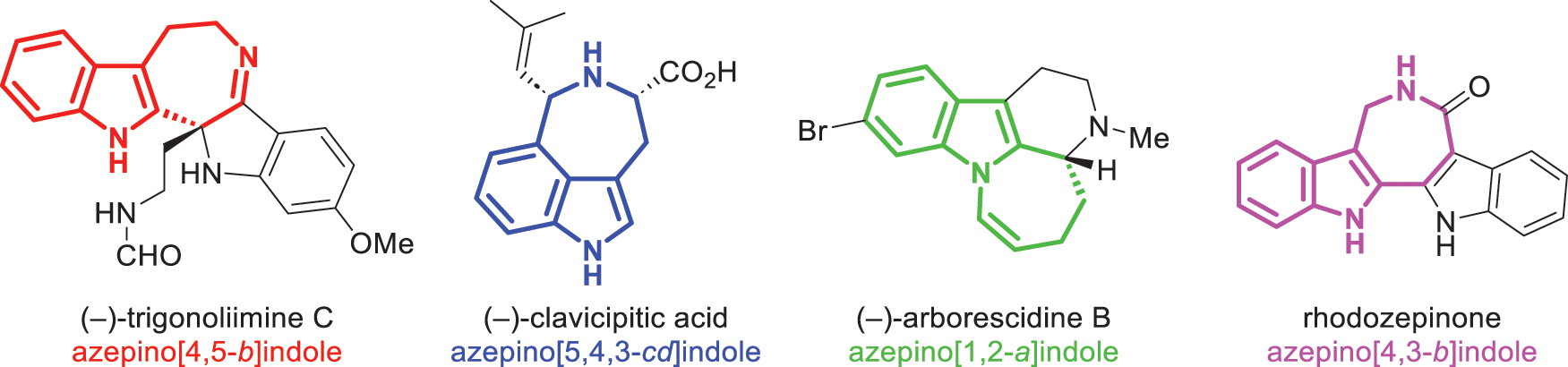
Indoles hold a pivotal position as “the privileged structure” in medicinal chemistry owing to their unique and intriguing biological properties, rendering them essential in drug discovery and development.1–5) Among indole derivatives, heterocycle-fused indoles have garnered significant interest owing to their profound biological implications. Particularly, the azepinoindole framework serves as a crucial structural component in numerous natural products,6–18) such as trigonoliimine C,19) clavicipitic acid,20,21) arborescidine B,22) and rhodozepinone,23) which are recognized as representative azepinoindole alkaloids (Fig. 1). These alkaloids are categorized based on their frameworks as azepino[4,5-b]indole, azepino[5,4,3-cd]indole, azepino[1,2-a]indole, or azepino[4,3-b]indole. The intriguing bioactivities of alkaloids within these frameworks have led to significant attention in synthetic studies within medicinal chemistry.24–28) From a synthetic chemistry perspective, a crucial aspect in synthesizing these frameworks is the creation of a 7-membered azepine ring. Various strategies have been developed to synthesize azepinoindoles, focusing on azepine ring formation.16,17) The formation of an azepine core in azepino[4,5-b]indoles involves the cyclization of tryptamine29–37) or isotryptamine38–41) derivatives, along with the incorporation of a C2 unit. In the synthesis of azepino[5,4,3-cd]indoles, an azepine ring is formed through the cyclization of tryptamine derivatives with a C1 unit42,43) or by linking C3 and C4 side chains with a nitrogen source.44–47) For azepino[1,2-a]indoles, the production of azepine rings through olefin metatheses,48) [2 + 5] cycloaddition,49,50) radical cyclization,51) and transition-metal-catalyzed cyclization52,53) has been reported. The synthesis of azepino[4,3-b]indoles involves the formation of an azepine ring through the cyclization of gramine containing pendant carboxylic acid chains.54) The ongoing research and development of synthetic methods for azepinoindoles underscore their importance in medicinal chemistry.
Ynamides have garnered significant attention as versatile building blocks due to their distinctive structure, featuring a carbon–carbon triple bond directly linked to the nitrogen atom of an amide group.55–64) The electron-donating property of the nitrogen atom induces triple bond polarization, giving ynamides a reactivity different from that of conventional alkynes. Recently, we catalytically synthesized indole 3 from N-arylynamide 1 through a cascade of 1,2-rearrangement and cyclization using a ruthenium–vinylidene intermediate 265) (Chart 1, previous work). Given our interest in metal vinylidene66–69) and ynamide chemistry,70–76) we anticipate that the ruthenium vinylidene intermediate derived from ynamides holds significant potential as a robust species for constructing nitrogen-containing heterocycles. We predict that a ruthenium vinylidene intermediate from a ynamide bearing an indolyl group at a suitable position could catalytically form various fused azepinoindole frameworks, including a 7-membered azepine ring. As shown in Chart 1 (this work), utilizing 2-, 4-, and 1-indolyl groups in ynamides 4, 7, and 10 yielded azepino[4,5-b]indole 6, azepino[5,4,3-cd]indole 9, and diazepino[1,7-a]indole 12, respectively, from ruthenium vinylidene intermediates 5, 8, and 11. In this study, we present the catalytic synthesis of azepinoindole and diazepinoindole frameworks using a ruthenium–vinylidene species generated from an indolyl moiety containing a ynamide.
Results and Discussion
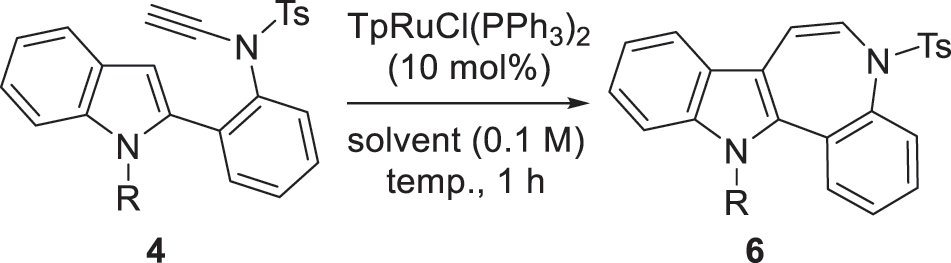
To synthesize azepinoindole frameworks using a metal vinylidene intermediate, we 1st investigated the reaction of ynamide 4a containing a 2-indolyl group with a catalytic quantity of TpRuCl(PPh3)2 in tetrahydrofuran (THF). This investigation followed the reaction parameters established in our previously published indole synthesis65) (Chart 2). Unexpectedly, azepino[4,5-b]indole 6a was not produced. This outcome may be attributed to the high flexibility of the alkyl chain attached to the C2 position of the indole. To address this, we explored the use of dimethyl-substituted ynamides at the C2α position of indole 4b, anticipating the Thorpe–Ingold effect. However, even under identical reaction conditions as 4a, the desired product 6b was not synthesized.
To investigate the reactivity difference between N-alkyl and N-aryl ynamides, we selected benzene ring-fused ynamide 4c as the substrate (Table 1). Despite the use of 4c, azepinoindole 6c was not formed under the optimized conditions, and 4c was recovered in a 62% yield (entry 1). Subsequently, we optimized the reaction conditions and evaluated the solvent effect (entries 2–5). Conducting the reaction in benzene yielded azepinoindole 6c in 8% (entry 2). The structure of 6c was confirmed via X-ray crystallography77) (Fig. 2). The utilization of nitromethane slightly increased the yield of 6c to 22% (entry 4). Although acetone led to a moderate yield of 6c (entry 5), a high mass balance was observed (31% for 6c and 59% for 4c). The recovery of ynamide 4c suggested an incomplete reaction due to the low nucleophilicity of the indole nucleus. Consequently, we examined substrates with an electron-donating group on the nitrogen atom of the indole (entries 6 and 7). The use of ynamides with 1-methyl and 1-benzyl indole moieties (compounds 4d and 4e) resulted in smooth reactions, yielding products 6d and 6e in 99 and 84% yields, respectively.
Table 1. Optimization of Reaction Conditions
 |
| Entry |
4 |
R |
Solvent |
Temperature |
6 |
Yield (%) |
Recovery of 4 (%) |
| 1 |
4c |
H |
THF |
Reflux |
6c |
n.d.a) |
62 |
| 2 |
4c |
H |
Benzene |
70°C |
6c |
8 |
27 |
| 3 |
4c |
H |
MeCN |
70°C |
6c |
n.d.a) |
99 |
| 4 |
4c |
H |
MeNO2 |
70°C |
6c |
22 |
35 |
| 5 |
4c |
H |
Acetone |
Reflux |
6c |
31 |
59 |
| 6 |
4d |
Me |
Acetone |
Reflux |
6d |
99 |
n.d.a) |
| 7 |
4e |
Bn |
Acetone |
Reflux |
6e |
84 |
n.d.a) |
Next, to investigate the substituent effect, we utilized 2-indolylphenyl ynamides as substrates (Chart 3). The reaction of the ynamide with a 5-methoxyindolyl group yielded azepino[4,5-b]indole 6f in a 27% yield. Increasing the catalyst loading to 30 mol% improved the yield of 6f to 60%, with 21% recovery of the starting material 4f. Conversely, employing a 6-methoxyindolyl derivative, with high electron density on the C3 carbon of the indole nuclei, resulted in the formation of product 6g with 75% yield. The 5-fluoroindolyl derivatives, upon examination, provided 6h in moderate yield. Product 6i was not obtained when the 4-methoxy indolyl derivative was used, likely due to steric hindrance from the indole moiety. Subsequently, reactions with ynamides bearing substituents on the aniline ring yielded the corresponding azepinoindoles 6j–6l in moderate yields.
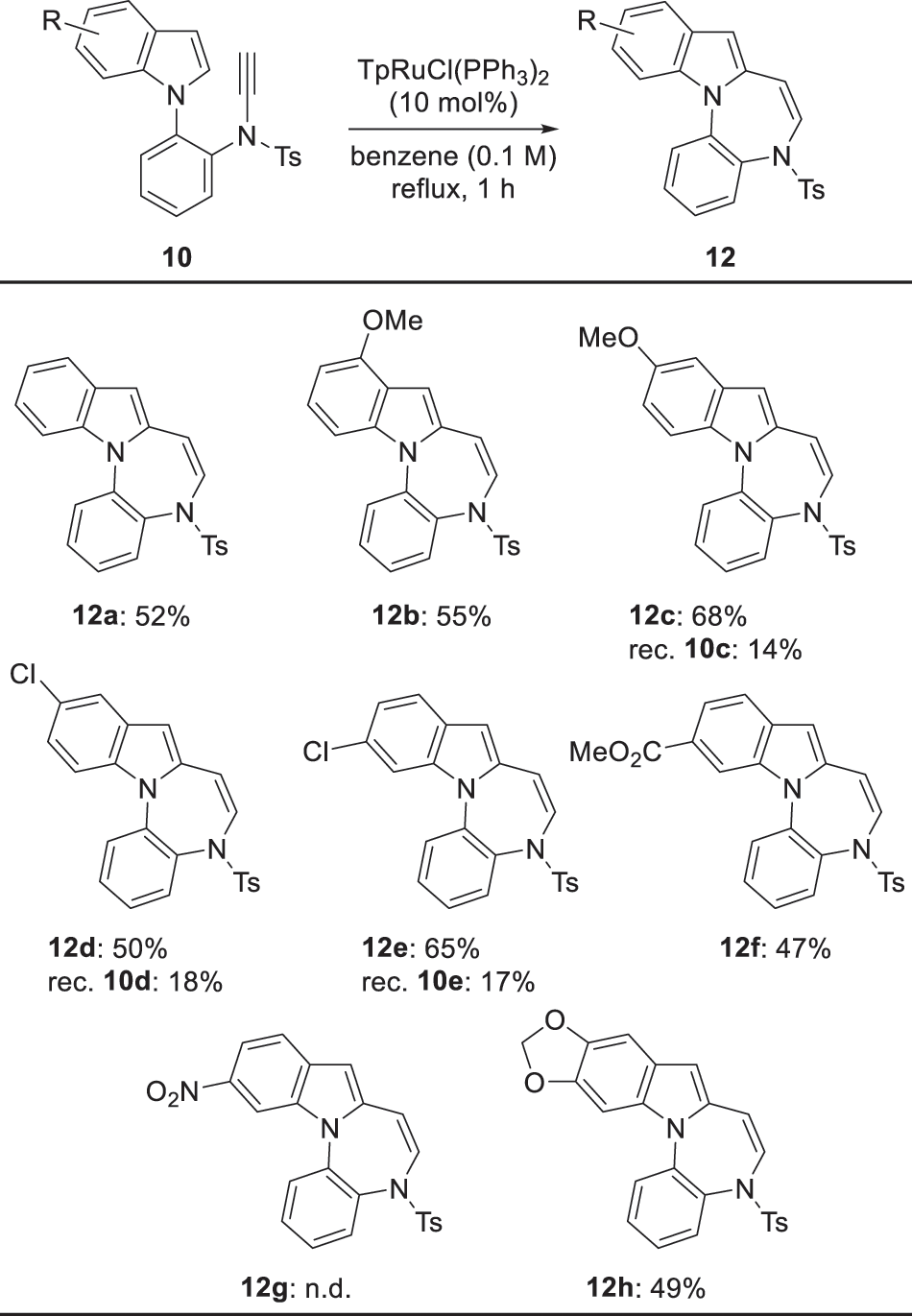
Further, the synthesis of other fused azepinoindole frameworks using the corresponding ynamides was examined (Chart 4). The reaction of 1-indolylphenyl ynamide 10a proceeded through cyclization at the indole C2-position, resulting in the formation of diazepino[1,7-a]indole 12a with a yield of 52%. This compound plays a crucial role in organic electronic devices and occurs naturally.78–80) Investigating the effect of substituents on the synthesis of diazepino[1,7-a]indole 12, substrates containing 4-methoxyindolyl and 5-methoxyindolyl derivatives 10b and 10c produced the respective products 12b and 12c in 55 and 68% yields, respectively. Treatment with 5- and 6-chloroindolyl derivatives 10d and 10e led to the formation of products 12d and 12e with yields of 50 and 65%, respectively. The methoxycarbonyl-substituted substrate 10f, serving as a carbonyl derivative, furnished the corresponding product 12f in 47% yield. The introduction of a nitro group led to a complex reaction mixture, and the desired diazepinoindole 12g was not detected. The strong electron-withdrawing nature of the nitro group is assumed to inhibit cyclization after the formation of the ruthenium vinylidene species, resulting in the progression of various reactions, including intermolecular processes. The substrate 10h bearing a methylenedioxy ring as an acetal derivative underwent transformation to afford the polycyclic product 12h in 49% yield.
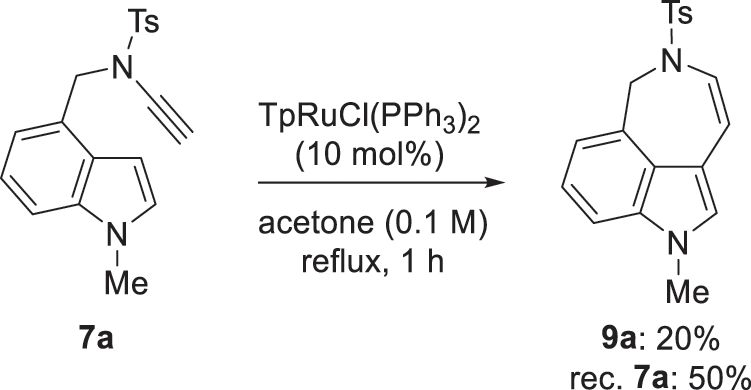
To synthesize a new fused azepinoindole framework, the 4-indolyl group-bearing ynamide 7a was subjected to optimized conditions, yielding azepino[5,4,3-cd]indole 9a in 20% yield, while 7a was recovered at a 50% yield (Chart 5). The steric bulkiness of the ruthenium vinylidene moiety appears to prevent proper orientation toward the C3 position of the indole core, resulting in suppression of the cyclization reaction involving nucleophilic attack.
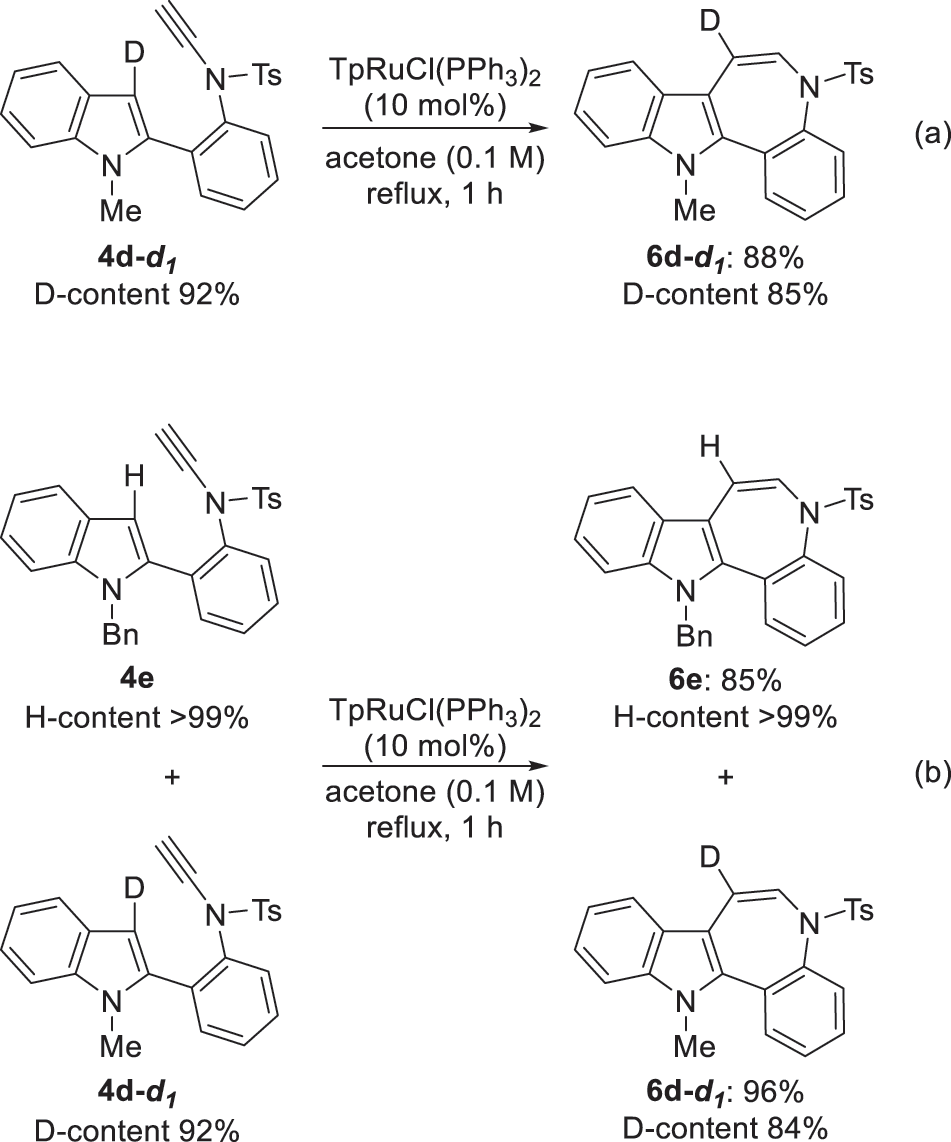
To investigate the reaction mechanism for the synthesis of azepino[4,5-b]indole 6, we conducted deuterium labeling experiments (Chart 6). We utilized indole C3-deuterated ynamide 4d–d1 (D-content 92%) as the substrate to determine the proton source at the indole C3a position (Chart 6a). The deuterated azepinoindoles 6d–d1 were obtained in 88% yield while maintaining the D-content at 85%, indicating that the indole C3a proton originated from the indole C3 proton of 4d–d1. To ascertain whether the indole C3a protonation proceeded via an intramolecular or intermolecular reaction, we conducted a crossover experiment using a 1 : 1 mixture of 4e (H content >99%) and 4d–d1 (D content 92%) (Chart 6b). This reaction yielded azepinoindoles 6e and 6d–d1 in 85% (H content >99%) and 96% (D content 84%) yield, respectively, without hydrogen–deuterium intermolecular scrambling. While a slight decrease in the D-content of 6d–d1 was observed, the findings suggest that C3a protonation predominantly occurs intramolecularly. However, the results also imply that the proton may be partially derived from acetone.81)
A plausible reaction mechanism for 6d, based on the observations from these experiments, is illustrated in Chart 7 (left side). Initially, the coordination of ynamide 4d to the ruthenium complex leads to the formation of I, triggering a 1,2-rearrangement that generates the ruthenium vinylidene intermediate II. Subsequent cyclization of II results in the formation of the indolenium intermediate III, facilitating the creation of a C–C bond. Ultimately, intramolecular proton transfer from the indole C3 position, or intermolecular proton transfer from acetone, along with the elimination and regeneration of the ruthenium species, yields azepinoindole 6d. In addition, a plausible reaction mechanism leading to 12a is depicted in Chart 7 (right side). Coordination of ynamide 10a to the ruthenium complex forms intermediate I′, which undergoes a 1,2-rearrangement to generate the ruthenium vinylidene species II′. Subsequent cyclization of II′ affords intermediate III′. Finally, proton transfer, along with elimination and regeneration of the ruthenium species, furnishes diazepinoindole 12a.
Conclusion
In this study, we developed a ruthenium-catalyzed reaction for creating diverse azepinoindole frameworks using ynamides with an indole motif. We gained mechanistic insights from deuterium labeling and crossover experiments. This method enables the synthesis of various azepinoindole derivatives with potential applications in medicinal chemistry. Our work highlights the promise of ynamide cyclization involving metal vinylidene intermediates for synthesizing nitrogen-containing heterocycles. Ongoing investigations in our lab focus on further synthetic studies of biologically active azepinoindole alkaloids and extensive exploration of nitrogen-containing heterocycles.
Experimental
Typical Procedure for the Ruthenium-Catalyzed Construction of Azepinoindole 6d
A solution of ynamide 4d (40.8 mg, 0.10 mmol, 1.0 equivalent) in acetone (1.0 mL, [4c] = 0.1 M) was added to TpRuCl(PPh3)2 (8.6 mg, 0.01 mmol, 10 mol%) by cannulation at room temperature. After refluxing for 1 h, the reaction mixture was filtered through a Celite pad. The filtrate was concentrated under reduced pressure. The residue was purified by silica gel column chromatography with n-hexane/EtOAc (6/1) to give 6d (40.4 mg, 0.10 mmol, 99%) as a greenish amorphous. IR (neat) 1495, 1470, 1346, 1165, 1092 cm–1; 1H-NMR (400 MHz, CDCl3) δ: 1.83 (3H, s), 3.60 (3H, s), 6.39 (1H, d, J = 6.9 Hz), 6.47 (2H, d, J = 8.2 Hz), 6.88 (1H, d, J = 6.4 Hz), 7.12–7.22 (4H, m), 7.22–7.30 (1H, m), 7.36 (1H, dd, J = 8.0, 1.6 Hz), 7.41–7.51 (2H, m), 7.54 (1H, td, J = 7.6, 1.4 Hz), 7.67 (1H, dd, J = 7.8, 1.4 Hz); 13C-NMR (101 MHz, CDCl3) δ: 21.1, 32.2, 109.0, 112.5, 118.5, 120.4, 123.4, 124.0, 125.2, 126.2 (2C), 126.6, 127.8 (2C), 128.1, 128.6, 129.5, 129.7, 132.7, 137.7, 137.9, 139.3, 142.5 (2C); electron ionization-high resolution MS: Calcd for C24H20N2O2S: 400.1245. Found: 400.1246.
Acknowledgments
We gratefully acknowledge financial support from JSPS KAKENHI (Grant Number 22K06538). We also thank T. Koseki and S. Yamada at the Analytical Center of our university for performing microanalysis, NMR, and MS measurements.
Conflict of Interest
The authors declare no conflict of interest.
Supplementary Materials
This article contains supplementary materials.
References and Notes
- 1) Humphrey G. R., Kuethe J. T., Chem. Rev., 106, 2875–2911 (2006).
- 2) Taber D. F., Tirunahari P. K., Tetrahedron, 67, 7195–7210 (2011).
- 3) Gribble G. W., “Indole Ring Synthesis from Natural Products to Drug Discovery,” Wiley, New York, 2016.
- 4) Kumar I., Kumar R., Sharma U., Synthesis (Stuttg.), 50, 2655–2677 (2018).
- 5) Mancuso R., Dalpozzo R., Catalysts, 8, 458 (2018).
- 6) Joule J. A., “The Alkaloids,” Vol. 4, ed. by Saxton J. E., The Royal Society of Chemistry, London, 1974, pp. 280–321.
- 7) Cordell G. A., “Chemistry of Heterocyclic Compounds: Indoles, The Monoterpenoid Indole Alkaloids,” Vol. 25, John Wiley & Sons, Inc., Hoboken, NJ, USA, 2008, pp. 467–537.
- 8) Kitajima M., Takayama H., “The Alkaloids: Chemistry and Biology,” Vol. 76, ed. by Knölker H.-J. Academic Press, 2016, pp. 259–307.
- 9) Batters A. R., “The Alkaloids,” Vol. 1, ed. by Saxton J. E, The Royal Society of Chemistry, London, 1971, pp. 31–47.
- 10) Sungberg R. J., Smith S. Q., “The Alkaloids: Chemistry and Biology,” Vol. 59, ed. by Cordell G. A., Elsevier Science, San Diego, CA, United States, 2002, pp. 281–376.
- 11) Taylor W. I., “The Alkaloids: Chemistry and Physiology,” Vol. 8, ed. by Manske R. H. F., Academic Press, Cambridge, MA, 1965, pp. 203–235.
- 12) Takayama H., Sakai S.-I., “The Alkaloids: Chemistry and Biology,” Vol. 50, ed. by Cordell G. A., Academic Press, Cambridge, MA, 1998, pp. 415–452.
- 13) Borschberg H.-J., Curr. Org. Chem., 9, 1465–1491 (2005).
- 14) Popik P., Skolnick P., “The Alkaloids,” Vol. 52, Academic Press, Cambridge, MA, 1999, pp. 197–231.
- 15) Alper K. R., “The Alkaloids Chemistry and Biology,” Vol. 56, Academic Press, Cambridge, MA, 2001, pp. 1–38.
- 16) Lindsay A. C., Kim S. H., Sperry J., Nat. Prod. Rep., 35, 1347–1382 (2018).
- 17) Abe N., Heterocycles, 101, 33–89 (2020).
- 18) Tasker N. R., Wipf P., “The Alkaloids: Chemistry and Biology,” Vol. 85, ed. by Knölker H.-J., Academic Press, Cambridge, MA, 2021, pp. 1–112.
- 19) Tan C. J., Zhang Y., Kong N.-C., Di Y.-T., Hao Y.-J., Helv. Chim. Acta, 98, 72–77 (2015).
- 20) Robbers J. E., Floss H. G., Tetrahedron Lett., 10, 1857–1858 (1969).
- 21) King G. S., Mantle P. G., Szczyrbak C. A., Waight E. S., Tetrahedron Lett., 14, 215–219 (1973).
- 22) Chbani M., Païs M., Delauneux J.-M., Debitus C., J. Nat. Prod., 56, 99–104 (1993).
- 23) Elsayed Y., Refaat J., Abdelmohsen U. R., Ahmed S., Fouad M. A., Med. Chem. Res., 26, 2751–2760 (2017).
- 24) Singh A. K., Raj V., Saha S., Eur. J. Med. Chem., 142, 244–265 (2017).
- 25) Koenig X., Hilber K., Molecules, 20, 2208–2228 (2015).
- 26) Kadagathur M., Patra S., Sigalapalli D. K., Shankaraiah N., Tangellamudi N. D., Org. Biomol. Chem., 19, 738–764 (2021).
- 27) Leśniewska A., Przybylski P., Eur. J. Med. Chem., 275, 116556 (2024).
- 28) Kaur M., Garg S., Malhi D. S., Sohal H. S., Curr. Org. Chem., 25, 449–506 (2021).
- 29) Donets P. A., Van der Eycken E. V., Synthesis (Stuttg.), 13, 2147–2153 (2011).
- 30) Liu S., Hao X.-J., Tetrahedron Lett., 52, 5640–5642 (2011).
- 31) Qi X., Bao H., Tambar U., J. Am. Chem. Soc., 133, 10050–10053 (2011).
- 32) Buyck T., Wang Q., Zhu J., Org. Lett., 14, 1338–1341 (2012).
- 33) Lindsay A. C., Leung I. K. H., Sperry J., Org. Lett., 18, 5404–5407 (2016).
- 34) Pradhan S., Shahi C. K., Bhattacharyya A., Chauhan N., Ghorai M. S., Org. Lett., 19, 3438–3441 (2017).
- 35) Li L., Chen X.-M., Wang Z.-S., Zhou B., Liu X., Lu X., Ye L.-W., ACS Catal., 7, 4004–4010 (2017).
- 36) Abe T., Yamada K., Org. Lett., 20, 1469–1472 (2018).
- 37) Gurram R., Nanubolu J. B., Menon R. S., Chem. Commun. (Camb.), 57, 635–638 (2021).
- 38) Liu Y., McWhorter W. W. Jr, J. Am. Chem. Soc., 125, 4240–4252 (2003).
- 39) Higuchi K., Sato Y., Tsuchimochi M., Sugiura K., Hatori M., Kawasaki T., Org. Lett., 11, 197–199 (2009).
- 40) Douki K., Ono H., Taniguchi T., Shimokawa J., Kitamura M., Fukuyama T., J. Am. Chem. Soc., 138, 14578–14581 (2016).
- 41) Torres-Ochoa R. O., Buyck T., Wang Q., Zhu J., Angew. Chem. Int. Ed., 57, 5679–5683 (2018).
- 42) Yamada K., Namerikawa Y., Haruyama T., Miwa Y., Yanada R., Ishikura M.,Eur. J. Org. Chem., 2009, 5752–5759 (2009).
- 43) Lei T., Zhang H., Yang Y.-R., Tetrahedron Lett., 56, 5933–5936 (2015).
- 44) Yamada F., Makita Y., Suzuki T., Somei M., Chem. Pharm. Bull., 33, 2162–2163 (1985).
- 45) Hegedus L. S., Toro J. L., Miles W. H., Harrington P. J., J. Org. Chem., 52, 3319–3322 (1987).
- 46) Krishnan S., Bagdanoff J. T., Ebner D. C., Ramtohul Y. K., Tambar U. K., Stoltz B., J. Am. Chem. Soc., 130, 13745–13754 (2008).
- 47) Brak K., Ellman J. A., Org. Lett., 12, 2004–2007 (2010).
- 48) González-Pérez P., Pérez-Serrano L., Casarrubios L., Domínguez G., Pérez-Castells J., Tetrahedron Lett., 43, 4765–4767 (2002).
- 49) Kusama H., Suzuki Y., Takaya J., Iwasawa N., Org. Lett., 8, 895–897 (2006).
- 50) Shenje R., Martin M. C., France S., Angew. Chem. Int. Ed., 53, 13907–13911 (2014).
- 51) Caddick S., Aboutayab K., West R. I., J. Chem. Soc. Chem. Commun., 1353–1354 (1995).
- 52) Cera G., Piscitelli S., Chiarucci M., Fabrizi G., Goggiamani A., Ramón R. S., Nolan S. P., Bandini M., Angew. Chem. Int. Ed., 51, 9891–9895 (2012).
- 53) Lee H. S., Kim S. H., Kim T. H., Kim J. N., Tetrahedron Lett., 49, 1773–1776 (2008).
- 54) Itoh T., Abe T., Heterocycles, 98, 798–803 (2019).
- 55) Evano G., Coste A., Jouvin K., Angew. Chem. Int. Ed., 49, 2840–2859 (2010).
- 56) DeKorver K. A., Li H., Lohse A. G., Hayashi R., Lu Z., Zhang Y., Hsung R. P., Chem. Rev., 110, 5064–5106 (2010).
- 57) Wang X.-N., Yeom H.-S., Fang L.-C., He S., Ma Z.-X., Kedrowski B. L., Hsung R. P., Acc. Chem. Res., 47, 560–578 (2014).
- 58) Evano G., Theunissen C., Lecomte M., Aldrichim Acta, 48, 59–70 (2015).
- 59) Cook A. M., Wolf C., Tetrahedron Lett., 56, 2377–2392 (2015).
- 60) Evano G., Blanchard N., Compain G., et al., Chem. Lett., 45, 574–585 (2016).
- 61) Evano G., Lecomte M., Thilmany P., Theunissen C., Synthesis (Stuttg.), 3183–3214 (2017).
- 62) Saito N., Sato Y., J. Synth. Org. Chem. Jpn., 76, 699–709 (2018).
- 63) Zhou B., Tan T.-D., Zhu X.-Q., Shang M., Ye L.-W., ACS Catal., 9, 6393–6406 (2019).
- 64) Hong F.-L., Ye L.-W., Acc. Chem. Res., 53, 2003–2019 (2020).
- 65) Tayu M., Watanabe R., Isogi S., Saito N., Adv. Synth. Catal., 363, 1147–1151 (2021).
- 66) Bruneau C., Top. Organomet. Chem., 43, 203–230 (2013).
- 67) Varela J. A., González-Rodríguez C., Saá C., Top. Organomet. Chem., 48, 237–287 (2014).
- 68) Varela J. A., Saá C., Synthesis (Stuttg.), 48, 3470–3478 (2016).
- 69) Roh S. W., Choi K., Lee C., Chem. Rev., 119, 4293–4357 (2019).
- 70) Saito N., Katayama T., Sato Y., Org. Lett., 10, 3829–3832 (2008).
- 71) Sato Y., Saito N., Katayama T., Heterocycles, 82, 1181–1187 (2011).
- 72) Saito N., Saito K., Shiro M., Sato Y., Org. Lett., 13, 2718–2721 (2011).
- 73) Saito N., Ichimaru T., Sato Y., Org. Lett., 14, 1914–1917 (2012).
- 74) Saito N., Saito K., Sato Y., Sato Y., Adv. Synth. Catal., 355, 853–856 (2013).
- 75) Saito N., Abdullah I., Hayashi K., Hamada K., Koyama M., Sato Y., Org. Biomol. Chem., 14, 10080–10089 (2016).
- 76) Doi R., Abdullah I., Taniguchi T., Saito N., Sato Y., Chem. Commun. (Camb.), 53, 7720–7723.
- 77) The structure of 6c was elucidated by X-ray crystallographic analysis. Details, see Supplementary Materials. CCDC 2400852 contains the supplementary crystallographic data for this paper. This data can be obtained free of charge from The Cambridge Crystallographic Data Centre.
- 78) Kim Y.-R., Kim Y.-H., Kim J.-Y., Jang J.-W., Lee Y.-S., Lee H.-D., South Korea Patent KR102391274B1 (2019).
- 79) Kim Y.-R., Kim Y.-H., Kim J.-Y., Jang J.-W., Lee Y.-S., Lee H.-D., WO2021112478A1 (2021).
- 80) Yu H.-F., Qin X.-J., Ding C.-F., Wei X., Yang J., Luo J.-R., Liu L., Khan A., Zhang L.-C., Xia C.-F., Luo X.-D., Org. Lett., 20, 4116–4120 (2018).
- 81) Although the proton at the C3a position could be partially derived from acetone, the possibility that acetone facilitates the protonation rate cannot be excluded.