Abstract
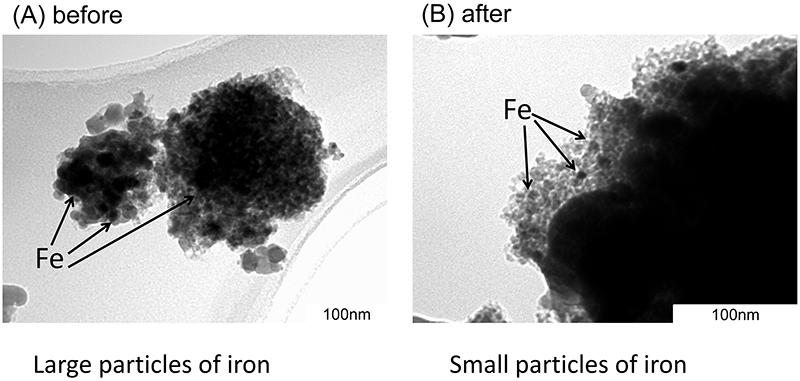
Hydrogenation of carbon monoxide in the presence of solvent under low pressure of 0.5 MPa was developed to easily evaluate catalysts, and was used to examine novel carbon–oxide composite supported cobalt catalysts. CO conversion increased in the order 16Co63C21TiO2 = 16Co63C21Al2O3 < 16Co63C21SiO2 < 16Co63C21ZrO2 (16Co: 16 wt% Co; 63C: 63 wt% carbon in PEG; 21TiO2, Al2O3, SiO2 or ZrO2 : 21 wt% TiO2, Al2O3, SiO2 or ZrO2). This reaction was performed for easy evaluation of catalysts under high temperature and low pressure conditions, which are not usually used for Co catalysts, so most product was methane for all cobalt catalysts. 16Co63C21ZrO2 catalyst showed the highest conversion of 31 % at 340 °C, probably because 16Co63C21ZrO2 catalyst consists of only mesopores which have advantages for mass transfer and was unchanged after the reaction. Furthermore, cobalt metal species did not change and were detected by XRD after the reaction, which would also maintain the higher activity. Novel carbon–oxide composite supported iron catalysts were similarly prepared and reactivity for the hydrogenation of carbon monoxide in the presence of solvent was examined. CO conversion increased in the order 16Fe63C21SiO2 = 16Co63C21TiO2 < 16Fe63C21Al2O3 < 16Fe63C21ZrO2 (calcined at 500 °C) < 16Fe63C21ZrO2 (calcined at 700 °C). Most product was methane for all iron catalysts under low pressure in the presence of solvent, but 16Fe63C21ZrO2 calcined at 700 °C also produced C2-C6 hydrocarbons. These results may be related to the increased surface area and pore volume for ZrO2 supported catalysts with higher calcination temperature and the decreased iron particle sizes after the reactions, specifically from 42 to 7.2 nm for the catalyst calcined at 700 °C.