Abstract
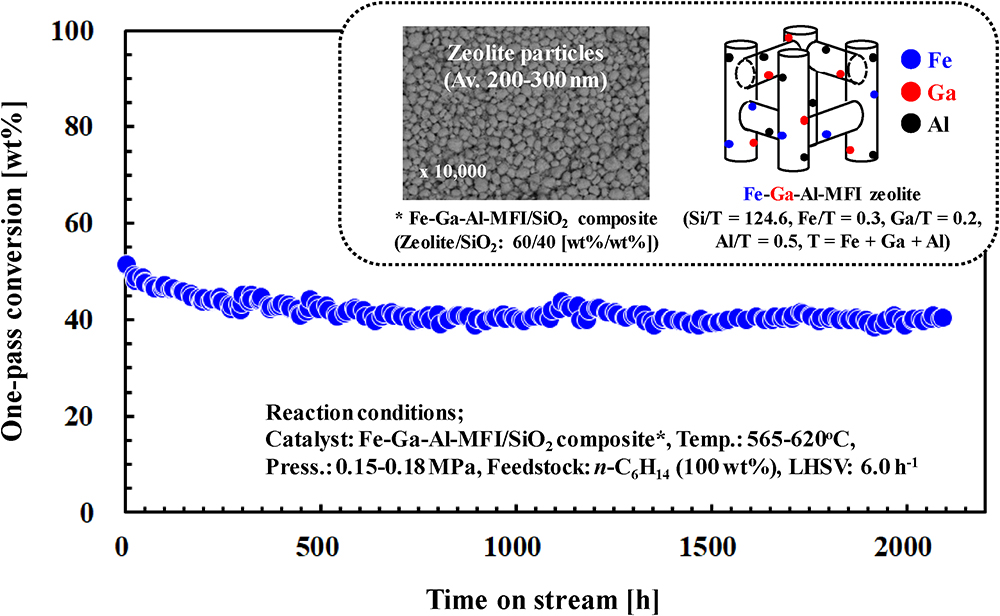
Catalytic cracking of light-naphtha fraction over zeolite-based composites in fixed-bed mode was investigated to establish an efficient method for on-purpose propylene production. The composite catalysts, consisting of MFI-type zeolites containing iron, gallium and aluminum species (Fe–Ga–Al-MFI) and metal-oxide binder (e.g., silicon oxide, aluminum oxide), were employed for cracking of light-naphtha fraction. Fe–Ga–Al-MFI zeolites as matrix, containing each heteroatom at adequate ratio in the zeolite framework, exhibited both overall acid strength suitable for selective formation of light olefins and enhanced activity for dehydrogenation of light alkanes to alkenes, so that high overall yields of light olefins (ethylene, propylene and butenes) were attained by suppressing aromatics formation compared to cracking of light-naphtha fraction using conventional Al-MFI zeolite (ZSM-5). The unique acidity of the Fe–Ga–Al-MFI zeolite was maintained in the extruded form by using neutral and inactive silicon–oxide binder, which was selected to enhance mechanical strength and/or reduce pressure drop during reaction. The zeolite-based composite (Fe–Ga–Al-MFI/SiO2) selectively converted light-naphtha fraction (n-hexane) into light olefins including propylene with catalyst lifetime longer than 2000 h, suitable for fixed-bed operation, due to its excellent resistance to coke formation. Furthermore, the cracking reactions proceeded in the absence of steam at moderate temperatures below 650 °C, so catalytic cracking using the present zeolite-based composite saved considerable thermal energy required in the reaction unit, and the total amount of hydrocarbon feedstock was reduced by ca. 15 %, compared to conventional thermal cracking at 850 °C. The present review discusses the excellent properties of these zeolite-based catalysts and catalytic cracking of light-naphtha fraction emphasizing the catalytic chemistry and reaction engineering of the catalytic process.