Regular Articles
An Ophthalmic Formulation of Disulfiram Nanoparticles Prolongs Drug Residence Time in Lens

2016 年 39 巻 11 号 p. 1881-1887
詳細
2016 年 39 巻 11 号 p. 1881-1887
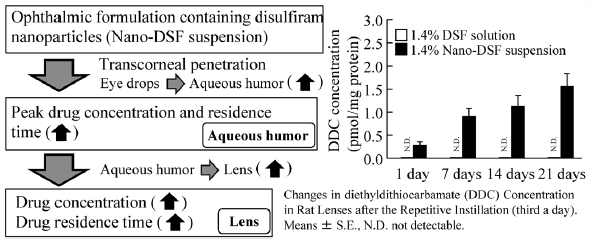
Disulfiram (DSF) is a dimer of diethyldithiocarbamate (DDC) that we previously added to a solution of 2-hydroxypropyl-β-cyclodextrin (DSF solution). We found that the instillation of this DSF solution delayed lens opacification in a hereditary cataractous ICR/f rat. In this study, we attempted to design an ophthalmic formulation containing DSF nanoparticles for use as a lens targeted drug delivery system (nano-DSF suspension), and investigated the changes in drug content in the lens after the instillation of DSF solution or nano-DSF suspension. The nano-DSF suspension was prepared by a bead mill method to yield a mean particle size of nano-DSF of 181 nm. Following the instillation of 1.4% DSF solution or the nano-DSF suspension, DDC was detected only in the aqueous humor and lens; in both, the area under the curve (AUC) and mean residence time (MRT) for the nano-DSF suspension were higher than for the DSF solution. In addition, we found that the DDC residence time in the cortex and nucleus of the lens was higher than in the capsule-epithelium. Although DDC was not detected in the cortex and nucleus of lenses following the instillation of the 1.4% DSF solution, the instillation of a 1.4% nano-DSF suspension led to the accumulation of DDC in both areas. In conclusion, it is possible that the instillation of a nano-DSF suspension can supply more DDC into the aqueous humor and lens than a conventional formulation, and these findings provide information significant for the prevention of cataracts and the design of a lens targeted drug delivery system.