Current Topics: Regular Article
Construction of Biosensing System for Glycated Albumin Using an Electron Transfer Peptide-Modified Protein Probe

2024 年 72 巻 3 号 p. 258-265
詳細
2024 年 72 巻 3 号 p. 258-265
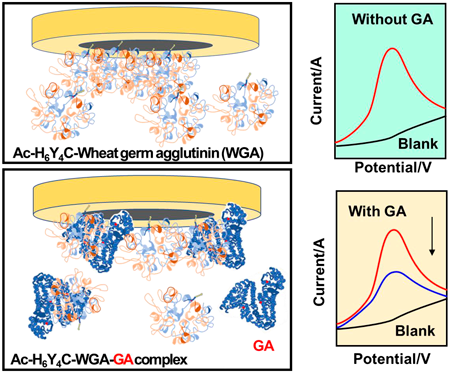
Glycated albumin (GA) is one of the proteins that replaces several sugar moieties and can be used as an indicator of diabetes mellitus. We developed a sensing system that uses GA in the early detection of diabetes mellitus. In this study, H6Y4C acetylated (Ac-) at the N-terminals of the peptide was combined with wheat germ agglutinin (WGA) to recognize glucose moieties. The Ac-H6Y4C-WGA was constructed as a GA-sensing probe. The tyrosine residues of Y4C exhibited an oxidation peak, and His-tag moieties were introduced to separate Ac-H6Y4C-WGA in the synthesis of the probe. The Ac-H6Y4C-WGA probe binds with the 1–2 molecules of Ac-H6Y4C per WGA using matrix assisted laser desorption/ionization-time of flight (MALDI-TOF)-MS. Next, the functions of Ac-H6Y4C-WGA were evaluated using voltammetry. The number of electron-transfers was calculated based on the relationship between the peak potential and logarithm of scan rate and was 3.03. In the electrochemical measurements with mannose and bovine serum albumin, the peak currents were similar to that of GA alone. By contrast, a decrease in the peak current was suppressed when glucose was added to the solution containing the probe. As a result, Ac-H6Y4C-WGA was selectively bound to the glucose moieties of GA. The calibration curve via differential pulse voltammetry was proportional to the concentrations of GA and ranged from 1.0 × 10⁻¹² to 2.0 × 10⁻¹¹ M with a detection limit of 3.3 × 10⁻¹³ M.