Technical papers
Characterization of Prokaryotic Community Diversity in New and Aged Pit Muds from Chinese Luzhou-flavor Liquor Distillery

2017 年 23 巻 2 号 p. 213-220
詳細
2017 年 23 巻 2 号 p. 213-220
The quality and yield of Luzhou-flavor liquor is directly determined by the quality of pit mud from the Luzhou-flavor liquor distillery. The aged pit mud produces the good quality liquor while new pit mud dose not. The aim of this study was to investigate the prokaryotic community diversity between new and aged pit mud by high-throughput sequencing technique and the real-time quantitative PCR (qPCR) assay. Results indicated that diversities of prokaryotic community in new pit muds were higher than those in aged pit muds. The abundances of the phylum Bacteroidetes in aged pit muds were significantly (P < 0.05) higher than those in new pit muds, while the abundances of the genus Lactobacillus and Bacillus changed in the opposite trend. Additionally, the quantity of Clostridium Kluyveri in aged pit mud was higher than that in new pit mud. Bacteroidetes, Lactobacillus, Bacillus and C. kluyveri may be the potential indicator-like microbe to distinguish new and aged pit mud fast, conveniently and reliably by qPCR. Results presented in this study provide specific understanding of the differences in prokaryotic community between the new and aged pit muds, and have laid initial foundation for identifying aged pit mud and for advancing pit mud aged.
Luzhou-flavor liquor, also named as Chinese strong-flavor liquor, is the most acceptable liquor in China (Zhang et al., 2009). All of the famous Luzhou-flavor liquors are distilled from Zaopei, a mixture of fermented grains including sorghum, corn, wheat and rice, which is fermented in a soil underground cellar constructed by pit mud (Wu et al., 2009; Luo et al., 2014). Generally, pit mud is made from yellow mud, Daqu, Zaopei, yellow water, liquor and cultures from old pit mud. Pit mud is closely related to the quality and yield of Luzou-flavor liquor, and some famous liquor-making enterprises such as Wuliangye, Luzhoulaojiao and Jiannanchun, even have pit muds been used to produce liquor for hundreds of years without interruption (Zhao et al., 2012).
The growing quantity demand of the good-quality Luzhou-flavor liquor has resulted in large-scale producing of artificial new pit mud. However, liquors distilled from Zaopei fermented in new cellar are spicy, astringent and some even without Luzhou-flavor. During the long period of fermentation with the reuse of part of the fermented Zaopei and the periodical closes of the cellar, the pit mud gradually becomes into the aged state. The aged pit mud is in the anaerobic and slightly acid condition with high concentration of ethanol. In the aged pit mud, the functional microbes are enriched and the community becomes balance, slowly and continuously (Shi et al. 2011). Some pit muds even have to be cultivated for more than 20 years to become aged (Ding et al. 2014). As a result, the proportion of composite aroma in liquor fermented in aged pit mud becomes appropriate, which makes the liquor good quality with Luzhou-flavor, as a highly flavored, sweet and refreshing alcohol drink (Zhang et al. 2011; Luo et al. 2014). Therefore, it is essentially important to comprehensively understand the differences in the prokaryotic community between new and aged pit mud, find and monitor the indicator-like microbes, which could guide Luzhou-flavor liquor production and control its quality.
In this study, to fully understand the variation of the microbes in new and aged pit muds from the Luzhou-flavor liquor distillery, the diversity and structure of prokaryotic community were evaluated by the 16S rRNA gene high-throughput sequencing technique. To further confirmed differences between new and aged pit mud, Bacteroidetes, Lactobacillus, Bacillus and C. kluyveri were selected for additional analysis by qPCR assay. To our knowledge, this is the first time to focus on analyzing distinctions between new and aged pit muds by combined high-throughput sequencing and qPCR methods.
Sampling Samples of pit mud were collected from a famous Luzhou-flavor liquor manufacture located in Mianzhu, Sichuan, China. Sample, about 500 grams, was taken from the four corners and the center of the bottom of the pit. Pit muds used for 5-year and 10-year (N1 and N2), 20-year and 50-year (A1 and A2) were labelled as new and aged, respectively, by skilled workers based on their sensory quality and productivity, well mixed, transferred into sterile bags and stored at −20°C for further use.
DNA extraction and polymerase chain reaction (PCR) Genomic DNA was extracted from each sample using E.Z.N.A Soil DNA Kit (Omega, USA) following the manufacturer's instruction. PCR was carried out in a Mastercycler (Bio Rad, USA) to amplify the V3-V4 hypervariable region of 16S rRNA genes with barcoded primers 341F (5′-CCC TAC ACG ACG CTC TTC CGA TCT G (barcode) CCT ACG GGN GGC WGC AG -3′) and 805R (5′-GAC TGG AGT TCC TTG GCA CCC GAG AAT TCC AGA CTA CHV GGG TAT CTA ATC C-3′) (Herlemann et al. 2011). PCR reaction was carried out in 50 µL with 0.5 µL forward and reverse primers (50 µM), 10 ng genomic DNA, 5 µL 10 × PCR buffer, 0.5 µL 10 mM each dNTP and 0.5 µL Platinum Taq DNA polymerase (Thermo Fisher Scientific). The thermal cycling consisted of initial denaturation at 94°C for 3 min followed by 5 cycles of denaturation at 94°C for 30 s, annealing at 45°C for 20 s, and extension at 65°C for 30 s and 20 cycles of denaturation at 94°C for 20 s, annealing at 55°C for 20 s, and extension at 72°C for 30 s, with a final extension of 5 min at 72°C. Products were examined by electrophoresis on 1% agarose gel.
Illumina Miseq sequencing The PCR products were sent to Sangon Biotech (Shanghai) Co., Ltd., (Shanghai, China) for sequencing on the Illumina Miseq sequencing system. Pairs of reads were merged according to the unique sample barcode sequence, followed by quality control processing (lengths between 400 – 600 bp, and the average length 440 bp). The sequences were clustered by the pseudo-single linkage clustering method. Operational taxonomic units (OTUs) were classified using 97% of 16S rRNA gene sequence similarity by Silva. Shannon index and Chao1 estimator values were calculated in RDP at 97% sequence similarity. The phylogenetic affiliation of each sequence was analyzed by RDP Classifier at the 80% confidence level.
Real-time quantitative PCR analysis The real-time quantitative PCR (qPCR) was performed in a LightCycler® Nano system (Roche, Switzerland). Amplification reactions were carried out in a total volume of 20 µL, contained 10 µL of SYBR GREEN Realtime PCR Master mix (Toyobo, Japan), 100 nM of each primer, 1 µL of DNA template and distilled water. Plasmids came from 16S rRNA clone library and were preserved in our lab. DNA concentration of plasmid was determined on a spectrophotometer (Nanodrop Technologies, Wilmington, USA) and copy number was calculated as Whelan et al. (2003). Standard curve was constructed using 10-fold serial dilutions of plasmid. The standard curve shows the correlation between the threshold cycle (Ct) values and the logarithm of copy numbers of dilutions. Details of primers and plasmids are shown in Table 1, for Bacteroidetes, Lactobacillus, Bacillus and C. kluyveri. All qPCR runs were completed with a melting analysis, 65°C to 95°C with ramp 0.5°C ·min−1, for products specificity and primer-dimer formation checking.
| Specificity | Primera | Plasmid | Accession No. |
|---|---|---|---|
| Bacteroidetes | Bac2F/Bac2R | LNX80 | LC036242 |
| Lactobacillus | LacF/LacR | QX-19 | FR683099 |
| Bacillus | BacF/BacR | XNX1 | LC036212 |
| C. kluyveri | CloKly1F/CloKly1R | J303 | LC149721 |
Statistical analysis Except high-throughput sequencing of 16S rRNA, experiments were performed at least in triplicate, and the results were analyzed by one-way analysis of variance and Duncan's multiple comparison test (P < 0.05) using SPSS software, version 19 (SPSS Inc., USA). Results were expressed as mean values ± standard deviations.
Nucleotide sequence accession number The metagenome sequences determined in this study have been deposited in GenBank under the following accession number: SRP075871.
Microbial richness and diversity in pit mud Four 16S rRNA gene libraries were constructed by high-throughput sequencing of microbial communities from new and aged pit muds. After trimming, sorting and quality control, 28351 (N1), 25876 (N2), 19656 (A1) and 21772 (A2) high-quality sequences were clustered into 3935 (N1), 3113 (N2), 1299 (A1) and 1566 (A2) operational taxonomic units (OTUs) (Table 2). The Shannon index, Chao1 index and coverage were also presented in Table 2. The numbers of Shannon and Chao1 index in new pit muds were higher than those in aged pit muds, which meant higher prokaryotic diversities of new pit muds. Based on the relative abundance of OTUs (Supplementary Fig. 2A) and the Bray-Curtis distance, prokaryotic communities in four cellars formed two clusters, as follows, group 1 contained A1 and A2, and group 2 contained N1 and N2 (Supplementary Fig. 2B).
| Sample* | Seq num | OTU num | Shannon index | Chao1 index | Coverage |
|---|---|---|---|---|---|
| N1 | 28351 | 3935 | 5.90 | 7569 | 0.92 |
| N2 | 25876 | 3113 | 4.77 | 8279 | 0.92 |
| A1 | 19656 | 1299 | 3.85 | 4088 | 0.96 |
| A2 | 21772 | 1566 | 4.15 | 5329 | 0.95 |
Taxonomic complexity and changes of pit mud community In total, 88.2% of all reads were affiliated with bacterial phyla and 11.8% of total reads were assigned to archaeal phyla (Figure 1). The dominant bacterial phyla (>5.0% of total reads) were Firmicutes (58.2%), Bacteroidetes (13.0%) and Proteobacteria (8.1%), and the dominant archaea phyla were Euryarchaeota (11.0%). There were five out of prokaryotic genera as those with relative abundance higher than 1.0% at least in one sample included in archaea bacteria, Methanoculleus, Methanolinea, Methanosaeta, Methanospirillum and Thermogymnomonas, belonging to the Euryarchaeota phylum. The process of aged cellar resulted in dramatically decrease in total prokaryotic phyla, as 38 in N1, 34 in N2, and 10 in both of the aged pit muds. There existed 33 phyla only detected in new pit muds, especially Deinococcus-Thermus (6.4% and 2.1%) and Verrucomicrobia (0.5% and 0.3%). As the dominant bacterial phylum, Firmicutes mainly contained the class of Clostridia and Bacilli in pit muds. Ratios of Clostridia in new pit muds were 5.3% and 16.6%, and they counted for 25.3% and 66.5% in aged pit muds. The numbers of Proteobacteria in new pit muds was higher than those in aged pit muds. However, the ratios of Bacteroidetes in aged pit muds were higher than those in new pit muds.
Prokaryotic genera as those with relative abundance higher than 1.0% in at least one sample are presented in Figure 2, including 26 bacterial genera and 5 archaeal genera. In general, these genera constituted 62.8%, 74.6%, 80.5%, and 86.9% of total abundance in N1, N2, A1 and A2, respectively. At the level of genus, there were 13 genera decreased gradually in the process of aged, including Acinetobacter (1.6%, 0.6%, <0.05% and <0.05%), Anoxybacillus (1.5%, 0.5%, <0.05% and <0.05%), Bacillus (1.7%, 0.4%, <0.05% and <0.05%), Brevundimonas (6.6%, 2.1%, <0.05% and <0.05%), Carnobacterium (1.3%, 0.6%, <0.05% and <0.01%), Clostridium sensu stricto (3.4%, 2.7%, 0.3% and 0.2%), Methanolinea (2.11%, 0.87%, <0.01% and <0.01%), Methanospirillum (1.8%, 0.6%, <0.01% and <0.01%), Phenylobacterium (1.9%, 0.9%, <0.01% and <0.01%), Prevotella (4.1%, 1.8%, <0.01% and <0.01%), Pseudomonas (1.4%, 0.6%, <0.01%, and <0.01%), Streptococcus (4.8%, 1.7%, <0.01% and <0.01%) and Termus (6.4%, 2.0%, <0.01% and <0.01%). Conversely, abundances of Clostridium XII (<0.01%, <0.01%, 0.2% and 1.5%), Garciella (<0.01%, 0.5%, 1.1% and 1.7%) and Syntrophaceticus (<0.01%, 1.1%, 1.1% and 2.2%) in aged pit muds were higher than those in new pit muds.
Quantitative analysis by qPCR To further confirmed differences between new and aged pit mud, by a quick and convenient way, Bacteroidetes, Lactobacillus, Bacillus and C. kluyveri were selected and analyzed by qPCR. The amplification efficiencies were range from 97.2% to 101.5% and the values of R2 of standard curves were all higher than 0.99, indicated that qPCR assay developed was feasible (Supplementary Table 1). Table 3 shows the 16S rRNA gene copies of Bacteroidetes, Lactobacillus, Bacillus and C. kluyveri obtained by qPCR. The aged pit muds had significantly higher copy numbers of the phlum Bacteroidetes than new pit muds had. While copy numbers of the genus Lactobacillus and the genus Bacillus decreased in the process of aged. C. kluyveri was shown to exist 5.16 ± 0.05 and 5.98 ± 0.12 log10 copies per gram of pit mud in new pit muds, and at 8.49 ± 0.01 and 7.36 ± 0.01 log10 copies per gram of pit mud in aged pit muds.
| Samplea | Indicator (log10 copies/g)b | |||
|---|---|---|---|---|
| Bacteroidetes | Lactobacillus | Bacillus | C. kluyveri | |
| N1 | 7.87±0.98b | 9.48±0.01a | 6.17±0.07a | 5.16±0.05d |
| N2 | 7.02±0.03b | 8.18±0.01b | 5.64±0.7ab | 5.98±0.12c |
| A1 | 9.93±0.05a | 4.12±0.02d | 4.48±0.12c | 8.49±0.01a |
| A2 | 9.34±0.01a | 5.73±0.08c | 4.58±0.3c | 7.36±0.01b |
In this study, prokaryotic community of new and aged pit muds was studied. New and aged pit muds could be distinguished by high-throughput sequencing of 16S rRNA. Pit muds used for 5-year and 10-year (N1 and N2) were classified into the new pit mud, which was concordant with Ding et al. (2014) and Tao et al. (2014), some special communities in pit mud have to be cultivated for more than 20 years in order to produce high quality liquor (Ding et al., 2014). Species in new pit muds were enriched but unbalanced and with useless brewing microbiota, which may be the cause in forming off-flavors in liquor, namely, liquor distilled from Zaopei fermented in new cellar is poor-quality.
To our knowledge, it is the first time that Methanolinea and Thermogymnomonas were detected from pit mud. Methanogens play important roles in fermentation and enhance the quality of liquor, especially co-fermented with caproic acid bacteria (Shen, 2014). The genus Methanoculleus, widely detected in pit mud (Ding et al., 2014; Luo et al., 2014), utilize H2/CO2 as substrates for methanogenesis, cannot use acetate and methylated compounds like methanol, methylamines and methyl sulfides as substrates (Martín-González et al., 2011). Tao et al. (2014) may agree that the number of Methanoculleus increased with the increasing year of the pit mud but sharply fluctuated among parallel aged pit muds. Methanolinea, Methanosaeta and Methanospirillum decreased in the process of aged, among them Methanolinea and Methanospirillum are hydrogenotrophic methanogens (Lee et al., 2016). Methanosaeta, belonging to Methanosarcinales, metabolizes acetate and acetic acid as the substrate (Fernandez et al., 2000; Liu and Whitman, 2008), so the reduction of Methanosaeta in aged pit mud may bring about the increases of acetic acid.
Microbes in the class Clostridia have been identified as the dominant bacterium in pit mud and can form representative aroma components, four organic acids and their ethyl esters, for Luzhou-flavor liquor (Hou et al., 2013). Sedimentibacter ferments amino acids and glycine to ethanol or to acetic acid and butyric acid (Obst et al., 2005.). Syntrophomonas can produce acetic acid (McInerney, 1992). Tissierella produces acetic, butyric, isovaleric acids (Vos et al., 2009). C. kluyveri produces caproic acid (Barker and Taha, 1942; Weimer and Stevenson, 2012) which was the precursor for ethyl caproate, the typical flavor of Luzhou-flavor liquor. Hu et al. (2015) had found that C. kluyveri in aged mud for distillery was higher than that in new mud by qPCR, which was consistent with our study. Tao et al. (2014) have found that the relative abundances of Syntrophomonas and Sedimentacter in aged pit muds were higher than those in new pit muds from the same Luzhou-flavor liquor manufacture, which was in accordance with the result of this study.
In pit mud, the principal orders in the class of Bacilli were Bacillales and Lactobacillales. Both of them decreased in the process of being aged. As lactic acid producing microbes (Wasney et al., 2001), the numbers of Carnobacterium, Lactobacillus and Streptococcus in new pit muds were higher than these in aged pit muds. The reduction of these three genera resulted in the reduction of lactic acid and ethyl lactate in aged pit muds. Tao et al. (2014) have reported that the numbers of Lactobacillus decreased with the increasing years in pit mud. Anoxybacillus and Bacillus belonging to Bacillales are endospore-forming bacteria. The genus Anoxybacillus encompasses aerotolerant anaerobes, aerobes, or facultative anaerobes (Inan et al., 2011), and the genus Bacillus is aerobic and facultatively anaerobic (McKillip, 2000). In the progress of becoming aged, pit mud becomes anaerobic state (Zhang et al., 2011). The lack of oxygen could be one of the major causes in decreasing of Anoxybacillus and Bacillus in aged pit muds.
As the second major bacterial phylum, the numbers of Bacteroidetes increased in the aged process of pit muds. Specifically, aged pit muds had higher ratios of Petrimonas and Proteiniphilum, but lower ratios of Prevotella, Petrimonas and Proteiniphilum. Petrimonas and Proteiniphilum are fermentative bacteria, utilizing a wide range of sugar and peptone (Chen and Dong, 2005; Yamada et al., 2006), producing acetic acid, hydrogen and carbon dioxide (Krieg et al., 2010). So they may contribute not only to the increase contents of acetic acid, but also the forming of anaerobic state and the reduction of aerobic genera, Acinetobacter, Brevundimonas, Phenylobacterium and Pseudomonas (Proteobacteria phylum) and Thermus (Deinococcus-Thermus phylum) (Peleg et al., 2008; Oh and Roh, 2012) in aged pit muds.
We define the microbe which could be used to distinguish new pit mud from aged pit mud as indicator-like microbe. From high-throughput sequencing, Bacteroidetes, Lactobacillus and Bacillus were chosen to be the potential indicator-like microbe. So, qPCR was used in this study in quantifying relative amount of them. Results showed that changes of Bacteroidetes, Lactobacillus and Bacillus had the same variation trend when detected by both high-throughput sequencing and qPCR, which illustrated that they may be indicator-like microbes. Further studies should be undertaken to monitor Bacteroidetes, Lactobacillus and Bacillus in new and aged pit muds as many as possible in order to ensure they are indeed the indicator-like microbes and then make a level for each of them in order to distinguish new pit mud from aged pit mud quickly and accurately. As the structure and community of microbes in pit mud is extremely complex, and there exist lots of syntrophic networks, more potential indicator-like microbes should be detected and identified. What is more, the function and metabolic pathways of indicator-like microbe in pit mud should be studied to deeply understand the mechanism of pit mud aged process and isolate more functional microbes which can be added in new pit mud in order to advance the aged process.
The combination of high-throughput sequencing and qPCR assay could be used to distinguish new pit muds from aged pit muds. The microflora became less diverse in the aged pit mud than that in the new pit mud. The abundances of the phylum Bacteroidetes and C. Kluyveri in aged pit muds were higher than those in new pit muds while the abundances of the genus Lactobacillus and Bacillus were in the opposite trend. Bacteroidetes, Lactobacillus and Bacillus may be the indicator-like microbe used for distinguishing new pit mud from aged pit mud quickly and accurately by qPCR. The information obtained in our study may be useful to improve the understanding of the mechanism from new pit mud to aged pit mud and to carry out the effective management for improving the quality and yield of Luzhou-flavor liquor.
Acknowledgement The authors thank the special fund of National Natural Science Foundation of P.R. China for its financial support (No. 31571824).
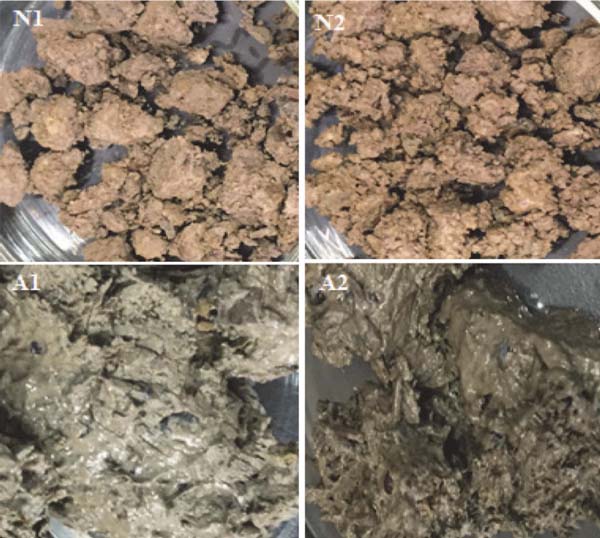
New and aged pit muds. N1 and N2 represented the new pit muds; A1 and A2, aged pit mud.

Richness rarefaction plot of 97% 16S rDNA sequence similarity.
Fig. 2B Cluster analysis of prokaryotic communities in new and aged pit mud. N1 and N2 represented the new pit muds; A1 and A2, aged pit mud.

Relative abundance of each sample at the level of phylum (ratio ≥ 0.5%). N1 and N2 represented the new pit muds; A1 and A2, aged pit mud.

Relative abundance of the predominant species at the level of genus (ratio ≥ 1.0%). N1 and N2 represented the new pit muds; A1 and A2, aged pit mud.
| Specificity | Content (ng/uL) | Copy number (copies/mL) | Standard curve | R2 | Amplification efficiency |
|---|---|---|---|---|---|
| Bacteroidetes | 46.02±0.03 | 9.82 × 10¹² | Ct=−3.45log10(q)+53.51 | 0.9976 | 99.50% |
| Lactobacillus | 31.43±0.18 | 6.71 × 10¹² | Ct=−3.35log10(q)+46.79 | 0.9988 | 97.20% |
| Bacillus | 34.85±0.08 | 7.44 × 10¹² | Ct=−3.39log10(q)+48.70 | 0.9941 | 98.70% |
| C. kluyveri | 40.65±0.17 | 8.68 × 10¹² | Ct=−3.29log10(q)+46.68 | 0.9966 | 101.50% |

Melting curves of qPCR
Note: A-the amplification and melting curves of qPCR for Bacteroidetes; B-the amplification and melting curves of qPCR for Lactobacillus; C-the amplification and melting curves of qPCR for Bacillus; D-the amplification and melting curves of qPCR for C. kluyveri.


