Original Research Papers
Photostability of Risperidone in Tablets
 https://ror.org/00088z429
2018 Volume 35 Pages 209-215

Details
2018 Volume 35 Pages 209-215
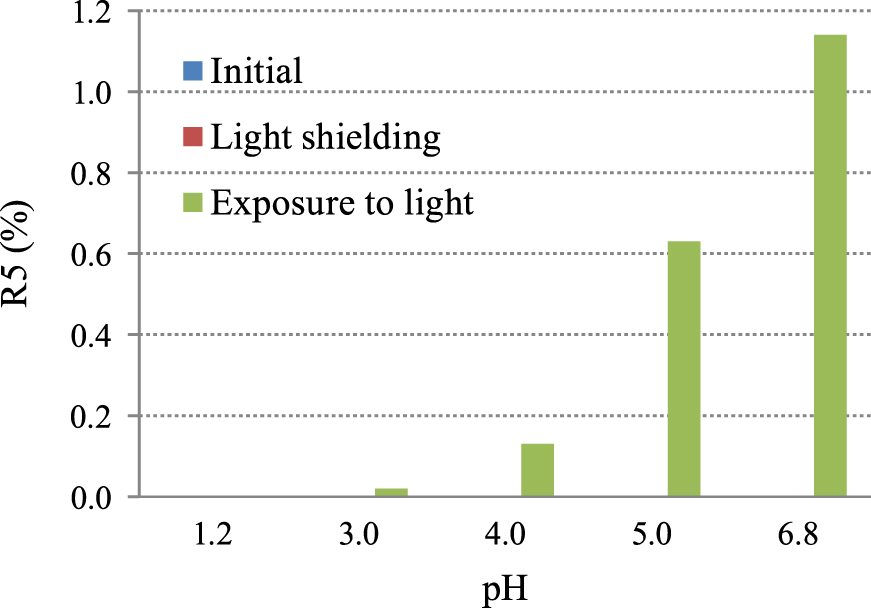
The purpose of this study is to evaluate the photostabilization mechanism of risperidone tablets. Risperidone is widely used for sensory integration disorder. It is formulated as tablets, orally disintegrating tablets, fine granules, oral solutions, and intramuscular injections. We found that risperidone was unstable in tablets and generated oxidized products. Formation of the oxidized product R5 was promoted in the presence of hydroxypropylcellulose by photoirradiation. On the other hand, photostability improved greatly when carmellose (CMC) or carmellose calcium (CMC-Ca) was used as a disintegrant. Since CMC and CMC-Ca are acidic substances, the photostability of tablets may have been affected by pH. Therefore, the effects of different pHs were examined. Risperidone was dissolved in methanol and the buffer (in the presence or absence of hydroxypropylcellulose) at different pHs (1.2, 3.0, 4.0, 5.0, and 6.8) was added. The photodegradation of risperidone was not observed at less than pH 3.0 in the presence of hydroxypropylcellulose, and low pHs improved the photostability of risperidone. On the other hand, risperidone solution without hydroxypropylcellulose was stable at all pH values. Therefore, risperidone was photochemically oxidized in the presence of hydroxypropylcellulose at high pHs.