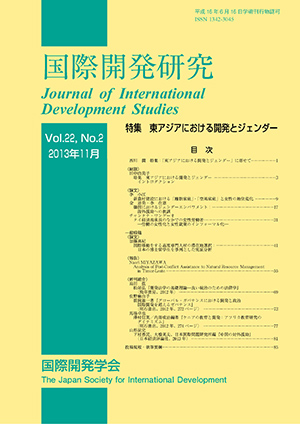
国際開発研究
Online ISSN : 2434-5296
Print ISSN : 1342-3045
22 巻, 2 号
選択された号の論文の11件中1~11を表示しています
特集 東アジアにおける開発とジェンダー
総説
論文
一般投稿
論文
  • 加藤 真紀
    2013 年22 巻2 号 p. 41-54
    発行日: 2013/11/15
    公開日: 2019/09/27
    ジャーナル フリー

    International migration of highly skilled individuals has been increasing in recent years, similar to the growth in investment in higher education worldwide, and the tendency of countries receiving highly skilled migrants to provide them with preferential treatment. Recent studies on international migration use decent data to produce evidence-based analysis and made major contributions to the field. However, most studies analyzed the situation of researchers primarily in Europe, the United States, or Japan. In contrast, this study targets the younger generation mainly of Asian origin, and investigates factors related to the return migration of international doctoral students who graduated from Japanese universities in 2002-2006. In this study, the results of the empirical analysis indicate that factors influencing return migration of international students after completing their doctoral programs in Japan include stable employment subsequent to their return to their countries of origin and their period of stay in Japan. Having job stability, such as a tenured position at a university, and shorter periods of stay, such as the time required to complete a doctoral program, are major influencing factors of return migration. These findings are similar to the results found in previous studies that target researchers living in developed countries. Although job stability is a common factor for migrants to return to their countries of origin, period of stay in Japan depends on the country of origin. Students of African or Asian origin except those from China and Korea tend to return to their countries of origin, while those from other countries do not. Because factors vary depending on the student's country of origin, future studies need to take this point into consideration. The results indicate that doctoral degree holders have a greater tendency to return to their countries of origin compared with those without such degrees. These results should be interpreted carefully because it could be due to financial reasons or Japan's unique doctoral program system.

報告
  • Naori MIYAZAWA
    2013 年22 巻2 号 p. 55-67
    発行日: 2013/11/15
    公開日: 2019/09/27
    ジャーナル フリー

    This study analyzed the United Nations—supported natural resource management project in post-conflict Timor-Leste, and specified factors which influenced success and failure of the natural resource management project. The case study identified key factors, which influenced the outcomes of the project. Firstly, in the post-conflict societies, reforestation activities with a community-based approach were found to be difficult, because the function of community has not recovered fully in many cases. The success is related to the fact that the project has incorporated the activity which contributed to reconstruction of community in the second phase of the project. Secondly, the case study identified that success of reforestation activity was associated with community's social fabric, since the project implementation requires cooperation among community members, when planting and maintenance activity largely relied on participation of community members. Approach taken by the project was through facilitation of forming Self Help Groups, particularly through nurseries operations. Self Help Groups could provide a basis for self-sustained system in community to facilitate development at the grass root level.

新刊紹介
feedback
Top