抄録
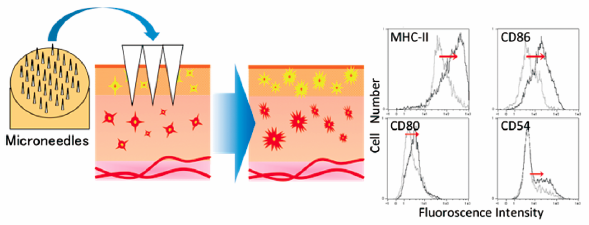
An adequate immune response to percutaneous vaccine application is generated by delivery of sufficient amounts of antigen to skin and by administration of toxin adjuvants or invasive skin abrasion that leads to an adjuvant effect. Microneedles penetrate the stratum corneum, the outermost layer of the skin, and enable direct delivery of vaccines from the surface into the skin, where immunocompetent dendritic cells are densely distributed. However, whether the application of microneedles to the skin activates antigen-presenting cells (APCs) has not been demonstrated. Here we aimed to demonstrate that microneedles may act as a potent physical adjuvant for successful transcutaneous immunization (TCI). We prepared samples of isolated epidermal and dermal cells and analyzed the expression of major histocompatibility complex (MHC) class II and costimulatory molecules on Langerhans or dermal dendritic cells in the prepared samples using flow cytometry. The expression of MHC class II and costimulatory molecules demonstrated an upward trend in APCs in the skin after the application of 500- and 300-µm microneedles. In addition, in the epidermal cells, application of microneedles induced more effective activation of Langerhans cells than did an invasive tape-stripping (positive control). In conclusion, the use of microneedles is likely to have a positive effect not only as an antigen delivery system but also as a physical technique inducing an adjuvant-like effect for TCI.