- Issue 6 Pages 321-
- Issue 5 Pages 251-
- Issue 4 Pages 179-
- Issue 3 Pages 117-
- Issue 2 Pages 57-
- Issue 1 Pages 1-
- |<
- <
- 1
- >
- >|
-
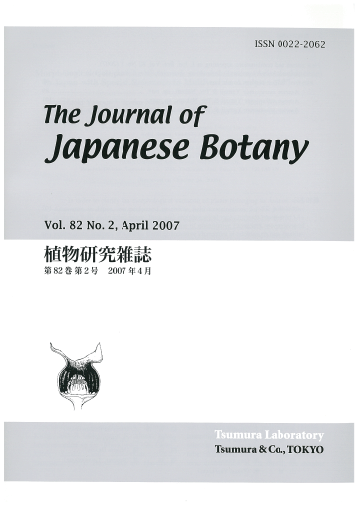
Article type: cover
2007Volume 82Issue 2 Article ID: 82_2_9955
Published: April 20, 2007
Released on J-STAGE: October 20, 2022
JOURNAL FREE ACCESSDownload PDF (1305K) -
Hiroki YAMAJI, Teruko NAKAMURA, Jun YOKOYAMA, Kenji KONDO, Takash ...Article type: Originals
2007Volume 82Issue 2 Pages 57-78
Published: April 20, 2007
Released on J-STAGE: October 20, 2022
JOURNAL FREE ACCESSIn order to clarify the morphological variation of plants belonging to Asarum sect. Asiasarum in Japan, we performed extensive field examinations for 55 populations covering both geographic range, taxa, and morphological races hitherto recognized. As previous studies were not enough in evaluation of quantitative characters, we performed multivariate analyses of various floral quantitative characters in addition to new qualitative floral characters, together with those used in the previous studies. As a result, eight morphologically distinct forms were recognized. They were first divided into two groups by color patterns in the inner surface of calyx tube; form D is dark purple, form L is dark purple proximally, ivory white, yellowish green or light purple in the middle part, dark purple or white at the throat. Form D is further divided into D1-D4 by the number of cells of trichomes in the adaxial surface of calyx and by the number of stamens and pistils. Form L is further divided into L1-L4 by the shape of calyx tube, the width of calyx tube throat, and the size and shape of calyx lobes. The eight forms were distributed almost allopatrically, and were concluded to be worthy to be recognized as distinct taxa.
View full abstractDownload PDF (1722K) -
Hiroki YAMAJI, Teruko NAKAMURA, Jun YOKOYAMA, Kenji KONDO, Takash ...Article type: Originals
2007Volume 82Issue 2 Pages 79-105
Published: April 20, 2007
Released on J-STAGE: October 20, 2022
JOURNAL FREE ACCESSThree species and one variety of Asarum sect. Asiasarum have hitherto been known in Japan. They are reclassified into seven species including three new species: A. maruyamae, A. tohokuense, and A. mikuniense. Most of the taxonomic studies on the section gave weight to the characters of leaves, calyx lobes, and the number of stamens and pistils. However, this study is base on the following characters to distinguish the species: color pattern in the adaxial surface of calyx tube, the shape of calyx tubes, the width of calyx tube throat, the shape of calyx lobe, and the number and height of ridges on inner surface of calyx tubes. The distribution range of the seven species are geographically segregated. Asarum sieboldii is distributed in central and western Honshu, as well as Korea and central to southern China; A. misandrum in Kyushu, the Aso Mountains as well as southern Korea; A. heterotropoides var. heterotropoides in northern Honshu, Hokkaido, southern Sakhalin and Kuriles; A. tohokuense in central and northern Honshu; A. mikuniense in central Honshu; A. maruyamae in western Honshu; A. dimidiatum in western Honshu, Shikoku and Kyushu.
View full abstractDownload PDF (880K) -
Okihito YANO, Kumiko ITO, Takuji HOSHINOArticle type: Originals
2007Volume 82Issue 2 Pages 106-111
Published: April 20, 2007
Released on J-STAGE: October 20, 2022
JOURNAL FREE ACCESSFour species of the genus Carex from Kuroshima Island were used for karyomorphological studies. Intraspecific aneuploidy, 2n = 38 = 19II, 39 = 19II + I, and 58, were found in C. atroviridis var. scabrocaudata and these chromosome numbers are reported for the first time in this study. Chromosome numbers of C. multiflora var. pallidisquama (2n = 72), C. tokarensis (2n = 26 = 13II), and C. tsushimensis (2n = 32 = 16II) were determined for the first time. Carex atroviridis var. scabrocaudata and C. tokarensis are endemic to the Kuroshima and Tokara Islands. Our results suggest a close relationship among C. atroviridis var. scabrocaudata, C. conica, and C. oshimensis. Carex tokarensis is also considered to be closely related to C. reinii, because these two species had the same chromosome number.
View full abstractDownload PDF (1780K) -
Hiroyoshi OHASHI, Hideaki OHBAArticle type: Obituary
2007Volume 82Issue 2 Pages 112-114
Published: April 20, 2007
Released on J-STAGE: October 20, 2022
JOURNAL FREE ACCESSDownload PDF (1339K) -
Norman K. B. ROBSONArticle type: Obituary
2007Volume 82Issue 2 Pages 114-115
Published: April 20, 2007
Released on J-STAGE: October 20, 2022
JOURNAL FREE ACCESSDownload PDF (844K) -
Hiroo KANAIArticle type: Obituary
2007Volume 82Issue 2 Pages 115-116
Published: April 20, 2007
Released on J-STAGE: October 20, 2022
JOURNAL FREE ACCESSDownload PDF (831K)
- |<
- <
- 1
- >
- >|