MATERIALS TRANSACTIONS
Online ISSN : 1347-5320
Print ISSN : 1345-9678
ISSN-L : 1345-9678
Volume 65, Issue 5
Displaying 1-19 of 19 articles from this issue
Review
  • Takahiro Mineta
    Article type: Review
    2024Volume 65Issue 5 Pages 455-465
    Published: May 01, 2024
    Released on J-STAGE: April 25, 2024
    Advance online publication: February 16, 2024
    JOURNAL FREE ACCESS FULL-TEXT HTML

    Mg-Li based alloys, distinguished by their low density among structural metallic materials, emerge as pivotal candidates in ushering in the era of next-generation lightweight metals. Their notable drawbacks encompass poor room-temperature strength and creep resistance, prompting diverse efforts to enhance these aspects through microstructure control techniques, including heat treatment. The amelioration of mechanical properties in Mg-Li based alloys holds significant promise for advancing various industries, spanning aerospace, automotive, and biomaterials sectors. This review article provides an overview of endeavors aimed at improving the mechanical properties of Mg-Li based alloys, with a specific focus on alloying, heat treatment, and severe plastic deformation as strategies for microstructure control.


    This Paper was Originally Published in Japanese in J. JILM 73 (2023) 297–306. The title was changed due to the addition of “Review -”.

  • Kaveh Edalati
    Article type: Review
    2024Volume 65Issue 5 Pages 466-480
    Published: May 01, 2024
    Released on J-STAGE: April 25, 2024
    Advance online publication: February 26, 2024
    JOURNAL FREE ACCESS FULL-TEXT HTML

    Light metals and alloys based on magnesium, aluminum, and titanium are of significance in daily life and industrial applications due to their low density and superior mechanical and functional properties. The formation of nanostructures and ultrafine grains can further improve the properties of these materials. High-pressure torsion (HPT), as a severe plastic deformation (SPD) method, is one of the most effective processes for nanostructuring these materials. Various modifications of HPT such as conventional HPT with discs, HPT with rings, and continuous HPT with strips and wires are currently applied to light metals and their alloys, composites, intermetallics, and metallic glasses. The HPT processing of these materials is effective for grain refinement, hardening through the Hall–Petch mechanism, lattice defect generation, phase transformations, and solid-state reactions through fast diffusion with reasonable time/thermal stability. This article after discussing these fundamental issues, reviews some mechanical and functional properties of nanostructured lightweight materials such as tensile, compression, and bending properties, superplasticity including room-temperature superplasticity, wear resistance, electrical conductivity, superconductivity, biocompatibility, hydrogen production, and hydrogen storage.

Regular Article
Materials Physics
Microstructure of Materials
  • Toshikazu Yoshii, Muneyoshi Iyota, Kyozo Arimoto
    Article type: Regular Article
    2024Volume 65Issue 5 Pages 487-493
    Published: May 01, 2024
    Released on J-STAGE: April 25, 2024
    Advance online publication: February 26, 2024
    JOURNAL FREE ACCESS FULL-TEXT HTML

    The mechanism of curving that occurs during the quenching process of Japanese swords has not been clearly explained. Experiments on this phenomenon were conducted using Japanese sword type specimens made of the same steel and processes as Japanese swords, and model Japanese sword type specimens made of carbon steel (S55C) and austenitic stainless steel (SUS304) by machining. Applying the simulated strains-based approach to heat treatment simulation results for these experiments found that positive plastic strain and transformation strain on the cutting-edge side are main contributors to curving generation in Japanese sword.


    This Paper was Originally Published in Japanese in NETSUSHORI 63 (2023) 76–82.

Mechanics of Materials
  • Hui Lin, Lidong Shao, Lin Lv, Jiusheng Bao
    Article type: Regular Article
    2024Volume 65Issue 5 Pages 494-501
    Published: May 01, 2024
    Released on J-STAGE: April 25, 2024
    Advance online publication: February 16, 2024
    JOURNAL FREE ACCESS FULL-TEXT HTML

    The nanoindentation test is a widely adopted technique for characterizing the mechanical properties of materials. In this study, a dislocation density-based and a phenomenological crystal plasticity hardening model are employed to investigate the evolution of plastic anisotropy and pile-up of a single-crystal aluminum specimen with varying crystallographic orientations during nano-indentation. Utilizing crystal plasticity finite element (CPFE) simulations, we delve into the influence of crystal orientations on key factors such as depth-load curves, stress distributions, shear strains across different slip systems, and dislocation density evolution. Our analysis highlights the plasticity anisotropy inherent in the material, elucidated through the evolving shear strain exhibited by activated slip systems. Furthermore, we gain insights into the pile-up phenomenon by examining the evolution of shear strains within slip systems and the associated dislocation density, employing various modeling approaches. The height of pile-up evolution is determined by the localized cumulative shear strains and evolution of dislocation density.

    Fig. 8 Evolution of pile-up height and dislocation density in the selected element during the nanoindentation on (011) surface. Fullsize Image
  • Kazushige Tokuno, Takayuki Yonezawa, Genichi Shigesato, Hideo Tsutamor ...
    Article type: Regular Article
    2024Volume 65Issue 5 Pages 502-511
    Published: May 01, 2024
    Released on J-STAGE: April 25, 2024
    Advance online publication: February 16, 2024
    JOURNAL FREE ACCESS FULL-TEXT HTML

    Surface relief formation processes of the high cyclic-loaded coarse-grained aluminum polycrystals with point defect clusters were investigated. Until the loading of 1 × 10⁵ cycles with the stress ratio of −1 and the maximum stress of 8.0 MPa, the coarse ribbon-like primary persistent slip markings (PSMs) consisting of extrusions and intrusions had been formed, and the average extrusion height of the PSMs had reached 2.0 µm. This value was much higher than that of the ordinary aluminum single crystal. The high mobile dislocation density accompanied by the dislocation channeling effect inside the persistent slip bands (PSBs) were considered to produce the high extrusions. Until the loadings to 2.4 × 10⁵ cycles with the stress ratio of −1 and the maximum stress of 8.0 MPa, activities of the primary PSBs had been weakened or terminated, and instead, the secondary slips had been activated and deformed the shapes of the preexisting primary PSMs. And the deep brittle-like cracks along the grain boundaries (GBs) were observed. The accumulation of the dislocations and the vacancies into the GBs were considered to be the trigger for the energy reduction of the GBs as the interfaces and the brittle-like cracks formation.

    Fig. 16 (a) SEM image showing the deep brittle-like crack observed after the loading of 2.4 × 10⁵ cycles with the maximum stress of 8.0 MPa at the GB between “Grain C” and “Grain D”. (b) Enlarged image of the crack. A huge number of faint PSMs were intersecting with the GB where the crack opened. Fullsize Image
  • Miu Hayashi, Takeshi Ando, Ryohei Gonda, Keishi Kitabatake, Jinta Arak ...
    Article type: Regular Article
    2024Volume 65Issue 5 Pages 512-517
    Published: May 01, 2024
    Released on J-STAGE: April 25, 2024
    JOURNAL FREE ACCESS FULL-TEXT HTML

    In this study, experimental investigations were conducted to create fatigue limit diagrams for NSSC180 ferritic stainless steel, which is used for automobile exhaust system parts, subjected to excess deformation, in order to clarify the relationship between the mean stress and fatigue limit. The fatigue tests were conducted under a fixed maximum stress, which allowed a fatigue design diagram to be obtained. The results indicated that the fatigue limit curve has a region where the effect of increasing the mean stress on the decrease in the fatigue limit is more moderate than that predicted by a modified Goodman line. Furthermore, it was found that a fatigue design based on static crack initiation is more appropriate than the modified Goodman line for higher values of mean stress.


    This Paper was Originally Published in Japanese in J. Soc. Mater. Sci., Japan 72 (2023) 535–541.

    Fig. 12 Fatigue design diagram subjected to excessive deformation under fixing maximum stress condition. Fullsize Image
Materials Chemistry
  • Takayuki Kojima, Shunsuke Nakajima, Souta Tate
    Article type: Regular Article
    2024Volume 65Issue 5 Pages 518-523
    Published: May 01, 2024
    Released on J-STAGE: April 25, 2024
    Advance online publication: February 16, 2024
    JOURNAL FREE ACCESS FULL-TEXT HTML

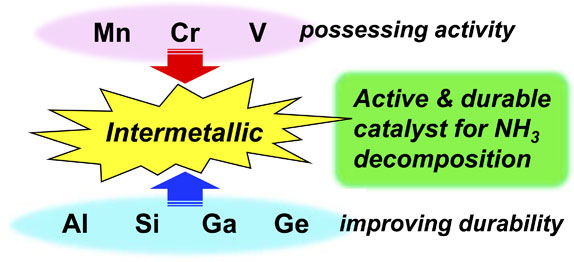
    Intermetallic catalysts were investigated for ammonia decomposition, a key technology to extract hydrogen from an ammonia source as a hydrogen carrier. Since Mn, Cr, and V were active in pure 3d-transition metal catalysts, their IMCs with p-block metals were selected. The pure Mn, Cr, and V were nitrided during the reaction, while their IMCs resisted the nitridation. In the Cr- and V-based IMC catalysts, a larger composition of Cr and V resulted in a larger conversion. The Cr3X and V3X catalysts exhibited a high activity with any X elements. These results indicate that in IMC catalysts for ammonia decomposition, the activity is dominated by transition metals, and the resistivity against nitridation is improved by p-block metals.

  • Yuki Takahashi, Takashi Murata, Katsunori Yamaguchi
    Article type: Regular Article
    2024Volume 65Issue 5 Pages 524-529
    Published: May 01, 2024
    Released on J-STAGE: April 25, 2024
    Advance online publication: March 08, 2024
    JOURNAL FREE ACCESS FULL-TEXT HTML

    In the hydrometallurgical process used for the recycling of platinum group metals (PGMs), a residue containing Cr2O3 and PGMs is generated. In this study, a pyrometallurgical process was applied, in which PGMs from the residue generated in the hydrometallurgical processes were concentrated in a molten Cu phase as a collector metal, and Cr2O3 was separated into a slag phase with SiO2 and CaO as the flux. To reduce the loss of PGMs into the slag, the dissolution of PGMs into the slag must be reduced. Therefore, the distribution ratio of Rh, as a representative PGM, between the liquid SiO2–CaO–Al2O3–CrOx or the liquid SiO2–CaO–CrOx slag and molten Cu were measured at 1773 K under an oxygen partial pressure of pO2 = 10-10. The experimental results revealed that the distribution of Rh in the slag increased with increasing CrOx concentration. At a constant Cr2O3 concentration in the slag, the solubility of Rh increased with increasing slag basicity, which is defined as B = (mass%CaO)/(mass%SiO2). Furthermore, compared with the distributions of Rh and Pt between the slag system and molten Cu, Rh was more easily lost to the slag, and the dependence of Rh on basicity was greater than that of Pt.

    Fig. 2 Relationship between the distribution ratio of PGMs and the concentration of Cr2O3 in the slag (1773 K, pO2 = 10-10). Fullsize Image
  • Takayuki Kojima, Taihei Wakayama, Yusuke Oi
    Article type: Regular Article
    2024Volume 65Issue 5 Pages 530-533
    Published: May 01, 2024
    Released on J-STAGE: April 25, 2024
    Advance online publication: March 08, 2024
    JOURNAL FREE ACCESS FULL-TEXT HTML

    Intermetallic compounds can be novel catalysts due to their unique structures consisting of multiple elements that occupy specific atomic sites. Heusler alloys (X2YZ) are a ternary intermetallic group consisting of various sets of X, Y, and Z. This group is useful in investigating the catalytic roles of individual elements under the same crystal structure. In this study, we investigated the catalytic characteristics of 3d transition metals and the group 13,14 elements in Heusler alloys for hydrogenation of propyne (C3H4). A larger number of valence electrons for 3d transition metals seemed to result in higher activity for the hydrogenation reaction, as well as pure metal catalysts, the activity hierarchy of which was Ni > Co > Fe. For the group 13,14 elements, the alloys with Al and Si were slightly active, whereas the ones with Ga and Ge were active, in which the Ge alloys were highly selective for producing propylene (C3H6). All the Sn-containing alloys significantly caused side reactions producing C4 and C6 species. This indicates that Sn possesses the ability to crack and couple carbon chains.

Materials Processing
  • Kazunori Asano, Hiroshi Yamada, Seiji Sugimura
    Article type: Regular Article
    2024Volume 65Issue 5 Pages 534-540
    Published: May 01, 2024
    Released on J-STAGE: April 25, 2024
    JOURNAL FREE ACCESS FULL-TEXT HTML

    Improvement in the erosion resistance of permanent molds to aluminum alloy melt is required. Since chemically and mechanically stable layer containing aluminum oxides can be formed on the cast irons by aluminum addition and heat treatment, the layer would improve the erosion resistance of the cast iron in the running melt. In this study, cast irons with different aluminum contents were fabricated, then they were heat-treated to form the oxide layer on the surface. The optimum heat treatment conditions to form