All issues
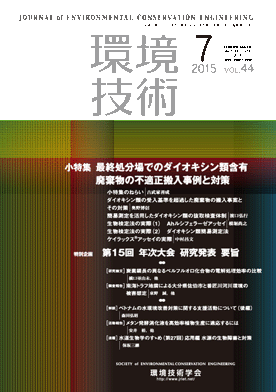
Volume 44, Issue 7
Displaying 1-2 of 2 articles from this issue
- |<
- <
- 1
- >
- >|
-
Ayumi HASHIGUCHI, Yoko FUJIKAWA, Minoru YONEDA, Shogo TANIGUCHI, Hiroa ...2015Volume 44Issue 7 Pages 391-401
Published: July 20, 2015
Released on J-STAGE: November 24, 2015
JOURNAL FREE ACCESSIn this study, we investigated the application of electrolysis using Pt electrodes for decomposition of PFCs (perfluorinated compounds) in water. We principally used NaHCO3 as a supporting electrolyte since it did not interfere with the analysis of decomposition products of PFCs. The target compounds in the present study were PFOS, PFOA, perfluorocarboxylates with a 6 and 7 carbon chain lengths (PFHxA and PFHpA, respectively), and PFHxS (a C6 perfluorosulfonate).Through the experiment, we showed that PFOS, PFOA, PFHxA, PFHxS and PFHpS were decomposed by electrolysis. Although the Pt anode has lower oxidizing potential than anodes made of boron doped diamond, it was able to oxidize highly refractory PFCs like PFOS and PFOA. In addition, PFHxA and PFHxS were decomposed according to the zeroth-order kinetics with time of electrolysis, and PFHpS was decomposed at the highest current efficiency among the PFCs tested. We also observed that PFOS contained in secondary sewage effluent was decomposed by electrolysis. During the actual electrolysis process, a pre-concentration of PFCs as well as the removal of any other organic matter present should be performed to efficiently remove PFCs.View full abstractDownload PDF (1293K) -
Makoto HIGASHINO, Kouki ONITSUKA, Kyohei YOKOTA, Takashi FURUKAWA, D ...2015Volume 44Issue 7 Pages 402-408
Published: July 20, 2015
Released on J-STAGE: November 24, 2015
JOURNAL FREE ACCESS
- |<
- <
- 1
- >
- >|